The Younghusband Expedition to Tibet of 1903–1904 was a significant episode in the history of British India, Himalayan geopolitics and Anglo-Tibetan relations. Led politically by Colonel Francis Edward Younghusband and supported militarily by a British Indian force commanded by Brigadier-General James Macdonald, the expedition advanced from the Sikkim frontier to Lhasa, the capital of Tibet. Although initially presented as a diplomatic mission intended to establish relations and resolve outstanding disputes, it developed into a military campaign that compelled Tibetan representatives to sign the Convention of Lhasa on 7 September 1904.
The expedition reflected the strategic concerns of the British Indian government under Viceroy Lord Curzon (January 1899 – November 1905), particularly its anxiety about Russian influence in Tibet. It also demonstrated how imperial rivalry, trade interests, disputed political relationships and unequal military power shaped Britain’s frontier policy. For students of the Indian freedom struggle and modern Indian history, the expedition is important because it illustrates the foreign policy of British India beyond the immediate boundaries of the Indian subcontinent.
What Was the Younghusband Expedition?
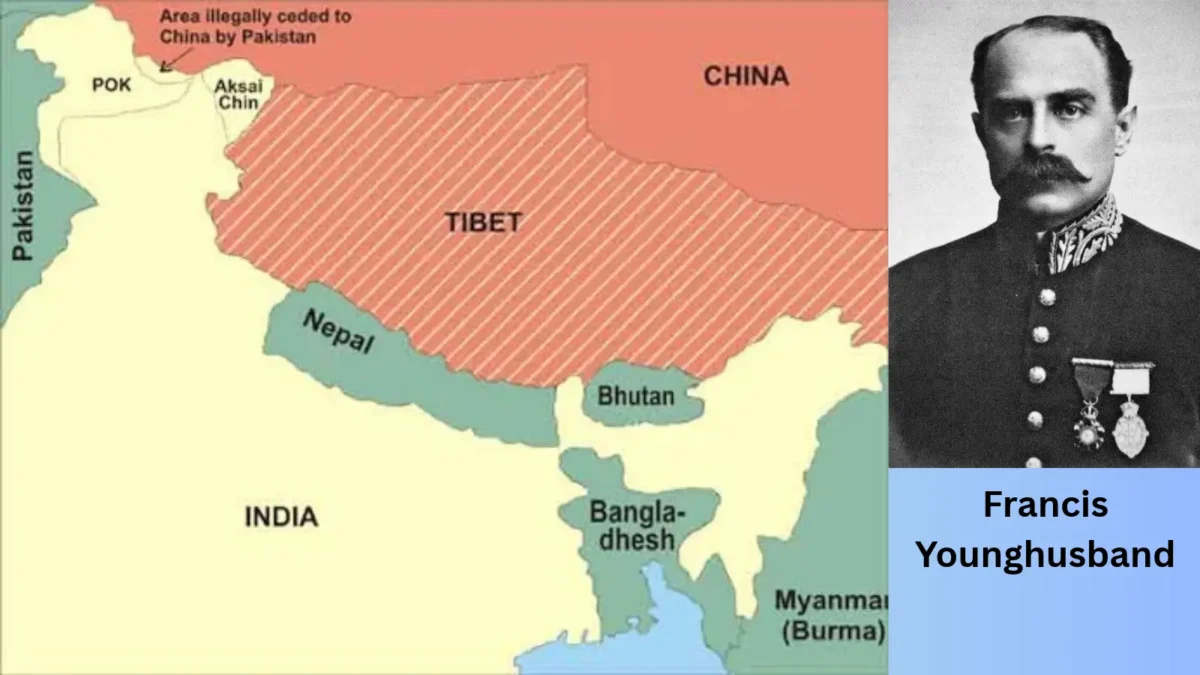
The Younghusband Expedition was a British Indian military expedition to Tibet conducted during 1903–1904. Its immediate purpose was to press the Tibetan authorities to negotiate with the British government over trade, frontier questions and Tibet’s external relations. The mission was associated with Francis Younghusband, a British political officer and explorer who had considerable experience in Central Asia and the Himalayan region.
The expedition began as an officially diplomatic undertaking but acquired an increasingly military character when negotiations failed to produce the results sought by the British. British Indian troops crossed into Tibet, fought Tibetan forces at several locations and eventually reached Lhasa in August 1904. The campaign culminated in the signing of the Convention of Lhasa on 7 September 1904.
The expedition should be understood in the context of British imperial expansion, the strategic importance of the Himalayan frontier and the Great Game, the term commonly used for the nineteenth- and early twentieth-century rivalry between Britain and Russia in Central Asia.
Who Was Francis Younghusband?
Francis Edward Younghusband (1863–1942) was a British Army officer, explorer and imperial official who became prominent through his travels in Central Asia and his involvement in British policy towards Tibet. His experience of Asian frontier regions helped him gain the confidence of officials who favoured a more assertive British presence beyond India’s northern borders.
Younghusband served as the political head of the Tibet mission. He was responsible for conducting negotiations and representing British interests, whereas the military force supporting the mission operated under General James Macdonald. This distinction is important: Younghusband was the principal political leader of the expedition, but he was not the sole commander of its military operations.
The expedition remains controversial because diplomatic objectives were pursued through armed coercion, and the British advance caused substantial Tibetan casualties. The episode illustrates the difference between the official language of diplomatic engagement and the realities of imperial military intervention.
Historical Background: Tibet and British India Before 1903
Tibet occupied a strategically important position north of the Himalayan ranges. Its location connected the Indian subcontinent with the wider Central Asian region, while its relationships with China, Nepal, Bhutan, Sikkim and other neighbouring territories affected the political environment of Britain’s northern frontier.
During the nineteenth century, British India sought to establish clearer political and commercial arrangements along the Himalayan borderlands. The Anglo-Sikkimese Treaty of 1890, concluded between Britain and China, addressed the boundary between Sikkim and Tibet and included provisions concerning trade. However, implementing the associated arrangements proved difficult, and the British government complained that Tibetan authorities had not accepted or applied the provisions in the manner expected by Britain.
Relations were further complicated by the political position of the Qing Empire in Tibet. Britain frequently negotiated with China over Tibetan affairs, while Tibetan authorities exercised substantial control over their internal administration and resisted external pressure. The competing interpretations of Tibet’s political status later became important in the diplomatic arrangements surrounding the expedition.
Major Causes of the Younghusband Expedition
1. The Great Game and Fear of Russian Influence
The most important strategic background was the Anglo-Russian rivalry commonly known as the Great Game. British policymakers worried that Russian influence might extend towards Tibet and eventually threaten the northern approaches to British India. The prospect of Russian diplomatic or military penetration into Tibet was treated by some British officials as a potential security concern.
Lord Curzon, who served as Viceroy of India from 1899 to 1905, was particularly concerned about the strategic implications of developments in Tibet. He favoured a more active policy to prevent rival powers from gaining influence in the Himalayan region. However, the extent of the Russian threat was disputed, and the expedition’s strategic justification should not be treated as proof that Russia was preparing an imminent invasion of India through Tibet.
2. British Concerns About Tibetan Foreign Relations
The British government sought to prevent Tibet from entering into arrangements with a rival power that might undermine British strategic interests. Reports of contacts between Tibetan representatives and Russia intensified British anxieties. British officials feared that an external power could use Tibet as a channel for diplomatic pressure or strategic influence against British India.
Later historical assessments have questioned whether these fears accurately reflected the actual extent of Russian involvement. The expedition therefore demonstrates how imperial perceptions of potential threats could influence policy even when the available evidence did not establish an immediate military danger.
3. Disputes Over Trade and Earlier Agreements
British officials wanted Tibetan authorities to implement earlier agreements concerning trade and frontier relations. They sought improved access to Tibetan markets and a more predictable system of commercial relations between Tibet and British India. The failure to secure the desired implementation of previous arrangements became one of the stated reasons for sending the mission.
Trade was not merely an economic issue. Commercial access could provide political contacts, intelligence and a stronger British presence in a strategically sensitive region. Consequently, trade negotiations formed part of a wider imperial strategy.
4. Lord Curzon’s Forward Policy
Lord Curzon favoured a more assertive approach towards regions bordering British India. He believed that diplomatic inactivity could allow rival powers to expand their influence. In the case of Tibet, he pressed for direct engagement with Tibetan authorities and supported the use of a mission backed by military force when negotiations did not achieve the intended outcome.
The British government in London initially showed greater caution about an extensive military operation. The policy ultimately adopted reflected negotiations between Curzon’s strategic objectives and the British government’s concerns about the costs and consequences of intervention.
5. Failure of the Initial Diplomatic Mission
The British mission first assembled at Khamba Jong in 1903, expecting to negotiate with Tibetan representatives. However, the discussions did not produce an agreement acceptable to the British. Disputes over representation, the authority of the participants and the substance of the negotiations contributed to the deadlock.
The failure of the initial talks provided the immediate context for the escalation of the mission. Rather than withdrawing, the British government authorised a stronger advance into Tibet. The undertaking consequently shifted from a limited diplomatic initiative towards a military expedition designed to compel negotiations.
Course of the Younghusband Expedition: Important Events
1. The Mission at Khamba Jong, 1903
In July 1903, Younghusband’s mission reached Khamba Jong in Tibet, accompanied by a relatively small military escort. The mission was intended to establish negotiations with Tibetan authorities over outstanding political and commercial questions. However, the absence of negotiations that met British expectations prolonged the deadlock.
During the following months, the British authorities reconsidered their approach. By late 1903, the decision had been taken to move beyond the limited mission and prepare for a more substantial advance into Tibet. The change marked a major turning point in the development of the expedition.
2. The Advance into Tibet, December 1903
British Indian forces advanced across the frontier in December 1903 under the military command of General James Macdonald, with Younghusband continuing to lead the political mission. The force included British and Indian Army personnel, engineers and supporting units required to move supplies across difficult mountain terrain.
The geographical conditions presented major logistical challenges. High-altitude routes, severe weather, limited transport facilities and the difficulty of supplying a large force far from established bases placed considerable pressure on the expedition. The British advance also confronted Tibetan forces who sought to resist the intrusion into their territory.
3. The Chumik Shenko Incident, March 1904
One of the most consequential and controversial episodes occurred at Chumik Shenko, also known as Guru, in March 1904. Tibetan forces confronted the advancing British Indian expedition. The confrontation escalated into a devastating encounter in which British troops, equipped with modern firearms and machine guns, inflicted heavy casualties on the Tibetan side.
The disparity in military equipment was a major factor in the outcome. Tibetan resistance included traditional weapons and locally organised forces, while the British Indian contingent possessed more effective modern firearms and supporting military technology. Accounts of the encounter differ in their details, but the severe loss of Tibetan lives is central to understanding the human cost of the expedition.
The incident weakened organised Tibetan resistance along the route and enabled the expedition to continue its advance. It also undermined the claim that the mission was simply a peaceful diplomatic initiative. The use of overwhelming military force became a defining feature of the campaign.
4. The Capture of Gyantse and Further Advance
After the fighting at Chumik Shenko, British Indian troops continued towards Gyantse, an important settlement on the route to Lhasa. Tibetan resistance continued in the surrounding region, including around the fortified positions associated with Gyantse. The British subsequently conducted military operations to secure their route and overcome the remaining resistance.
The advance involved the occupation or control of strategic positions, the movement of supplies and the use of military force against Tibetan defenders. The campaign demonstrated the importance of logistics and modern weaponry in operations across high-altitude terrain. Although geographical conditions created serious difficulties, the expedition maintained its progress towards the Tibetan capital.
5. The Arrival in Lhasa, August 1904
British Indian forces reached Lhasa in August 1904. The arrival of the expedition in the Tibetan capital was the culmination of months of military advance and the failure of earlier negotiations. The 13th Dalai Lama, Thubten Gyatso, had left Lhasa before the British reached the city and eventually travelled to Mongolia.
The Tibetan government was therefore placed in a difficult position. With the capital occupied by the expedition and the Dalai Lama absent, negotiations were conducted with senior Tibetan religious and secular representatives. Younghusband pressed for an agreement that would satisfy British demands regarding trade, indemnity and Tibet’s external relations.
6. The Convention of Lhasa, 7 September 1904
The expedition culminated in the signing of the Convention of Lhasa on 7 September 1904. Younghusband signed on behalf of the British government, while Tibetan representatives signed on behalf of the Tibetan authorities. The agreement imposed substantial obligations on Tibet and reflected the coercive circumstances in which negotiations had taken place.
The convention required Tibet to pay an indemnity, provided for the opening of trade marts and restricted the granting of certain territorial or commercial concessions to foreign powers without British consent. It also provided for the British occupation of the Chumbi Valley until specified conditions, including payment of the indemnity, had been fulfilled.
The original indemnity was fixed at 75 lakh rupees. The British government subsequently reduced it to 25 lakh rupees, while the arrangements for the withdrawal from the Chumbi Valley remained linked to the convention’s conditions. The agreement was ratified by the Government of India in November 1904.
Main Provisions of the Convention of Lhasa
The Convention of Lhasa was the principal diplomatic outcome of the expedition. Its provisions were intended to secure British commercial access and limit the possibility of competing foreign influence in Tibet.
- Indemnity: Tibet was required to pay an indemnity of 75 lakh rupees, subsequently reduced by the British government to 25 lakh rupees.
- Trade marts: The agreement provided for the establishment or opening of British trade marts at Yatung, Gyantse and Gartok.
- Foreign concessions: Tibet undertook not to grant certain territorial or commercial concessions to foreign powers without British consent.
- Strategic occupation: British occupation of the Chumbi Valley was to continue until the specified financial and other conditions were fulfilled.
- British commercial interests: The convention established arrangements intended to improve British access to Tibetan trade and provide mechanisms for dealing with commercial disputes.
The agreement should be studied alongside the later Anglo-Chinese Convention of 1906. The 1906 convention addressed China’s position in relation to Tibet and Britain, and included commitments concerning the non-annexation of Tibetan territory by Britain and the exclusion of other foreign powers from concessions in Tibet. The later agreement modified the wider diplomatic framework within which the 1904 convention operated.
Sources: Convention of Lhasa, 1904
Consequences of the Younghusband Expedition
1. Strengthening of British Influence
The expedition temporarily strengthened Britain’s position in Tibet by securing commercial arrangements and compelling the Tibetan authorities to accept terms favourable to British interests. The campaign also demonstrated that British India could project military power beyond the Himalayan frontier despite the considerable logistical difficulties involved.
However, the results should not be interpreted as the establishment of permanent British rule over Tibet. Britain did not annex Tibet through the Convention of Lhasa, and the subsequent diplomatic arrangements continued to involve China and Tibetan authorities.
2. Heavy Tibetan Casualties and Political Resistance
The military campaign caused substantial loss of life among Tibetan defenders. The difference between the weaponry available to the expedition and that used by Tibetan forces contributed to the severity of the fighting. The violence at Chumik Shenko and during subsequent operations remains essential to any balanced assessment of the expedition.
The campaign also exposed the limits of diplomacy when backed by an unequal distribution of military power. The convention was signed after British troops had reached the capital, making the circumstances of its negotiation an important issue in evaluating the agreement.
3. Changes in Tibet’s External Relations
The expedition forced Tibetan authorities to engage with British demands concerning trade and foreign relations. The subsequent Anglo-Chinese Convention of 1906 further developed the diplomatic framework governing relations among Britain, China and Tibet.
In 1907, Britain and Russia concluded a convention addressing their interests in Persia, Afghanistan and Tibet. Its Tibet provisions included commitments by the two powers to respect China’s position and to avoid direct dealings with Tibetan authorities except through the Chinese government. These arrangements reflected an attempt to reduce imperial rivalry through diplomatic agreements.
4. Strategic Lessons for British India
The expedition highlighted the logistical complexity of operating in the Himalayas and on the Tibetan Plateau. Transport, communications, medical support, engineering and the movement of supplies were crucial to sustaining the advance. It also demonstrated the military advantages of modern firearms against forces with less effective equipment.
For the British Indian government, the campaign offered lessons about frontier intelligence, military planning and the relationship between political objectives and operational capabilities. At the same time, the diplomatic costs and controversy surrounding the expedition illustrated the risks of extending imperial commitments into difficult frontier regions.
5. Significance for Modern Indian History
The Younghusband Expedition is relevant to modern Indian history because the Government of India played a central role in organising and supporting the mission. Although Tibet was not part of British India, its geographical proximity made it an important element of British frontier policy.
The expedition also provides historical background for understanding later relations among India, Tibet and China. These later developments were shaped by different political circumstances, and the 1904 expedition should not be treated as a direct explanation of every subsequent dispute. Nevertheless, it demonstrates the long-standing strategic importance of the Himalayan region.
Was the Younghusband Expedition a Diplomatic Mission or a Military Invasion?
The expedition began under the formal description of a diplomatic mission intended to negotiate with Tibetan authorities. However, the use of a substantial military force, the fighting during the advance and the occupation of Lhasa transformed it into a coercive military intervention.
British officials presented the campaign as a means of resolving disputes and preventing rival foreign influence. A critical historical interpretation must also consider the broader objectives of imperial expansion, the disputed nature of the Russian threat and the severe consequences for Tibet. The distinction between the expedition’s stated purposes and its actual methods is therefore central to understanding its historical significance.
Conclusion
The Younghusband Expedition of 1903–1904 was a major episode in the history of British India and Tibet. It emerged from disputes over trade and frontier relations, combined with British fears of Russian influence in Central Asia. Under Lord Curzon’s assertive frontier policy, a diplomatic mission developed into a military campaign that reached Lhasa and culminated in the Convention of Lhasa.
The expedition secured important concessions for Britain but did so through military coercion and at considerable human cost to Tibet. Its significance lies not only in the treaty it produced but also in what it reveals about imperial strategy, the limits of diplomacy and the geopolitical importance of the Himalayas. For UPSC aspirants, the episode connects modern Indian history with colonial foreign policy, the Great Game, British military expansion and the historical foundations of Himalayan geopolitics.
Frequently Asked Questions (FAQs)
Who led the Younghusband Expedition to Tibet?
Francis Edward Younghusband led the political mission, while General James Macdonald commanded the military force supporting the expedition.
When did the Younghusband Expedition take place?
The expedition took place during 1903–1904, with British Indian forces reaching Lhasa in August 1904.
Why did the British launch the expedition?
The British government sought to address disputes over trade and frontier arrangements and to prevent what it perceived as potentially dangerous Russian influence in Tibet.
What was the Convention of Lhasa?
The Convention of Lhasa was signed on 7 September 1904. It imposed an indemnity on Tibet, provided for trade marts and restricted certain concessions to foreign powers without British consent.
What was the Great Game?
The Great Game refers to the strategic rivalry between Britain and Russia in Central Asia, particularly during the nineteenth and early twentieth centuries.
Previous Year Question-Oriented Practice and MCQs
Note: The following are practice questions prepared in a UPSC-oriented format, not verbatim questions claimed to have appeared in previous UPSC examinations.
Multiple-Choice Questions
1. The Younghusband Expedition to Tibet took place during which period?
- (a) 1857–1858
- (b) 1878–1879
- (c) 1903–1904
- (d) 1911–1912
Answer: (c) 1903–1904.
2. Who was the Viceroy of India when the Younghusband Expedition was initiated?
- (a) Lord Ripon
- (b) Lord Curzon
- (c) Lord Minto
- (d) Lord Hardinge
Answer: (b) Lord Curzon.
3. The Convention of Lhasa was signed in:
- (a) 1890
- (b) 1895
- (c) 1904
- (d) 1907
Answer: (c) 1904.
4. Which of the following best explains the strategic background of the expedition?
- (a) The Anglo-French rivalry in the Caribbean
- (b) The Great Game and British concerns about Russian influence
- (c) The First World War
- (d) The partition of Bengal
Answer: (b) The Great Game and British concerns about Russian influence.
5. Which statement about the expedition is correct?
- (a) It resulted in the permanent annexation of Tibet by British India.
- (b) It was conducted entirely through peaceful negotiations.
- (c) It culminated in a treaty imposing financial and commercial obligations on Tibet.
- (d) It took place after Indian independence.
Answer: (c) It culminated in a treaty imposing financial and commercial obligations on Tibet.
Mains Practice Questions
- 10 marks: Explain the causes and major events of the Younghusband Expedition to Tibet, 1903–1904.
- 15 marks: Examine the role of Lord Curzon’s frontier policy and the Great Game in shaping the Younghusband Expedition.
- 15 marks: Critically evaluate the Convention of Lhasa and its consequences for Tibet and British India.
- 15 marks: “The Younghusband Expedition demonstrates the relationship between imperial strategy and military coercion.” Discuss with reference to British policy towards Tibet.