
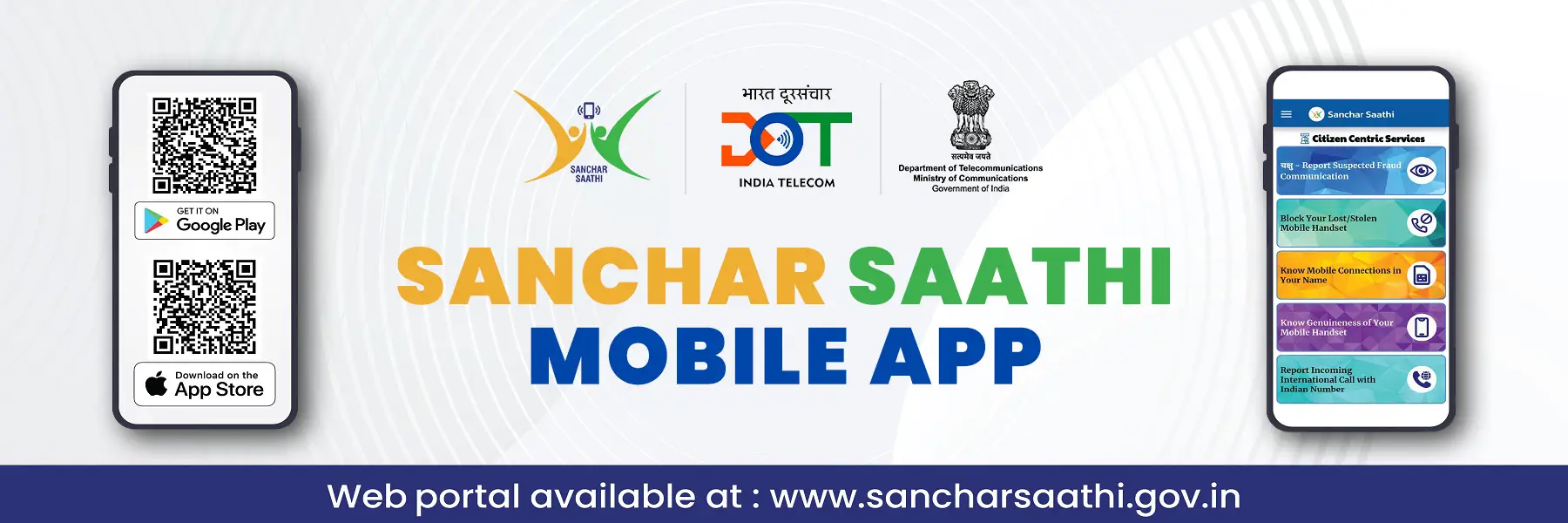
Sanchar Saathi as presented by the government, is a citizen-centric tool for combating telecom fraud, theft, resale of stolen devices, and unauthorised connections — a set of issues especially severe in India’s large second-hand mobile device market. This article covers information on Sanchar Saathi and its features, and the recent controversy related to its usage.
What is Sanchar Saathi?
Sanchar Saathi (which means “Communication Partner”) is a cybersecurity and telecom-security initiative by the Department of Telecommunications (DoT), Ministry of Communication, Government of India. DoT claims that through the app, hundreds of thousands of stolen or lost phones have been blocked or recovered, and many fraudulent connections have been terminated.
Officially launched in 2023 as a web portal and rolled out as a mobile app in January 2025, Sanchar Saathi aims to provide citizens with digital tools to protect themselves from phone-related fraud, theft and misuse. The app is available on both Android and iOS apart from the web portal. According to government data, as of mid-2025 the app had crossed 50 lakh downloads in six months.
What Can Sanchar Saathi App Do — Key Features & Uses
Sanchar Saathi offers several features designed to give users greater control over their mobile connections and device security:
Check handset authenticity via IMEI: Users can verify if a mobile device is genuine or if its IMEI (International Mobile Equipment Identity) has been tampered with or blacklisted. This helps reduce the risk of purchasing stolen or counterfeit phones.
Report and block lost or stolen phones: If a phone is lost or stolen, the user can report it via the app, after which its IMEI can be blocked across all telecom networks — rendering the device unusable even if a new SIM is inserted.
See all mobile connections registered in your name: The app allows you to view how many and which mobile connections (SIMs) are registered under your identity. This helps detect cloned SIMs or unauthorized connections.
Report suspicious calls, messages, or scams: Through a feature called “Chakshu”, users can report spam, phishing, impersonation calls, scam SMS/WhatsApp messages — aiding detection and prevention of fraud.
Check for possible fraudulent or unauthorized SIM/card usage: By alerting users to misuse of identity and telecom resources, the app aims to plug loopholes in telecom-related fraud and SIM misuse.
What Changed Recently — The New Pre-installation Mandate
As of late November 2025, through a directive issued on 28 November 2025, the DoT has ordered that all smartphones manufactured or imported for sale in India must come with Sanchar Saathi pre-installed.
Key details of this mandate: The app must be visible and accessible during the initial setup of a new handset; manufacturers/importers cannot hide or disable its features.
For devices already in stores or with consumers (i.e. existing devices), smartphone makers are expected to push the app through software updates.
The compliance window for manufacturers is 90 days, after which they must submit compliance reports; they have 120 days to file the formal report.
This move affects all major global and domestic smartphone brands sold in India.
Why the Move — Government’s Rationale
The government justifies this mandate on several grounds:
There is a serious risk from spoofed, cloned or tampered IMEIs — meaning a phone may be fraudulent or stolen, yet used with a valid SIM, leading to misuse or criminal activity.
India’s second-hand phone market is big; stolen or blacklisted devices are frequently resold, often entrapping unsuspecting buyers. The app aims to empower buyers to verify device authenticity.
There is a rising trend of telecom fraud, SIM-based scams, and identity misuse: by giving users a tool to track and report suspicious activity — unsolicited calls, phishing messages, multiple SIMs under one identity — the app hopes to reduce such offences.
The goal is to strengthen overall telecom cyber security and protect citizens, especially the more vulnerable, thus reducing financial losses and misuse of telecom resources.
Recent Controversy Related to Sanchar Saathi
The new directive has sparked a major debate, eliciting criticism from opposition parties, privacy advocates, civil society groups, and many smartphone users. The main concerns are:
Privacy, Surveillance & Data-Rights Concerns: Critics argue that mandating a government-backed app on all phones — potentially with deep access to call logs, SMS, storage, camera, and other personal data — amounts to mass surveillance, compromising citizens’ right to privacy.
Some have drawn parallels with spyware or surveillance tools (even comparing it to controversial tools like Pegasus), accusing the government of overreach and threat to digital freedoms.
Consent and “Mandatory” vs “Optional” — Mixed Messaging: Although the directive requires pre-installation and prohibits disabling or hiding the app (especially on new devices), after public backlash the government — via Jyotiraditya Scindia (Communications Minister) — clarified that users can uninstall the app if they wish.
This “clarification” has done little to assuage critics: many argue that pre-installing (and pre-activating) the app — even if uninstallable — effectively coerces users, and undermines informed consent.
Civil Liberties & Trust Deficit: Opposition parties and digital-rights organisations claim the move erodes personal freedoms, unfairly extends state control into private devices, and could stigmatise users as suspects by default.
There is concern about long-term precedent: once government apps are mandatory at factory-level, it could open the door to further mandatory pre-installation of surveillance or control-based apps, weakening user autonomy.
Industry Resistance — Tech Companies Push Back: Some smartphone manufacturers and global tech companies (notably Apple) reportedly resist the mandate, citing their global policies against forced government apps, and privacy/security principles.
This tension highlights a deeper concern about impact on market freedom, user choice, and the global reputation of India’s smartphone ecosystem.
Current Status (as of December 2025)
The government’s directive to pre-install Sanchar Saathi on all new and existing phones has been issued, with compliance expected within 90 days for new devices and via software updates for older ones.
Nonetheless, in response to the outcry, the government clarified that users are free to uninstall the app — softening its earlier stance on a non-removable mandate.
Public debate is ongoing: critics remain skeptical of official assurances, warning that such a move could undermine privacy and set dangerous precedents for state access to personal data.
Implications — What It Means for Users (and for India)
For many users — especially those buying second-hand phones or living in areas with high fraud risk — Sanchar Saathi can indeed be useful: it offers a relatively easy way to verify device authenticity, check SIMs under your name, and report suspicious activity.
However, the tension between security and privacy is real. Mandatory pre-installation — even if uninstallable — could erode voluntary consent and set a precedent for further digital intrusions.
The controversy also underscores larger questions about state surveillance vs citizen rights, data-governance, and digital trust in India’s rapidly digitising society.
For regulators and policymakers, the balancing act will be delicate: how to deliver on promised security and fraud prevention, without undermining fundamental rights or damaging public trust.
Conclusion
Sanchar Saathi is — on paper — a citizen-oriented effort to make India’s telecom ecosystem more secure, transparent, and fraud-resistant. Its features — IMEI verification, blocking of stolen phones, scam reporting, and SIM-under-name alerts — address genuine problems faced by millions. However, by making it mandatory on all devices, the government has triggered a major debate about privacy, consent and state overreach.
Whether Sanchar Saathi becomes a benchmark for effective digital protection or a cautionary tale of surveillance-state overreach depends on how responsibly its deployment is handled, how transparent data-governance remains, and whether citizens’ choice and privacy are truly respected.
Check more in National News