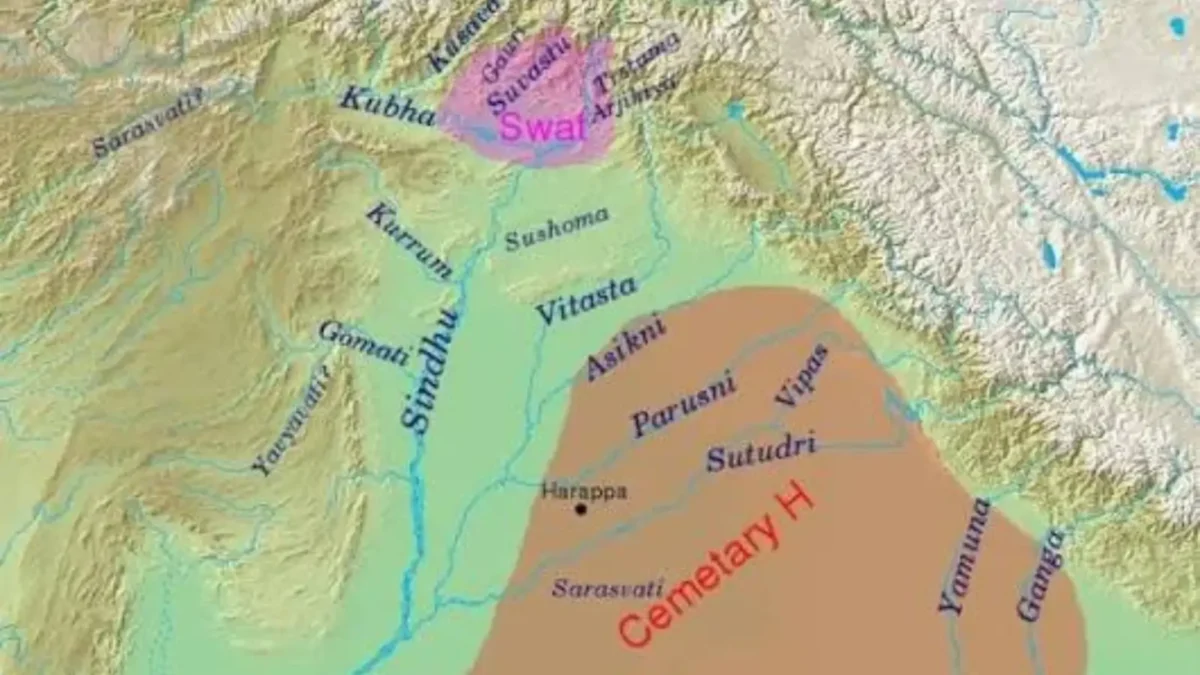
The rivers mentioned in the Rigveda provide important evidence for understanding the geographical setting, environment and life of the early Vedic people. Several rivers named in this ancient collection of Sanskrit hymns can be identified with modern rivers flowing through India, Pakistan and Afghanistan. These include the Sindhu (Indus), Vitasta (Jhelum), Parushni (Ravi), Asikni (Chenab), Vipash (Beas) and Shutudri (Sutlej).
The Rigveda also mentions the Sarasvati, Ganga and Yamuna, along with several rivers of the northwestern region whose modern identifications remain uncertain. The hymn known as the Nadistuti Sukta, found in the tenth Mandala of the Rigveda, is particularly important for studying these rivers.
This article examines the major rivers mentioned in the Rigveda, their Sanskrit names, present-day identifications, geographical locations and references in the ancient text. It also explains the importance of the Sapta Sindhu region and discusses the limitations of identifying ancient rivers with their modern counterparts.
Rigveda and Its Geographical Setting
The Rigveda is the oldest of the four Vedas and one of the principal literary sources for studying the early Vedic period. It consists of hymns composed in Vedic Sanskrit and preserved through an elaborate oral tradition. These hymns contain references to religious practices, social groups, animals, natural phenomena and geographical features, including numerous rivers.
The geographical references in the Rigveda suggest that the northwestern part of the Indian subcontinent was an important setting for the people who composed its hymns. The Indus and its tributaries feature prominently in the text. The references to rivers also provide clues about the landscape, routes of movement and the relationship between communities and their natural environment.
However, the Rigveda is primarily a collection of religious hymns, not a geographical gazetteer. Rivers are often mentioned in prayers, praises, metaphors and mythological descriptions. Consequently, historians must interpret these references carefully before associating a Sanskrit name with a modern river.
Nadistuti Sukta: The Hymn to the Rivers
The Nadistuti Sukta, or Hymn to the Rivers, is found in Rigveda 10.75. It is one of the most important textual sources for identifying rivers known to the early Vedic people. The hymn praises rivers and refers to several waterways of the northwestern subcontinent, as well as the Ganga and Yamuna.
Rigveda 10.75.5 names the Ganga, Yamuna, Sarasvati, Shutudri, Parushni, Asikni, Marudvridha, Vitasta, Arjikiya and Sushoma. The following verse mentions additional rivers, including Trishtama, Susartu, Rasa, Shveti, Kubha, Gomati, Krumu and Mehatnu.
The sequence is significant because it brings together rivers associated with different parts of the northwestern region. Some of these names have widely accepted modern equivalents, whereas others remain uncertain. The hymn should therefore be used as a primary textual source, while modern geographical identifications should be supported by historical and linguistic research.
Primary source: Rigveda, Mandala 10, Sukta 75 — Nadistuti Sukta.
Sapta Sindhu: The Land of Seven Rivers
The expression Sapta Sindhu is commonly associated with the seven-river region of the northwestern Indian subcontinent. The term is important in discussions of early Vedic geography, although its interpretation and the precise identification of all seven rivers require care.
In the conventional geographical explanation used in many educational accounts, the seven rivers are identified as the Indus, Sarasvati, Sutlej, Beas, Ravi, Chenab and Jhelum. This list combines the major Indus tributaries with the Sarasvati, whose identification with a modern river system remains debated.
The Indus and its tributaries form an interconnected drainage system extending across parts of present-day Tibet, India and Pakistan. The rivers flow through mountain valleys, plains and agricultural regions, ultimately contributing to the extensive Indus basin.
The importance of this region in the Rigveda is reflected in the number and variety of river names associated with the northwest. Nevertheless, Sapta Sindhu should not be treated as an undisputed list in which every ancient name has an exact and universally accepted modern equivalent.
Major Rivers Mentioned in the Rigveda and Their Present-Day Names
The following table lists major Rigvedic river names, their commonly accepted modern identifications and their present-day geographical settings. The identification column distinguishes established correspondences from cases that require caution.
| Rigvedic name | Present-day identification | Geographical location |
|---|---|---|
| Sindhu | Indus River | Tibet, Ladakh and Pakistan |
| Vitasta | Jhelum River | Kashmir Valley and Pakistan |
| Asikni | Chenab River | Himachal Pradesh, Jammu region and Pakistan |
| Parushni | Ravi River | Himachal Pradesh, Punjab and Pakistan |
| Vipash or Vipasa | Beas River | Himachal Pradesh and Punjab |
| Shutudri or Shatudri | Sutlej River | Tibet, Himachal Pradesh, Punjab and Pakistan |
| Sarasvati | Often associated with the Ghaggar-Hakra system | Northwestern India and adjoining parts of Pakistan |
| Ganga | Ganga River | Northern India and Bangladesh |
| Yamuna | Yamuna River | Uttarakhand, Haryana, Delhi and Uttar Pradesh |
| Kubha | Kabul River | Afghanistan and Pakistan |
| Krumu | Kurram River | Afghanistan–Pakistan border region and Pakistan |
| Gomati | Commonly identified with the Gomal River | Afghanistan–Pakistan border region and Pakistan |
| Suvastu | Swat River | Present-day Khyber Pakhtunkhwa, Pakistan |
| Sushoma | Often associated with the Sohan or Soan River | Pothohar Plateau, Pakistan |
| Drishadvati | Often associated with the Chautang river system | Parts of present-day Haryana and adjoining northwestern India |
Important note: The modern identifications above are based on commonly used historical and geographical interpretations. They should not be understood as proof that the ancient rivers followed exactly the same courses as their modern counterparts. River channels can change substantially over long periods, and some Sanskrit names may have had meanings broader than a single geographical feature.
Rigvedic, Ancient, and Greek Names of Rivers of the Indus Valley System
| Modern / Local Name | Rigvedic Name | Other Ancient Sanskrit Name(s) | Greek Name | Key Exam Notes |
|---|---|---|---|---|
| Indus | Sindhu | Sindhu | Indos | Name “India” derived from Greek usage |
| Jhelum | Vitastā | Vitastā | Hydaspes | Battle of Hydaspes (Alexander vs Porus) |
| Chenab | Asiknī | Chandrabhaga | Acesines | Name refers to dark-coloured waters |
| Ravi | Paruṣṇī | Iravati | Hydraotes | Mentioned in Battle of Ten Kings |
| Beas | Vipāśā | Vipasha | Hyphasis | Easternmost limit of Alexander’s campaign |
| Sutlej | Śutudrī | Shatadru | Hesidros | Meaning “river of a hundred streams” |
| Saraswati (Ghaggar–Hakra) | Saraswati | Saraswati | — | Major Rigvedic river, now largely dried |
The Indus River: Sindhu
The Sindhu is one of the most important rivers in the Rigveda. It corresponds to the modern Indus River, which rises in the Tibetan region, flows through Ladakh and Pakistan, and ultimately empties into the Arabian Sea.
The Indus is the principal river of the Indus drainage system. Its basin includes several major tributaries originating in the Himalayas and adjoining mountain ranges. These tributaries helped shape the physical geography of the northwestern subcontinent.
In the Rigveda, Sindhu appears in descriptions and praises of rivers. Its significance reflects the importance of the northwestern river system in the geographical world represented by the hymns.
The term sindhu can also be used in a broader sense for a river or large body of water in Sanskrit contexts. Therefore, a frequency study must distinguish references to the particular Indus River from occurrences in which the word may have a more general meaning.
The Five Rivers of the Punjab Region
The Punjab region is historically associated with five major rivers: the Jhelum, Chenab, Ravi, Beas and Sutlej. Their ancient names are important for understanding the geographical references in the Rigveda.
Vitasta — Jhelum River
The Rigvedic Vitasta is identified with the modern Jhelum River. It rises in the Kashmir region and flows through the Kashmir Valley before entering Pakistan, where it forms part of the Indus drainage system.
The Jhelum is an important river of the northwestern Himalayan region. Its identification with Vitasta is widely accepted in historical geography.
Asikni — Chenab River
Asikni is commonly identified with the Chenab River. The Chenab originates in the Himalayan region of Himachal Pradesh, flows through the Jammu region and continues into Pakistan.
Its ancient name is one of the principal correspondences used in reconstructing the river geography of the Rigvedic world. The Chenab eventually joins the larger Indus river system.
Parushni — Ravi River
Parushni is identified with the Ravi River. The Ravi originates in Himachal Pradesh and flows through the Punjab region before entering Pakistan.
The Ravi is particularly important in discussions of early Vedic geography because it is among the rivers named in the Nadistuti Sukta. Its ancient name is generally considered one of the more secure river identifications.
Vipash — Beas River
Vipash, also written as Vipasa, is identified with the modern Beas River. The Beas rises in Himachal Pradesh and flows through the Indian state of Punjab, where it joins the Sutlej.
The Beas and Sutlej are also important in the Rigvedic hymn describing the interaction between the sage Vishvamitra and two rivers. This passage is discussed in the NCERT chapter What Books and Burials Tell Us.
Shutudri — Sutlej River
Shutudri, also written as Shatudri, corresponds to the modern Sutlej River. It rises in the Tibetan region, enters India through Himachal Pradesh and flows through Punjab before continuing into Pakistan.
The Sutlej is one of the major tributaries of the Indus system. Its ancient name is important for identifying the geographical setting of several Rigvedic passages.
The Sarasvati River: Ancient References and Modern Identification
The Sarasvati is one of the most discussed rivers in studies of the Rigveda. It is praised in the Vedic text and appears in the Nadistuti Sukta. However, its precise geographical identification and the history of its ancient course remain subjects of scholarly debate.
One common hypothesis associates the Rigvedic Sarasvati with the Ghaggar-Hakra river system, which extends through northwestern India and adjoining parts of Pakistan. Researchers have examined the region’s geological features, palaeochannels, archaeological sites and historical descriptions to investigate this possibility.
It is important to distinguish the identification of a river system from the question of whether that system followed the same course during the period represented by the Rigveda. Ancient river channels can shift, lose water sources or become seasonally active over time.
The Rigvedic descriptions of the Sarasvati also need to be interpreted in their literary and religious context. A poetic description should not automatically be treated as a precise geographical measurement.
For these reasons, the Sarasvati should not be presented as conclusively identified with one modern river. The Ghaggar-Hakra system is a prominent proposed identification, but the evidence and its interpretation remain debated.
The Ganga and Yamuna in the Rigveda
Ganga
The Ganga is one of the most important rivers in Indian history and geography. Its Rigvedic reference is significant because it indicates that the river was known to the composers of the text.
The Ganga originates in the Himalayan region of Uttarakhand, flows through the northern plains of India and continues into Bangladesh as part of the Ganga-Brahmaputra delta system.
According to the NCERT textbook Our Pasts–I, in the chapter What Books and Burials Tell Us, the Ganga is named only once in the Rigveda. This is a useful textbook-level fact for understanding the geographical emphasis of the text.
Yamuna
The Yamuna is another major river of northern India. It originates in Uttarakhand, flows through Haryana and Delhi, and continues through Uttar Pradesh before joining the Ganga at Prayagraj.
NCERT also states that the Yamuna is named only once in the Rigveda. Its limited references, compared with those to the Indus and its tributaries, are consistent with the prominent place of the northwestern river system in the geographical setting represented by the text.
These statements should not be interpreted as proof that the Ganga and Yamuna were historically unimportant. The Rigveda is a religious collection rather than a systematic geographical account, and the frequency of a river’s mention does not directly measure its economic, political or cultural importance.
Other Rivers of the Northwestern Region
In addition to the major rivers of the Indus system, the Rigveda contains several names associated with the northwestern region. Their identification is useful for reconstructing the wider geographical horizon of the early Vedic people, although the evidence is not equally strong in every case.
Kubha — Kabul River
Kubha is commonly identified with the Kabul River. The river flows through Afghanistan and Pakistan and joins the Indus near Attock in present-day Pakistan.
The Kabul River forms part of the northwestern drainage system and is geographically significant for understanding connections between Afghanistan and the Indus basin.
Krumu is commonly identified with the Kurram River, which flows from the Afghanistan–Pakistan border region into Pakistan. It belongs to the wider network of rivers draining towards the Indus system.
This identification is frequently used in discussions of the northwestern rivers mentioned in the Rigveda, although individual textual references should still be examined in context.
Gomati — Gomal River
The Gomati named in the northwestern geographical context of the Rigveda is commonly identified with the Gomal River, which flows from the Afghanistan–Pakistan border region into Pakistan.
This identification must not be confused with the modern Gomti River of Uttar Pradesh. Similar names do not necessarily refer to the same watercourse, especially when the ancient textual setting points to a different geographical region.
Suvastu — Swat River
Suvastu is commonly identified with the Swat River in present-day Khyber Pakhtunkhwa, Pakistan. The river flows through the Swat Valley and forms part of the broader northwestern drainage region.
Its identification provides another example of how ancient river names can help researchers investigate the geographical setting of the Rigvedic hymns.
Sushoma and Other Uncertain Names
Sushoma has been associated by some scholars with the Sohan or Soan River of the Pothohar Plateau in Pakistan. However, this is not as secure an identification as the correspondences between the Indus and Sindhu or the Ravi and Parushni.
Other names, including Marudvridha, Arjikiya, Trishtama, Susartu, Shveti and Mehatnu, occur in the river hymn. Their precise geographical identities are uncertain or disputed. They should be included in a comprehensive inventory of Rigvedic hydronyms without assigning unsupported modern equivalents.
What Do the River References Reveal About Rigvedic Geography?
The river names in the Rigveda provide several important clues about the geographical setting represented in the text.
Importance of the Northwestern Region
The presence of the Indus and several of its tributaries demonstrates the importance of the northwestern river system in Rigvedic geographical references. The concentration of identifiable rivers in this region helps historians reconstruct the broad landscape associated with the early Vedic tradition.
Knowledge of Mountain Rivers and Plains
Several rivers mentioned in the Rigveda originate in or flow through mountainous regions before reaching the plains. The references therefore reflect familiarity with waterways connecting the Himalayan and adjoining highland regions with the northwestern plains.
Rivers as Sources of Life and Movement
The hymns describe rivers as powerful natural forces and frequently address them in religious language. The dialogue between Vishvamitra and the Beas and Sutlej, discussed in NCERT, also refers to crossing rivers with chariots and carts. Such passages help historians investigate movement through the landscape, although they should not be treated as detailed travel records.
Limits of Literary Evidence
The Rigveda cannot by itself provide a complete map of ancient river courses. Its poetic descriptions must be compared with archaeological evidence, geological research, palaeohydrology and other historical sources. This is particularly important for rivers such as the Sarasvati and for names whose modern identifications remain uncertain.
Important Facts for Competitive Examinations
- The Rigveda is the oldest of the four Vedas.
- The Nadistuti Sukta, or Hymn to the Rivers, occurs in Rigveda 10.75.
- Sindhu is identified with the Indus River.
- Vitasta is identified with the Jhelum River.
- Asikni is identified with the Chenab River.
- Parushni is identified with the Ravi River.
- Vipash is identified with the Beas River.
- Shutudri is identified with the Sutlej River.
- Kubha is commonly identified with the Kabul River.
- Krumu is commonly identified with the Kurram River.
- The northwestern Gomati is commonly identified with the Gomal River, not the modern Gomti of Uttar Pradesh.
- NCERT states that the Ganga and Yamuna are named only once in the Rigveda.
- The identification of the Rigvedic Sarasvati with the Ghaggar-Hakra system is a prominent hypothesis, not an undisputed conclusion.
Multiple-Choice Questions (MCQs)
Question 1. The Nadistuti Sukta is found in which part of the Rigveda?
(a) Mandala 2, Sukta 1
(b) Mandala 7, Sukta 18
(c) Mandala 10, Sukta 75
(d) Mandala 1, Sukta 1
Answer: (c) Mandala 10, Sukta 75.
Explanation: The Nadistuti Sukta is the hymn to the rivers found in the tenth Mandala of the Rigveda.
Question 2. Which of the following pairs is correctly matched?
(a) Vitasta — Ravi
(b) Parushni — Ravi
(c) Asikni — Beas
(d) Vipash — Jhelum
Answer: (b) Parushni — Ravi.
Explanation: Parushni is identified with the Ravi River. Vitasta corresponds to the Jhelum, Asikni to the Chenab and Vipash to the Beas.
Question 3. According to NCERT, which of the following rivers are named only once in the Rigveda?
(a) Indus and Sarasvati
(b) Ganga and Yamuna
(c) Ravi and Chenab
(d) Beas and Sutlej
Answer: (b) Ganga and Yamuna.
Explanation: The NCERT chapter What Books and Burials Tell Us states that the Ganga and Yamuna are named only once in the Rigveda.
Question 4. The Rigvedic river name Kubha is commonly identified with which modern river?
(a) Kabul
(b) Kaveri
(c) Narmada
(d) Godavari
Answer: (a) Kabul.
Explanation: Kubha is commonly identified with the Kabul River, which flows through Afghanistan and Pakistan.
Question 5. Which statement about the Rigvedic Sarasvati is the most accurate?
(a) It is conclusively identified with the modern Ganga.
(b) It is conclusively identified with the modern Yamuna.
(c) Its identification with the Ghaggar-Hakra system is a prominent hypothesis, but the issue remains debated.
(d) It is not mentioned in the Rigveda.
Answer: (c).
Explanation: The Sarasvati is mentioned in the Rigveda, but its exact geographical identification and ancient course remain debated.
Descriptive Questions and Answers
Question 1. Discuss the significance of the Nadistuti Sukta for reconstructing the geography of the Rigvedic period.
Answer: The Nadistuti Sukta, found in Rigveda 10.75, is an important textual source for the study of early Vedic geography. It names numerous rivers, including the Ganga, Yamuna, Sarasvati, Shutudri, Parushni, Asikni and Vitasta, along with rivers associated with the northwestern region. Several names can be connected with modern rivers, particularly those of the Indus basin. These references help historians reconstruct the broad geographical setting represented in the Rigveda. However, some identifications remain uncertain, and the hymn’s poetic descriptions cannot be treated as a complete geographical survey.
Question 2. Explain the importance of the Indus and its tributaries in the geographical references of the Rigveda.
Answer: The Indus and its tributaries are prominent in the Rigvedic geographical landscape. The ancient names Sindhu, Vitasta, Asikni, Parushni, Vipash and Shutudri are commonly identified with the Indus, Jhelum, Chenab, Ravi, Beas and Sutlej, respectively. Their references provide evidence of the importance of the northwestern river system in the world represented by the hymns. The rivers also connect the mountainous regions with the plains of the subcontinent. Nevertheless, the text is religious poetry rather than a systematic geographical account, so its references must be interpreted alongside other evidence.
Question 3. Why is the identification of the Rigvedic Sarasvati a subject of scholarly debate?
Answer: The Sarasvati is mentioned prominently in the Rigveda, but identifying it with a particular modern river is difficult. The Ghaggar-Hakra system is one of the principal proposed identifications. Researchers examine textual descriptions, geological evidence, ancient river channels and archaeological sites to investigate the question. However, the relationship between the ancient descriptions and the present-day landscape is not conclusively established in every respect. Changes in river courses and differences in the interpretation of the textual evidence contribute to the debate. Therefore, the identification should be presented as a hypothesis rather than an undisputed fact.
Conclusion
The rivers mentioned in the Rigveda provide valuable evidence for understanding the geographical setting of the early Vedic tradition. The Sindhu and its tributaries are especially important, while the references to the Ganga, Yamuna, Sarasvati and northwestern rivers broaden the geographical picture. The Nadistuti Sukta is a particularly useful primary source because it brings together many river names in a single hymn.
Identifying ancient river names with modern rivers requires a combination of textual interpretation, historical geography, linguistics and geological research. Some correspondences, such as Sindhu–Indus and Vitasta–Jhelum, are well established, whereas others remain uncertain. Similarly, accurate frequency totals require systematic verification of the Sanskrit text.
A careful study of these river references therefore contributes not only to the understanding of the Rigveda but also to the broader reconstruction of the historical geography of the Indian subcontinent.
References and Further Reading
- Primary text: Rigveda, Mandala 10, Sukta 75 — Nadistuti Sukta.
- NCERT: Our Pasts–I, Chapter: What Books and Burials Tell Us.
- Academic research: Václav Blažek, Hydronymia R̥gvedica, 2016.
- Textual concordance: Alexander Lubotsky, A Digital Concordance of the Rigveda.
- Additional educational reference: IGNOU eGyanKosh, study material on early Indian history and Vedic geography.