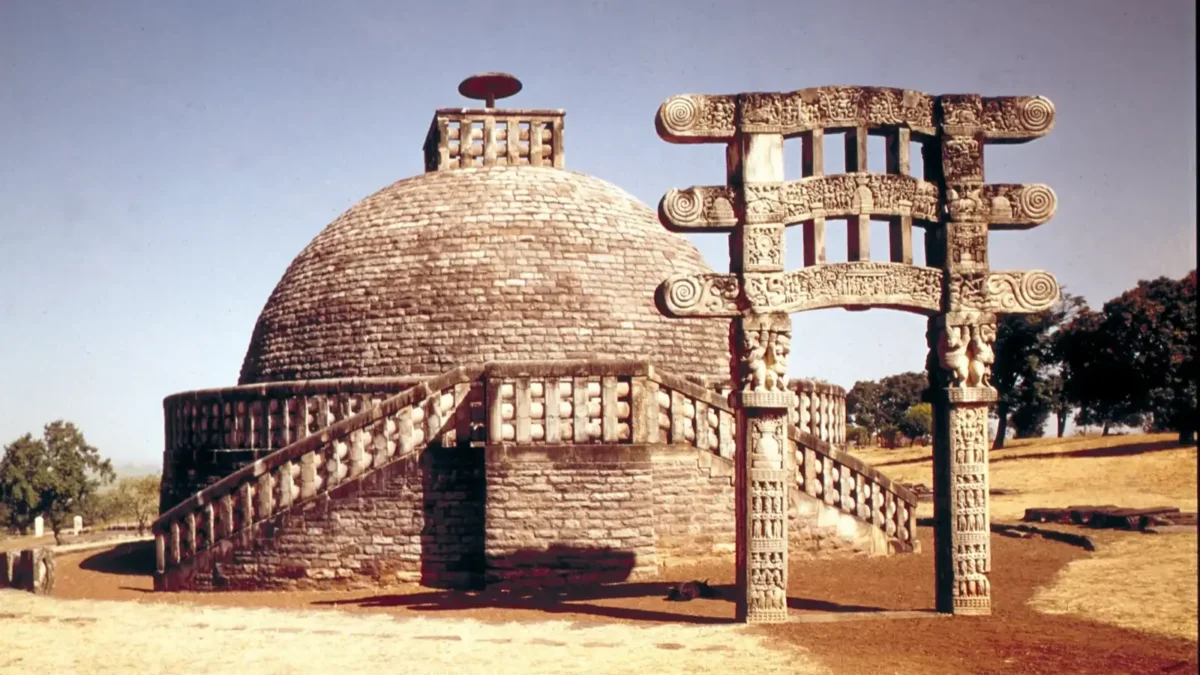
India is home to some of the most important Buddhist monuments in the world. Buddhist stupas preserve the history of the spread of Buddhism, royal patronage, religious practices and the development of ancient Indian art and architecture. From the Great Stupa at Sanchi to the monumental remains of Amaravati and Kesariya, these structures reflect different stages in the evolution of Buddhist architecture.
A stupa is generally a solid, mound-like structure associated with Buddhist worship. Stupas were built to enshrine relics, commemorate important events or sacred places, and provide a focus for devotional practices such as circumambulation. Their architectural features commonly include a hemispherical dome, a square railing or enclosure at the summit, a central mast and one or more ceremonial umbrellas.
This article examines five historically significant Buddhist stupas in India, covering their location, period, patronage, dimensions, architectural features, historical importance and present condition. The selection is based on historical and archaeological significance rather than an official ranking.
1. Great Stupa at Sanchi, Madhya Pradesh
Location: Sanchi, Raisen district, Madhya Pradesh
Original construction: 3rd century BCE
Principal patron: Emperor Ashoka of the Mauryan dynasty
Major enlargement: Shunga period, 2nd–1st centuries BCE
UNESCO status: Inscribed as part of the Buddhist Monuments at Sanchi in 1989
History and Construction
The Great Stupa at Sanchi, also known as Stupa 1, is one of the oldest surviving Buddhist monuments in India. Its original construction is associated with Emperor Ashoka in the 3rd century BCE, when Buddhism received substantial royal patronage under the Mauryan Empire.
The original structure was a relatively modest brick stupa. During the Shunga period, it was enlarged and enclosed with a stone casing. Additional architectural features, including the circumambulatory path and stone railings, were developed. The four elaborately carved gateways were added during the Satavahana period, generally dated to around the 1st century BCE or 1st century CE.
Further religious buildings, monasteries and smaller stupas were constructed at Sanchi over subsequent centuries. The site developed into an important Buddhist centre and remained significant into the medieval period.
Dimensions and Architectural Features
- Height: Approximately 16.4 metres for the main dome structure.
- Diameter: Approximately 36.6 metres.
- Anda: The large hemispherical dome forming the principal mass of the stupa.
- Harmika: A square enclosure at the summit of the dome.
- Chhatras: Umbrella-like elements mounted above the harmika.
- Toranas: Four richly carved gateways positioned in the cardinal directions.
- Pradakshina patha: A circumambulatory path used by devotees to walk around the stupa.
The gateways are especially important for the study of early Buddhist art. Their reliefs depict Jataka stories, scenes associated with the Buddha’s life, worship of sacred symbols and aspects of contemporary society. In much of the early sculpture, the Buddha is represented symbolically through features such as the Bodhi tree, the Dharma Chakra and the empty throne rather than through a human image.
Present Status and UNESCO Recognition
The Great Stupa survives as the principal monument within a wider archaeological complex containing temples, monasteries, pillars and other stupas. It is protected and maintained by the Archaeological Survey of India.
The Buddhist Monuments at Sanchi were inscribed on the UNESCO World Heritage List in 1989. UNESCO recognises the complex for its outstanding testimony to Buddhist architecture, artistic traditions and the historical development of Buddhism in India.
Historical significance: Sanchi is particularly important for understanding the development of the stupa from an early brick structure into a monumental stone-enclosed form decorated with elaborate gateways.
Official source: UNESCO — Buddhist Monuments at Sanchi.
2. Dhamek Stupa, Sarnath, Uttar Pradesh
Location: Sarnath, near Varanasi, Uttar Pradesh
Principal historical association: The Buddha’s First Sermon
Present structure: Generally dated to the Gupta period, around the 5th–6th centuries CE, with earlier structures at the site
Dimensions: Approximately 43.6 metres high and 28 metres in diameter
UNESCO status: Included within the Ancient Buddhist Site of Sarnath, inscribed in 2026
History and Construction
Dhamek Stupa is one of the most recognisable Buddhist monuments in northern India. It stands at Sarnath, traditionally identified as the place where Gautama Buddha delivered his First Sermon after attaining enlightenment at Bodh Gaya.
The sermon is associated with the beginning of the Buddha’s teaching mission and the establishment of the Buddhist Sangha. For this reason, Sarnath became one of the most important destinations in the Buddhist pilgrimage tradition.
The site received patronage over several centuries. An earlier structure is associated with the Mauryan period and Emperor Ashoka, who supported the development of Buddhist monuments at important sacred locations. The present Dhamek Stupa, however, is generally dated to the Gupta period and appears to have replaced or enlarged an earlier monument.
Dimensions and Architectural Features
- Height: Approximately 43.6 metres.
- Diameter: Approximately 28 metres.
- Structure: A massive cylindrical monument constructed mainly of brick, with a lower stone-clad section.
- Decorative work: The stone surface contains elaborate floral patterns and geometric designs characteristic of Gupta-period artistic traditions.
- Niches: The lower exterior includes decorative niches associated with the monument’s sculptural programme.
Unlike the Great Stupa at Sanchi, Dhamek Stupa does not preserve an elaborate set of four ceremonial gateways. Its monumental cylindrical form is its most distinctive architectural feature.
Present Status and UNESCO Recognition
Dhamek Stupa survives at the archaeological site of Sarnath and remains an important destination for Buddhist pilgrims and visitors. The wider site preserves the remains of stupas, monasteries, temples and other structures representing different phases of Buddhist history.
In 2026, UNESCO inscribed the Ancient Buddhist Site of Sarnath on the World Heritage List. The inscribed property includes the Chaukhandi Stupa and the archaeological remains of Sarnath, within which Dhamek Stupa is situated. Therefore, the correct description is that Dhamek Stupa forms part of a UNESCO World Heritage property, rather than being a separately inscribed monument.
Historical significance: Dhamek Stupa commemorates the sacred landscape associated with the Buddha’s First Sermon and illustrates the monumental architectural traditions of Gupta-period Buddhism.
Official sources: UNESCO — Ancient Buddhist Site of Sarnath; Ministry of Tourism — Dhamek Stupa.
3. Kesariya Stupa, Bihar
Location: Kesariya, East Champaran district, Bihar
Period: The surviving monumental structure is generally dated to the Gupta period, approximately 4th–7th centuries CE; an earlier foundation has been proposed.
Patronage: The precise original builder is not conclusively established.
Height: Approximately 31.7 metres, or 104 feet, according to Bihar Tourism
UNESCO status: Not individually inscribed on the UNESCO World Heritage List
History and Construction
Kesariya Stupa is a major Buddhist archaeological monument in Bihar. Its enormous size and terraced form make it one of the most striking surviving brick stupas in India.
The site is associated in Buddhist tradition with the Buddha’s final journey towards Kushinagar. According to the traditional account, the Licchavis of Vaishali received his alms bowl before he continued towards the place of his Mahaparinirvana. The stupa is traditionally connected with the commemoration of this event.
Bihar Tourism suggests that the site’s earliest phase may be associated with the Mauryan period, while the surviving structure developed during the Gupta period. These dates should be distinguished from the traditional narrative: the exact builder and chronology of every construction phase are not definitively established.
Dimensions and Architectural Features
- Height: Approximately 104 feet.
- Plan: A large polygonal, terraced brick structure.
- Terraces: The surviving monument has six principal terraced levels.
- Materials: Predominantly brick masonry.
- Sculptures: Excavations have revealed Buddha images and other archaeological remains.
The stepped arrangement distinguishes Kesariya from the more rounded dome of Sanchi. Its successive terraces and large scale reflect the development of monumental Buddhist architecture in eastern India.
Present Status and UNESCO Recognition
Kesariya Stupa is a protected archaeological monument under the Archaeological Survey of India. Excavations conducted in the modern period have helped reveal its scale and architectural features.
The monument is frequently described in tourism literature as one of the world’s largest or tallest Buddhist stupas. Such superlatives depend on the criteria used for comparison, including surviving height, original height and overall volume. For historical writing, its documented dimensions are more useful than an unqualified claim that it is definitively the largest.
Kesariya Stupa is not individually inscribed on the UNESCO World Heritage List. Its importance rests on its archaeological value, scale and association with Bihar’s Buddhist heritage.
Historical significance: Kesariya provides an important example of large-scale brick stupa architecture and the continuation of Buddhist monument-building in eastern India.
Official sources: Bihar Tourism — Kesariya Stupa; Bihar Tourism — Ready Reckoner.
4. Amaravati Mahachaitya, Andhra Pradesh
Location: Amaravati, present-day Guntur district, Andhra Pradesh
Period: Construction and enlargement from approximately the 3rd century BCE to the early centuries CE, with later activity at the site
Patronage: Developed over several phases under different patrons, particularly during the Satavahana period and subsequent dynasties
Dimensions: The original overall dimensions cannot be stated confidently from the surviving remains alone.
UNESCO status: Not individually inscribed on the UNESCO World Heritage List
History and Construction
The Amaravati Mahachaitya, also known as the Great Stupa of Amaravati, was one of the most important Buddhist monuments of ancient southern India. It developed over several centuries and became a major centre of Buddhist religious activity and artistic production.
The site’s earliest phase is often associated with the Mauryan period, although the precise date of its foundation and the attribution of its original construction to Ashoka remain subjects requiring caution. Archaeological evidence indicates substantial building activity during the second and first centuries BCE, followed by important phases of enlargement during the early centuries CE.
The Satavahana period was particularly significant for the development of the Amaravati sculptural tradition. The monument became famous for its richly carved limestone panels, which depict Buddhist narratives, sacred symbols, devotees and scenes from the life of the Buddha.
Dimensions and Architectural Features
- Mahachaitya: A monumental stupa that developed through multiple construction phases.
- Vedika: A railing surrounding the sacred structure.
- Ayaka platforms: Projecting platforms associated with the cardinal directions, a distinctive feature of the Amaravati monument.
- Drum slabs: Carved limestone panels that decorated the cylindrical drum of the stupa.
- Sculptural narratives: Reliefs depicting Buddhist stories, worship, devotees and symbolic representations.
The Amaravati artistic tradition is particularly notable for its sophisticated relief sculpture and dynamic compositions. The monument also illustrates the transition in Buddhist art from predominantly symbolic representations of the Buddha to more explicit anthropomorphic depictions in later phases.
Present Status and UNESCO Recognition
The original Mahachaitya no longer survives as a complete standing stupa. Archaeological remains, structural traces and sculptural fragments preserve evidence of its former scale and design. Many important Amaravati sculptures were removed during the colonial period and are now held in museums in India and abroad.
The Archaeological Survey of India protects the archaeological remains, and the Amaravati Site Museum preserves material associated with the monument. The surviving remains must be studied alongside museum collections to understand the original artistic and architectural richness of the site.
The Amaravati Mahachaitya is not individually inscribed on the UNESCO World Heritage List.
Historical significance: Amaravati is essential for understanding the development of Buddhist art in southern India, especially the elaborate limestone relief tradition associated with the Satavahana and subsequent periods.
Official sources: Archaeological Survey of India — Amaravati Circle; National Mission on Monuments and Antiquities — Amaravati.
5. Bharhut Stupa, Madhya Pradesh
Location: Bharhut, Satna district, Madhya Pradesh
Original foundation: Traditionally associated with the Mauryan period, possibly the 3rd century BCE
Major development: Shunga period, particularly around the 2nd century BCE
Patronage: Developed over time through royal and donor contributions; no single builder is conclusively established for the entire monument
Dimensions: The original stupa’s complete dimensions are not securely established from the surviving remains.
UNESCO status: Not individually inscribed on the UNESCO World Heritage List
History and Construction
Bharhut Stupa was an important early Buddhist monument in central India. Its original foundation is often associated with the Mauryan period, while its carved stone railings and gateways are particularly associated with the Shunga period.
The monument is especially important for the study of early Buddhist art because its sculptural panels preserve representations of Jataka stories, episodes associated with the Buddha, sacred symbols and figures from the wider religious world of ancient India.
The site was excavated by Alexander Cunningham in 1873. By the time of its archaeological rediscovery, the main stupa had largely disappeared. Important surviving architectural fragments, including portions of the stone railing and the eastern gateway, were removed to the Indian Museum in Kolkata.
Dimensions and Architectural Features
- Original structure: The stupa is generally reconstructed as a brick structure covered with plaster.
- Stone railing: The vedika enclosed the sacred monument and carried numerous carved panels.
- Gateway: The surviving eastern gateway is an important example of early Buddhist architectural sculpture.
- Jataka stories: Reliefs depict narratives associated with the previous births of the Buddha.
- Inscriptions: Brahmi inscriptions identify figures and stories and record donor contributions.
Bharhut is particularly valuable because many reliefs include identifying inscriptions. These provide evidence for the relationship between early Buddhist narrative traditions, visual representation and the use of writing in religious settings.
The carvings also illustrate an early aniconic phase of Buddhist art, in which the Buddha was frequently represented through symbols rather than a human figure. Sacred trees, wheels, thrones and stupas appear within scenes of worship.
Present Status and UNESCO Recognition
The main stupa does not survive as a standing monument. Its archaeological remains at Bharhut are limited, while many of the most important sculptural and architectural fragments are preserved in the Indian Museum, Kolkata.
The Bharhut Gallery of the Indian Museum displays the remains of the gateway and railings, including carvings that document early Buddhist artistic traditions. These collections are essential for studying a monument whose original architectural form is no longer intact.
Bharhut Stupa is not individually inscribed on the UNESCO World Heritage List.
Historical significance: Bharhut is one of the most important sources for the study of early Buddhist narrative art, donor inscriptions and symbolic representation of the Buddha.
Official sources: Indian Museum, Kolkata — Bharhut Gallery; Museums of India — Bharhut Gateway and Railings.
Comparison of the Five Major Stupas
| Stupa | State | Principal period | Distinctive feature | Present condition | UNESCO status |
|---|---|---|---|---|---|
| Great Stupa, Sanchi | Madhya Pradesh | 3rd century BCE onwards | Four carved gateways and monumental dome | Substantially survives | Part of a World Heritage property, 1989 |
| Dhamek Stupa, Sarnath | Uttar Pradesh | Gupta period, with earlier phases | Massive cylindrical form and carved stone exterior | Substantially survives | Part of the Ancient Buddhist Site of Sarnath, inscribed in 2026 |
| Kesariya Stupa | Bihar | Surviving structure generally associated with the Gupta period | Large, six-tiered terraced brick structure | Ruined but monumental | Not individually inscribed |
| Amaravati Mahachaitya | Andhra Pradesh | 3rd century BCE to early centuries CE, with later activity | Carved limestone reliefs and ayaka platforms | Main structure largely lost; archaeological remains survive | Not individually inscribed |
| Bharhut Stupa | Madhya Pradesh | Early foundation traditionally associated with Mauryan times; major Shunga-period sculpture | Carved railings, gateway and labelled narrative reliefs | Main stupa lost; important remains preserved in museums | Not individually inscribed |
Why Are Stupas Important in Buddhist Architecture?
Stupas were more than architectural structures. They became important centres of Buddhist devotion, pilgrimage and commemoration. Their form and decoration evolved as Buddhism spread across different regions of India and received patronage from rulers, merchants, monks and lay devotees.
Three broad features are particularly important:
- Religious significance: Stupas could enshrine relics, commemorate sacred events or mark important Buddhist locations.
- Architectural development: The transition from brick mounds to stone-enclosed monuments with elaborate railings, gateways and sculptures reflects changing artistic traditions.
- Historical evidence: Inscriptions, reliefs and archaeological remains reveal information about donors, religious practices, narrative traditions and the development of Buddhist communities.
The five monuments discussed here represent different aspects of this development. Sanchi preserves an exceptionally complete architectural ensemble, Dhamek is closely associated with the Buddha’s First Sermon, Kesariya demonstrates monumental terraced construction, Amaravati illustrates sophisticated southern Indian Buddhist sculpture, and Bharhut preserves important evidence of early narrative art.
Conclusion
The Great Stupa at Sanchi, Dhamek Stupa, Kesariya Stupa, Amaravati Mahachaitya and Bharhut Stupa are among the most historically significant Buddhist monuments in India. Their differences in size, form, artistic decoration and state of preservation reveal the diversity of Buddhist architecture across regions and centuries.
For historical study, it is important to distinguish the original foundation of a stupa from later enlargements, and a monument’s traditional religious association from conclusions established by archaeology. It is equally important to distinguish a UNESCO-listed archaeological complex from an individual monument within it.
Together, these stupas provide valuable evidence for understanding the spread of Buddhism, the development of sacred architecture and the evolution of artistic traditions in ancient India.
References and Further Reading
- UNESCO World Heritage Centre — Buddhist Monuments at Sanchi.
- UNESCO World Heritage Centre — Ancient Buddhist Site of Sarnath.
- Ministry of Tourism, Government of India — Dhamek Stupa.
- Bihar Tourism — Kesariya Stupa.
- Archaeological Survey of India — Amaravati Circle.
- National Mission on Monuments and Antiquities — Amaravati.
- Indian Museum, Kolkata — Bharhut Gallery.
- NCERT Class 11, An Introduction to Indian Art — Post-Mauryan Trends in Indian Art and Architecture.