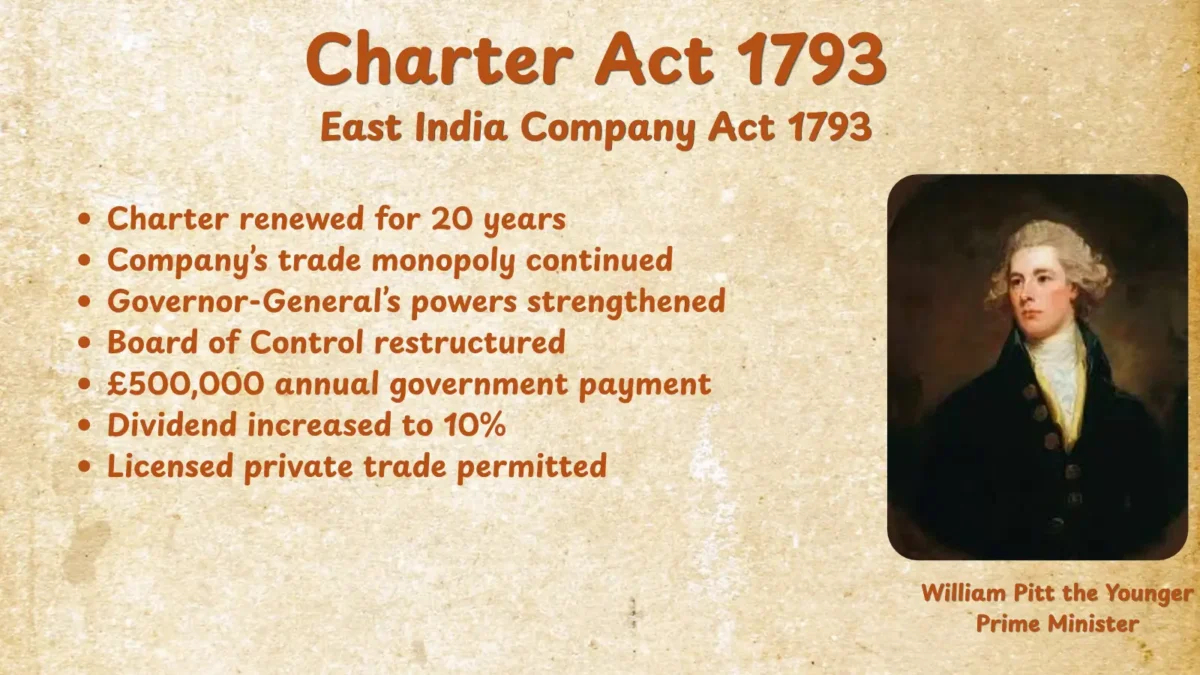
The Charter Act 1793, officially known as officially the East India Company Act 1793, was an important British parliamentary legislation that renewed the charter of the East India Company and continued its commercial and administrative privileges in India. Passed at a time when the Company was exercising extensive territorial and political authority, the Act largely retained the existing system of governance while strengthening certain administrative arrangements. It extended the Company’s exclusive trade privileges for another twenty years and reinforced the authority of the Governor-General over the subordinate presidencies.
The Act is significant in the constitutional history of British India because it continued the process of centralisation that had begun with the Regulating Act of 1773 and had been strengthened by Pitt’s India Act of 1784 and the Act of 1786.
Historical Background of the Charter Act 1793
The East India Company had originally been established as a commercial organisation. However, its political influence expanded significantly after the Battle of Plassey in 1757 and the Battle of Buxar in 1764. The grant of the Diwani rights of Bengal, Bihar and Orissa in 1765 gave the Company control over revenue collection in these territories and strengthened its position as a territorial power.
The Company’s growing political responsibilities and administrative difficulties led the British Parliament to introduce several measures to regulate its affairs. The Regulating Act of 1773 established an initial framework for parliamentary supervision. The Act of Settlement of 1781 clarified aspects of the relationship between the Supreme Court at Calcutta and the Company’s administration. Pitt’s India Act of 1784 established a system of dual control through the Court of Directors and the Board of Control. The Act of 1786 further strengthened the Governor-General’s executive authority under specified circumstances.
As the Company’s charter approached renewal, Parliament passed the Charter Act of 1793. Rather than introducing a completely new system, it continued many existing arrangements and made additional provisions concerning trade, administration, appointments and the supervision of British territories in India.
Important Facts about the Charter Act 1793
| Particular | Details |
|---|---|
| Common name | Charter Act 1793 / Charter Act of 1793 |
| Official statutory name | East India Company Act 1793 |
| Royal assent | 11 June 1793 |
| British monarch | King George III (ruled from 1760 to 1820) |
| British Prime Minister | William Pitt the Younger (served from 1783 to 1801) |
| Governor-General of Bengal | Lord Cornwallis (September 1786 – October 1793); Sir John Shore (October 1793 – March 1798) |
| Principal organisation concerned | East India Company |
| Term of renewed exclusive trade privileges | Twenty years, calculated from 1 March 1794 |
| Next major legislation | Charter Act of 1813 |
| Repealed by | The Government of India Act 1915 |
Main Provisions of the Charter Act 1793
1. Renewal of the Company’s Charter and Territorial Possessions
- Renewal of the Company’s charter: The East India Company’s exclusive trading privileges were renewed for another 20 years, beginning on 1 March 1794.
- Continuation of territorial possessions: The Company’s existing territorial possessions in India continued under its administration for the renewed term.
- Continuation of territorial revenues: The revenues generated from these territories continued to be administered under the Company’s system, subject to statutory restrictions and British parliamentary control.
- British Crown’s sovereignty: The Company’s possession of Indian territories did not extinguish the sovereignty and public claims of the British Crown.
- Possibility of early termination: Parliament retained the power to discontinue the renewed grant after giving three years’ notice.
- Continuation of parliamentary supervision: The Company’s civil government, military administration and management of territorial revenues remained subject to the supervisory and controlling powers established by earlier Acts of Parliament.
2. Powers of the Governor-General and Presidency Governments
- Power to override the Council: The Governor-General’s power to override his Council in specified circumstances was continued and extended beyond the special arrangement previously associated with Lord Cornwallis.
- Stronger control over Bombay and Madras: The authority of the Governor-General over the Presidencies of Bombay and Madras was strengthened, reinforcing the supremacy of the Bengal government in the Company’s political and administrative structure.
- Governor-General’s authority in another Presidency: When the Governor-General was present in Bombay or Madras, he took precedence over the Governor of that Presidency.
- Appointment of a Vice-President: When the Governor-General was absent from Bengal, a Vice-President could be appointed from among the civilian members of his Council to perform the necessary functions.
- Power of Governors to override their Councils: The Act continued the prescribed power of Presidency Governors to override their Councils in specified circumstances.
3. Board of Control and British Government
- Changes in the composition of the Board of Control: The Board’s composition was modified to include a President and two junior members, who were not necessarily required to be members of the Privy Council.
- Expenses of the Board of Control: The salaries of its paid members and the expenses of its staff were charged to the revenues of the East India Company.
- British Government’s supervisory authority: The Act continued the system under which the British Government, through the Board of Control, supervised the Company’s political, military and administrative affairs in India.
- Control over Indian revenues: The Company’s management and appropriation of territorial revenues remained subject to parliamentary legislation and the authority exercised through the Board of Control.
4. Financial Provisions
- Annual payment to the British Government: The Company was required to pay £500,000 annually to the British Government from Indian revenues, subject to the statutory financial arrangements.
- Increase in shareholders’ dividend: The Act permitted the Company’s dividend to be increased to 10%, subject to the applicable statutory conditions.
- Administrative expenses: Specified expenses connected with the Company’s administration were to be met from its revenues.
- Salaries and pensions: The salaries and pensions of specified officials, along with the expenses of the Board of Control, were charged to Company revenues under the applicable provisions.
- Regulation of Company revenues and profits: The Act laid down rules for appropriating the Company’s revenues and profits to specified purposes, maintaining parliamentary oversight over the financial benefits arising from its territorial possessions.
5. Appointments and Conduct of Company Officials
- Royal approval for senior appointments: The appointment of the Governor-General, Presidency Governors and Commander-in-Chief was subject to the prescribed royal approval.
- Restriction on leaving India: Senior Company officials covered by the Act were restricted from leaving India without the required permission.
- Departure without permission: An official who left India in violation of the applicable requirement could be treated as having resigned from office.
- Commander-in-Chief’s membership of the Council: The Commander-in-Chief was not automatically a member of the Governor-General’s Council merely by holding military office. Membership depended on the prescribed appointment arrangements.
6. Private Trade and Licensing
- Power to issue trade licences: The Company was authorised to grant licences to individuals, including certain Company employees, permitting them to engage in trade under the applicable conditions.
- Privilege trade or country trade: Private commercial activity conducted under such licences became associated with the terms privilege trade and country trade.
- Continuation of the Company’s monopoly: The licensing arrangement did not abolish the Company’s general exclusive trading privileges. Private traders operated under the Company’s permission and applicable restrictions.
- Connection with the China trade: Licensed private trade was historically associated with commercial activities involving China, including the opium trade. This was a historical consequence of the trading arrangements, rather than a separate provision expressly legalising every such activity.
7. Judicial Administration and Separation of Functions
- Separation of revenue and judicial functions: The Act is commonly associated with separating revenue administration from judicial functions in the Company’s administrative system.
- Abolition of revenue courts: The reorganisation is associated with the disappearance of maal adalats, or revenue courts, which handled matters connected with revenue collection.
- Administration of justice in Presidency towns: The Act contained provisions concerning the good order and government of Calcutta, Madras and Bombay, including matters relating to the administration of justice.
- Regulation of judicial authority: The Act included provisions concerning the operation and jurisdiction of courts within the Company’s territories. These provisions formed part of the wider legal framework established through successive parliamentary Acts.
- Continuation of the existing judicial structure: The Act did not establish an entirely new judicial system. Much of the existing structure continued, with changes introduced by the Act operating alongside earlier legislation.
8. Governance of Calcutta, Madras and Bombay
- Legal provisions for Presidency towns: The Act’s long title expressly included provisions for the good order and government of Calcutta, Madras and Bombay.
- Regulation of urban administration: These provisions formed part of the statutory framework governing the Company’s principal Presidency towns, where its administrative, commercial and judicial institutions were concentrated.
- Continuation of earlier legal arrangements: The Act operated alongside earlier legislation governing the Presidency towns rather than replacing the entire existing administrative and judicial framework.
9. Other Important Statutory Provisions
- Protection of actions taken under the Act: The Act contained provisions governing legal proceedings against persons for actions performed under its authority. These included restrictions on the time and place in which certain proceedings could be brought.
- Costs in specified legal proceedings: It prescribed consequences relating to legal costs in certain cases where the defendant succeeded or the plaintiff’s action failed under the circumstances specified by the Act.
- Parliament’s power to amend or repeal the Act: Parliament retained the authority to amend, alter or repeal the Act through subsequent legislation.
- Statutory duration: The Act specified the continuation of its provisions for the periods prescribed within it, including provisions with their own special periods of operation.
Significance of the Charter Act 1793
1. Continuity in the Company’s Rule
The Charter Act 1793 continued the East India Company’s political and administrative role in India. It confirmed that the existing structure would remain in place rather than being replaced by a new form of government.
2. Strengthening of Centralised Administration
By reinforcing the authority of the Governor-General and the supervisory relationship with Bombay and Madras, the Act contributed to the gradual concentration of administrative power. It helped establish the foundations for the more centralised system developed through later Charter Acts.
3. Continued Parliamentary Supervision
The renewal of the Company’s charter did not remove parliamentary control. The Company continued to administer its territories within a framework in which British political institutions exercised oversight over its governmental activities.
4. Financial Dependence on Indian Revenues
The provision concerning the expenses of the Board of Control demonstrated the extent to which Indian revenues were used to maintain the machinery of colonial administration. It also reflected the close relationship between political control and financial resources under Company rule.
5. Preservation of Commercial Privileges
The renewal of the Company’s trade privileges protected its commercial position for another twenty years. The continuation of this monopoly delayed the wider opening of Indian trade to British merchants, which occurred under the Charter Act of 1813.
Limitations of the Charter Act 1793
- Limited structural change: The Act largely continued the existing system instead of introducing a fundamentally new constitutional arrangement.
- Continuation of the Company’s monopoly: The exclusive trade privileges of the Company were extended, limiting broader competition in British trade with the East Indies.
- Limited Indian participation: The Act did not establish representative institutions through which Indians could participate meaningfully in the central administration.
- Continued colonial control: Administrative arrangements primarily served the interests of the Company and the British state rather than creating a system accountable to the Indian population.
- Further concentration of authority: Stronger central supervision and executive powers did not create democratic accountability or popular representation.
Difference Between the Charter Act 1793 and the Charter Act 1813
The Charter Acts of 1793 and 1813 are important to distinguish because they represented different stages in the development of the Company’s commercial position.
- Charter Act 1793: Renewed the Company’s exclusive trade privileges for another twenty years.
- Charter Act 1813: Ended the Company’s monopoly over trade with India, while preserving its monopoly over tea and trade with China.
- Common feature: Both Acts continued the Company’s territorial and administrative role under British parliamentary supervision.
- Historical direction: The 1793 Act largely preserved the existing commercial framework, whereas the 1813 Act opened a wider field of Indian trade to other British merchants.
Conclusion
The Charter Act 1793 was primarily a measure of continuation and consolidation. It renewed the East India Company’s charter, preserved its commercial privileges, strengthened the central government’s authority over subordinate presidencies and continued the overriding powers associated with the Governor-General’s office. It did not introduce a major new constitutional system, but it reinforced the existing machinery of colonial government.
Its importance becomes clearer when studied alongside the Regulating Act of 1773, Pitt’s India Act of 1784 and the Charter Act of 1813. Together, these measures illustrate how the British Parliament gradually increased its supervision of the Company while the Company continued to exercise political and administrative power in India.
Must Read Associated Acts
- East India Company Act
- Regulating Act 1773
- Amending Act 1781
- Act of 1786
- Pitts India Act 1784
- Charter Act 1793
- Charter Act 1813
- Charter Act 1833
- Charter Act 1853
- Government of India Act 1858
This article is part of broader article –
MCQs on the Charter Act 1793
Question 1. The Charter Act 1793 renewed the East India Company’s exclusive trade privileges for which period?
- Ten years
- Fifteen years
- Twenty years
- Thirty years
Answer: (c) Twenty years.
Question 2. The Charter Act 1793 is associated with which of the following?
- Establishment of the Board of Control for the first time
- Renewal of the Company’s charter and reinforcement of central administrative control
- Transfer of all Company territories directly to the British Crown
- Introduction of provincial autonomy
Answer: (b) Renewal of the Company’s charter and reinforcement of central administrative control.
Question 3. The Board of Control was originally established under:
- Regulating Act of 1773
- Act of Settlement of 1781
- Pitt’s India Act of 1784
- Charter Act of 1813
Answer: (c) Pitt’s India Act of 1784.
Question 4. Which Act ended the East India Company’s monopoly over trade with India, while retaining its monopoly over tea and trade with China?
- Charter Act of 1793
- Charter Act of 1813
- Charter Act of 1833
- Government of India Act of 1858
Answer: (b) Charter Act of 1813.
Question 5. Consider the following statements about the Charter Act 1793:
- It renewed the Company’s charter for another twenty years.
- It established the Board of Control for the first time.
- It reinforced the Governor-General’s authority within the existing administrative framework.
Which of the statements given above are correct?
- 1 and 2 only
- 1 and 3 only
- 2 and 3 only
- 1, 2 and 3
Answer: (b) 1 and 3 only.
Explanation: The Board of Control was established by Pitt’s India Act of 1784, not by the Charter Act of 1793.
Question 6. Which of the following best describes the overall character of the Charter Act 1793?
- A complete transfer of power from the Company to the Crown
- A major expansion of Indian representative government
- Continuation and consolidation of the existing administrative and commercial arrangements
- Abolition of the Company’s trade monopoly
Answer: (c) Continuation and consolidation of the existing administrative and commercial arrangements.
Descriptive Questions
- Discuss the major provisions of the Charter Act 1793. Why is it generally regarded as a measure of consolidation rather than a major constitutional transformation?
- Examine the role of the Charter Act 1793 in strengthening the authority of the Governor-General over the subordinate presidencies.
- Trace the development of British parliamentary control over the East India Company from the Regulating Act of 1773 to the Charter Act of 1793.
- How did the Charter Act 1793 preserve the Company’s commercial privileges? Compare its approach with that of the Charter Act of 1813.
- Assess the significance of the Charter Act 1793 in the gradual centralisation of colonial administration in India.
Sources
- Digital Library, Parliament of India: Charter Act 1793
- Wikipedia: Charter Act 1793
- “Comprehensive Modern Indian History: From 1707 To The Modern Times” written by Brijesh Singh and published by S. Chand. Check Amazon / Flipkart / S Chand website.