The Regulating Act of 1773 occupies an important place in the constitutional history of British India. It marked the beginning of systematic parliamentary intervention in the affairs of the East India Company and represented an early attempt to regulate the Company’s political, administrative and financial activities in India.
Before this Act, the East India Company had gradually transformed itself from a commercial organisation into a territorial power, particularly after the Battle of Plassey in 1757 and the Battle of Buxar in 1764. The acquisition of revenue-collection rights in Bengal, Bihar and Orissa in 1765 further strengthened its political position.
However, the Company’s growing authority was accompanied by administrative failures, corruption, financial difficulties and widespread economic distress. The British Parliament consequently considered it necessary to establish greater control over the Company’s affairs. The Regulating Act of 1773 was the first major legislative step towards this objective.
Historical Background of the Regulating Act of 1773
The East India Company was established in 1600 under a royal charter granted by Queen Elizabeth I. Initially, its principal objective was to conduct trade with the East. It gradually established trading settlements at important coastal locations, including Madras, Bombay and Calcutta. Its political influence expanded considerably during the eighteenth century as the Mughal Empire weakened and regional powers competed for supremacy.
The Battle of Plassey in 1757 strengthened the Company’s influence in Bengal, while its victory at the Battle of Buxar in 1764 consolidated its military and political position. In 1765, Mughal Emperor Shah Alam II granted the Company the Diwani rights of Bengal, Bihar and Orissa. These rights enabled it to collect revenue from these territories. The Company therefore acquired substantial financial resources and became a major political power in eastern India.
Robert Clive introduced the Dual System of Government in Bengal in 1765. Under this arrangement, the Company exercised the Diwani functions associated with revenue collection, while the Nawab nominally retained responsibility for Nizamat functions, including criminal justice and aspects of administration. In practice, the division of authority weakened accountability because the Company exercised considerable power without assuming full responsibility for the welfare of the population.
The Bengal famine of 1770, which caused enormous loss of life, exposed the serious weaknesses of the existing administrative arrangements. Revenue demands, economic distress, administrative failures and the Company’s commercial priorities contributed to the crisis, although the famine had multiple causes. The Company’s officials also faced criticism for corruption, private trading activities and the misuse of political authority.
At the same time, the East India Company experienced a severe financial crisis in Britain. Despite possessing extensive territorial revenues, it struggled with financial obligations and sought assistance from the British government in 1772. Parliament could no longer treat the Company merely as an independent commercial enterprise because its decisions affected British finances, imperial interests and millions of people in India. Parliamentary committees examined the Company’s affairs, and debates in Britain strengthened the demand for legislative intervention.
Against this background, the British Parliament passed the Regulating Act in 1773. It sought to improve the Company’s administration, establish greater central control and introduce mechanisms for supervising its activities. The Act was not intended to establish representative government or protect Indian political independence. Its principal purpose was to improve the administration of the Company’s territories while increasing parliamentary oversight.
Objectives of the Regulating Act of 1773
The Act had several interconnected objectives.
- First, it aimed to bring the East India Company’s political and administrative activities under greater parliamentary supervision.
- Second, it sought to address financial and administrative irregularities within the Company.
- Third, it attempted to strengthen the coordination of the Company’s territories by establishing a more centralised administrative structure.
- Fourth, it introduced a formal judicial institution at Calcutta through the provision for a Supreme Court.
- Finally, it sought to reduce corruption and the misuse of official positions by restricting certain private activities of Company officials.
The legislation represented an important change in the relationship between the British Parliament and the East India Company. Although the Company continued to administer its Indian territories, its authority was no longer treated as a matter of purely private corporate management.
Regulating Act of 1773 — Factual Details
| Particular | Fact |
|---|---|
| Popular title | Regulating Act of 1773 |
| Official title | An Act for establishing certain Regulations for the better Management of the Affairs of the East India Company, as well in India as in Europe |
| Year | 1773 |
| Act citation | 13 Geo. III, c. 63 |
| Enacted by | Parliament of Great Britain |
| British ruler | King George III, King of Great Britain and Ireland from October 1760 to January 1820 |
| Introduced by | Lord North, Prime Minister of Great Britain from January 1770 to 27 March 1782 |
| Date of introduction | 18 May 1773 |
| Royal Assent | 21 June 1773 |
Major Provisions of the Regulating Act of 1773
1. Creation of the Office of Governor-General of Bengal
One of the most important provisions of the Act was the creation of the office of Governor-General of Bengal. Previously, the chief executive at Bengal held the designation of Governor of Bengal. The new arrangement elevated Bengal’s administrative position and established a more centralised executive authority.
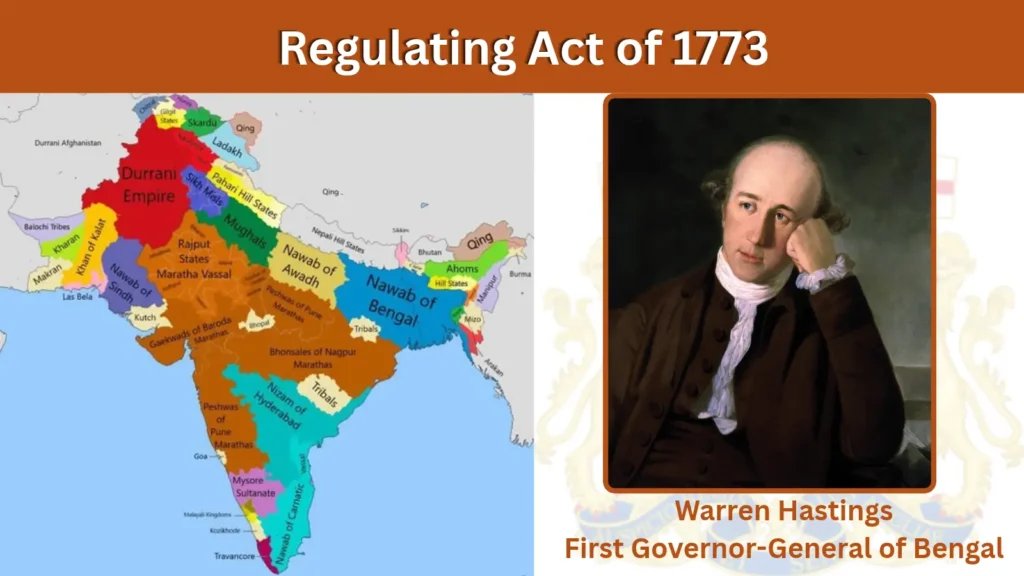
Warren Hastings, who was serving as Governor of Bengal, became the first Governor-General of Bengal under the Act. His appointment marked a significant stage in the development of the central administrative structure of British India.
The Governor-General was assisted by a council consisting of four members. The council was responsible for advising and participating in executive decisions. However, the Governor-General did not possess an unrestricted power to overrule the council. Decisions were generally determined by majority vote, and the Governor-General was bound by the council’s majority in ordinary matters. This arrangement later became a source of administrative conflict.
2. Establishment of the Governor-General’s Council
The Act established a four-member council to assist the Governor-General in administering Bengal. The council introduced a more formal system of executive decision-making, but it also created the possibility of disagreement between the Governor-General and other council members.
Warren Hastings frequently encountered opposition from members of his council, particularly Philip Francis. Since decisions could be taken by a majority against the Governor-General’s position, the arrangement sometimes weakened executive coordination. The Act did not provide a clear and effective mechanism for resolving persistent disagreements within the council.
The experience demonstrated that establishing a central executive authority was not sufficient by itself. Effective administration also required a clear distribution of powers and a workable method of decision-making.
3. Subordination of the Presidencies of Bombay and Madras
The Regulating Act of 1773 attempted to strengthen administrative coordination among the Company’s principal presidencies. The Presidencies of Bombay and Madras were made subordinate to Bengal in matters relating to war and peace with Indian states, subject to specified exceptions and the provisions of the Act.
Before this reform, the presidencies enjoyed considerable independence in their dealings with neighbouring rulers and regional powers. Their separate policies could create difficulties for the Company as a whole, especially when military operations or diplomatic decisions affected its wider interests.
The new arrangement was intended to reduce conflicting policies and strengthen central supervision. Nevertheless, it did not establish complete administrative uniformity throughout British-controlled territories. The extent of central control remained limited, and further legislation was required to develop a more coherent system of government.
4. Establishment of the Supreme Court at Calcutta
The Act provided for the establishment of a Supreme Court of Judicature at Fort William in Calcutta. The Court was subsequently established in 1774 through a royal charter.
The Supreme Court consisted of a Chief Justice and three other judges appointed by the British Crown. Sir Elijah Impey became its first Chief Justice. The Court exercised civil, criminal, admiralty and ecclesiastical jurisdiction within the limits prescribed by its governing arrangements.
Its establishment was a major development in the history of judicial administration under British rule. It introduced a superior royal court in Calcutta and provided a formal judicial institution distinct from the Company’s ordinary administrative machinery.
However, the precise extent of the Court’s jurisdiction created serious disputes. Questions arose regarding its authority over Indian inhabitants, Company officials and revenue administration. The relationship between the Supreme Court and the Governor-General’s Council was not adequately defined. These uncertainties contributed to conflicts between judicial and executive authorities and eventually encouraged Parliament to pass the Act of Settlement, also known as the Amending Act of 1781.
5. Restrictions on Company Officials
The Act sought to address corruption and conflicts of interest among the Company’s officials. It imposed restrictions on the acceptance of presents and related private benefits by the Governor-General, council members and Company servants. It also sought to restrict private trading activities by officials covered by its provisions.
These measures reflected the growing concern that public authority was being used for personal enrichment. Company officials had access to revenue collection, commercial privileges and political influence, creating opportunities for bribery and the exploitation of local populations.
The restrictions were intended to promote greater accountability and separate official duties from private financial interests. However, the effectiveness of these measures depended on enforcement, and corruption did not disappear merely because legal restrictions had been introduced.
6. Parliamentary Supervision of the East India Company
The Regulating Act strengthened the British Parliament’s involvement in the affairs of the East India Company. It required the Company to provide information concerning its civil, military and revenue administration to the British government.
The Act also affected the Company’s governing arrangements in Britain, including the terms associated with the election and tenure of its Court of Directors. These measures were intended to improve oversight and make the Company’s administration more accountable to public authorities.
Nevertheless, the Act did not transfer the entire administration of India directly to the British Crown. The East India Company continued to govern its territories, while Parliament began exercising a more active supervisory role. Direct Crown rule was introduced much later, under the Government of India Act of 1858, following the Revolt of 1857.
Why the Act is known as Regulating Act?
The Regulating Act of 1773 is known as “regulating” because it was the first direct step by the British Parliament to control, supervise, and regulate the affairs of the British East India Company in India.
Significance of the Regulating Act of 1773
The Regulating Act of 1773 was significant because it marked the beginning of systematic parliamentary regulation of the East India Company’s political and administrative activities. It recognised that a commercial corporation exercising territorial sovereignty could not be left entirely to its own internal arrangements.
The creation of the Governor-General of Bengal and the provision for a council represented an important step towards centralised administration. The subordination of Bombay and Madras in specified matters laid the groundwork for stronger coordination among the Company’s presidencies. The establishment of the Supreme Court at Calcutta introduced a new dimension to judicial administration and raised important questions about the relationship between executive and judicial authority.
The Act also established a precedent for subsequent parliamentary legislation concerning India. Its limitations became apparent in practice, prompting further reforms through the Act of Settlement of 1781 and Pitt’s India Act of 1784. The later legislation refined judicial jurisdiction and strengthened the British government’s control over the Company’s political affairs.
Its historical importance therefore lies not in the creation of a complete constitutional system, but in the beginning of a long process through which British parliamentary authority over India expanded.
Limitations and Defects of the Regulating Act of 1773
Despite its importance, the Act suffered from several structural weaknesses. The first was the absence of a clear and effective relationship between the Governor-General and his council. Since the Governor-General could be outvoted, disagreements could obstruct executive decision-making. Warren Hastings’ experience demonstrated the practical difficulties created by this arrangement.
The second major weakness was the unclear division of authority between the Supreme Court and the Company’s administration. The jurisdiction of the Court was not sufficiently defined in relation to revenue collection, provincial administration and Indian inhabitants. This uncertainty produced disputes that affected the functioning of the government.
Third, the Act did not establish a fully integrated administrative structure for all the Company’s territories. Although Bombay and Madras were subordinated to Bengal in specified matters of war and peace, they retained administrative functions of their own. The resulting system remained imperfectly centralised.
Fourth, the Act did not eliminate corruption or ensure effective accountability. Legal restrictions on presents and private trading activities could not by themselves overcome entrenched practices or weaknesses in enforcement.
Fifth, the Act did not create representative institutions for Indians. The population of the Company’s territories had no meaningful role in the legislative or executive arrangements established by the Act. Its primary concern was the regulation of British corporate power rather than the development of democratic government.
Finally, parliamentary supervision remained limited in practical terms. The Company continued to exercise substantial authority, and the relationship between commercial management and political administration remained unresolved. The need for further legislation was therefore evident.
Difference Between the Regulating Act of 1773 and the Act of Settlement of 1781
The Act of Settlement of 1781, commonly known as the Amending Act of 1781, was passed to address important difficulties arising from the operation of the Regulating Act of 1773, particularly conflicts concerning the jurisdiction of the Supreme Court.
The Regulating Act created the office of Governor-General of Bengal, established a four-member council and provided for a Supreme Court at Calcutta. However, the Court’s jurisdiction and its relationship with the Company’s executive and revenue administration were not adequately clarified.
The Act of Settlement of 1781 sought to resolve these difficulties by clarifying the jurisdiction of the Supreme Court and protecting specified aspects of the Company’s revenue administration from interference by the Court. It also provided greater clarity regarding the application of laws and customs to Indian inhabitants in relevant judicial matters.
The two Acts must therefore be understood as connected stages in constitutional development. The Regulating Act introduced major institutional changes, while the Act of Settlement attempted to correct some of the practical and legal problems that followed.
Difference Between the Regulating Act of 1773 and Pitt’s India Act of 1784
The Regulating Act of 1773 initiated parliamentary regulation of the East India Company and established a more centralised executive arrangement in Bengal. Its provisions were important but incomplete, particularly in relation to executive coordination, judicial jurisdiction and the extent of parliamentary control.
Pitt’s India Act of 1784 introduced a more developed system of control by distinguishing the Company’s commercial functions from its political and administrative responsibilities. It established a Board of Control through which the British government exercised greater supervision over the Company’s civil, military and revenue affairs. The Company’s Court of Directors continued to manage its commercial affairs, while political oversight was strengthened through the new arrangement.
The distinction between the two Acts reflects the gradual evolution of British control in India. The legislation of 1773 began the process of parliamentary intervention, the Act of Settlement of 1781 addressed important judicial problems, and Pitt’s India Act of 1784 strengthened the British government’s control over the Company’s political administration.
Chronology of Related British Acts
| Act | Major Significance |
|---|---|
| Regulating Act of 1773 | Introduced parliamentary regulation of the East India Company’s administration and established the office of Governor-General of Bengal. |
| Act of Settlement / Amending Act of 1781 | Clarified the jurisdiction of the Supreme Court at Calcutta and its relationship with the executive administration. |
| Pitt’s India Act 1784 | Established a system of dual control involving the Company and the British government. |
| Act of 1786 | Granted special powers to the Governor-General, including arrangements associated with Lord Cornwallis. |
| Charter Act of 1793 | Renewed the Company’s charter and continued its administrative and commercial privileges. |
| Charter Act of 1813 | Ended the Company’s trade monopoly in India, subject to important exceptions, and provided for educational expenditure. |
| Charter Act of 1833 | Centralised legislative authority and designated the Governor-General of Bengal as the Governor-General of India. |
| Charter Act of 1853 | Introduced changes to the legislative functions of the Governor-General’s Council and provided for open competition in civil-service recruitment. |
| Government of India Act of 1858 | Ended East India Company rule and transferred the government of India to the British Crown. |
| Indian Councils Act of 1861 | Restored legislative powers to the Bombay and Madras Presidencies under specified conditions and expanded legislative councils. |
| Indian High Courts Act of 1861 | Provided for the establishment of High Courts, replacing the existing Supreme Courts and Sadar Adalats in the relevant presidencies. |
| Indian Councils Act of 1892 | Expanded legislative councils and introduced indirect electoral elements into the selection of some members. |
| Indian Councils Act of 1909 (Morley–Minto Reforms) | Expanded legislative councils and introduced separate electorates for Muslims. |
| Government of India Act of 1912 | Provided for territorial and administrative changes associated with the reorganisation of Bengal and the creation of Bihar and Orissa as a separate province. |
| Government of India Act of 1915 | Consolidated and amended laws relating to the government of India. |
| Government of India Act of 1919 (Montagu–Chelmsford Reforms) | Introduced dyarchy in the provinces and established a bicameral legislature at the centre. |
| Government of India Act of 1935 | Introduced provincial autonomy, provided for a proposed all-India federation and divided legislative subjects into three lists. |
| Indian Independence Act of 1947 | Provided for the establishment of the independent Dominions of India and Pakistan and the end of British authority under the Act’s constitutional arrangements. |
Conclusion
The Regulating Act of 1773 was a landmark in the constitutional history of British India because it marked the first major parliamentary attempt to regulate the East India Company’s territorial administration. It created the office of Governor-General of Bengal, established a council for executive decision-making, strengthened coordination among presidencies in specified matters and provided for the establishment of a Supreme Court at Calcutta. At the same time, unclear jurisdictional boundaries, conflicts within the executive council and inadequate enforcement limited its effectiveness.
The Act did not establish direct Crown rule or representative government, but it laid the foundation for subsequent constitutional reforms. Its shortcomings led to the Act of Settlement of 1781 and Pitt’s India Act of 1784, beginning a prolonged process of institutional change that eventually culminated in the transfer of power and the Indian Independence Act of 1947.
Also see: The Regulating Act of 1773 by Britannica
Multiple-Choice Questions (MCQs)
1. The Regulating Act of 1773 was primarily intended to:
(a) Transfer the administration of India directly to the British Crown
(b) Introduce elected Indian representatives into the central legislature
(c) Regulate the affairs of the East India Company and strengthen parliamentary supervision
(d) End the East India Company’s commercial activities
Answer: (c). The Act introduced parliamentary regulation of the Company’s affairs but did not transfer the administration of India directly to the Crown.
2. Who became the first Governor-General of Bengal under the Regulating Act of 1773?
(a) Lord Cornwallis
(b) Warren Hastings
(c) Lord Wellesley
(d) Robert Clive
Answer: (b). Warren Hastings became the first Governor-General of Bengal under the Act.
3. The Supreme Court at Calcutta was established in:
(a) 1757
(b) 1765
(c) 1774
(d) 1784
Answer: (c). The Regulating Act of 1773 provided for the Court, which was established in 1774 under a royal charter.
4. Who was the first Chief Justice of the Supreme Court at Calcutta?
(a) Sir Elijah Impey
(b) Philip Francis
(c) Warren Hastings
(d) Lord Cornwallis
Answer: (a). Sir Elijah Impey was appointed the first Chief Justice of the Supreme Court at Calcutta.
5. How many members were appointed to the Governor-General’s Council under the Regulating Act of 1773?
(a) Two
(b) Three
(c) Four
(d) Six
Answer: (c). The Governor-General was assisted by a council consisting of four members.
6. Which of the following statements about the Regulating Act of 1773 is correct?
(a) It made the Governor-General of Bengal completely independent of his council.
(b) It created the office of Governor-General of India.
(c) It provided for the establishment of a Supreme Court at Calcutta.
(d) It transferred all Company territories directly to the Crown.
Answer: (c). The Act provided for a Supreme Court at Calcutta. The title Governor-General of India was introduced by the Charter Act of 1833.
7. The Act of Settlement of 1781 was primarily associated with:
(a) The introduction of provincial dyarchy
(b) Clarification of the Supreme Court’s jurisdiction
(c) The abolition of the East India Company
(d) The introduction of separate electorates
Answer: (b). The Act of Settlement of 1781 addressed jurisdictional conflicts arising from the operation of the Regulating Act of 1773.
8. Under the Regulating Act of 1773, the Presidencies of Bombay and Madras were made subordinate to Bengal in specified matters relating to:
(a) Religious administration
(b) Education and public health
(c) War and peace with Indian states
(d) Local taxation in every circumstance
Answer: (c). The Act sought to strengthen central supervision over war and peace, subject to the relevant statutory provisions and exceptions.
9. Which Act established the Board of Control to strengthen British government supervision over the Company’s political affairs?
(a) Regulating Act of 1773
(b) Act of Settlement of 1781
(c) Pitt’s India Act of 1784
(d) Charter Act of 1813
Answer: (c). Pitt’s India Act of 1784 established the Board of Control.
10. Which of the following was NOT a feature of the Regulating Act of 1773?
(a) Creation of the office of Governor-General of Bengal
(b) Provision for the establishment of a Supreme Court at Calcutta
(c) Introduction of elected Indian representatives into the central legislature
(d) Greater parliamentary supervision of Company affairs
Answer: (c). The Act did not introduce elected Indian representatives into the central legislature.
Previous-Year Questions (PYQs)
1. UPSC Civil Services Preliminary Examination, 2005 — Related question
Consider the following statements:
- Warren Hastings was the first Governor-General who established a regular police force in India on the British pattern.
- A Supreme Court was established at Calcutta by the Regulating Act of 1773.
- The Indian Penal Code came into effect in the year 1860.
Which of the statements given above are correct?
(a) 1 and 2 only
(b) 2 and 3 only
(c) 1 and 3 only
(d) 1, 2 and 3
Answer: (b) 2 and 3 only.
The Supreme Court at Calcutta was established in 1774 under a royal charter issued pursuant to the Regulating Act of 1773. The Indian Penal Code was enacted in 1860 and came into operation in 1862. The first statement is incorrect.
2. Madhya Pradesh Public Service Commission (MPPSC) Preliminary Examination, 2015 — Related question
In which year was the Regulating Act passed?
(a) 1753
(b) 1757
(c) 1764
(d) 1773
Answer: (d) 1773.
3. Uttar Pradesh Provincial Civil Services (UPPCS) Mains Examination, 2013 — Related question
Which Act first made provision for the office of Governor-General of Bengal?
(a) Regulating Act of 1773
(b) Pitt’s India Act of 1784
(c) Charter Act of 1813
(d) Charter Act of 1833
Answer: (a) Regulating Act of 1773.
Descriptive Questions for Practice
Short-answer questions
- What was the historical background of the Regulating Act of 1773?
- Why did the British Parliament consider it necessary to regulate the East India Company?
- Who was the first Governor-General of Bengal?
- Explain the significance of the Supreme Court at Calcutta.
- Why was the Act of Settlement of 1781 passed?
Long-answer and analytical questions
- Examine the major provisions of the Regulating Act of 1773 and assess its significance in the constitutional development of British India.
- Discuss the circumstances that led to the passage of the Regulating Act of 1773. To what extent did it address the administrative and financial problems of the East India Company?
- Critically examine the limitations of the Regulating Act of 1773, with particular reference to conflicts between the Governor-General’s Council and the Supreme Court at Calcutta.
- Compare the Regulating Act of 1773 with the Act of Settlement of 1781. How did the latter attempt to correct the defects of the former?
- Explain how the Regulating Act of 1773 marked the beginning of parliamentary control over the East India Company’s administration in India.
- “The Regulating Act of 1773 was a significant beginning, but an incomplete constitutional reform.” Discuss.