CSEguide.com
  • Home
  • UPSC
    • UPSC Civil Services
    • UPSC Prelims 2025 Exam Date
    • Exam Statistics
    • Eligibility Criteria
    • Syllabus
    • Books
    • Previous Year Questions
    • Websites for Preparation
    • Toppers Story
  • Study Material
    • Ancient Indian History
    • Medieval Indian History
    • Modern Indian History
    • Indian National Movement
    • Indian Polity
    • Indian Geography
    • Indian Economy
    • General Science
    • General Knowledge
  • Papers
    • UPSC Previous Year Question Papers
    • UPSC Essay Paper – 2007-2024
    • UPSC CSE 2025 Prelims GS1
    • UPSC CSE 2024 Prelims GS 1
    • Previous Years Question (PYQs)
    • Multiple Choice Questions (MCQs)
    • Practice MCQs
    • Model Test Paper
  • Current News
    • National News
    • General Knowledge
    • Articles
  • UP PSC
    • UP PSC Civil Services
    • UP PCS 2022 – Prelims – General Studies I
  • Exam Alert
  • Join us
No Result
View All Result
CSEguide.com
  • Home
  • UPSC
    • UPSC Civil Services
    • UPSC Prelims 2025 Exam Date
    • Exam Statistics
    • Eligibility Criteria
    • Syllabus
    • Books
    • Previous Year Questions
    • Websites for Preparation
    • Toppers Story
  • Study Material
    • Ancient Indian History
    • Medieval Indian History
    • Modern Indian History
    • Indian National Movement
    • Indian Polity
    • Indian Geography
    • Indian Economy
    • General Science
    • General Knowledge
  • Papers
    • UPSC Previous Year Question Papers
    • UPSC Essay Paper – 2007-2024
    • UPSC CSE 2025 Prelims GS1
    • UPSC CSE 2024 Prelims GS 1
    • Previous Years Question (PYQs)
    • Multiple Choice Questions (MCQs)
    • Practice MCQs
    • Model Test Paper
  • Current News
    • National News
    • General Knowledge
    • Articles
  • UP PSC
    • UP PSC Civil Services
    • UP PCS 2022 – Prelims – General Studies I
  • Exam Alert
  • Join us
No Result
View All Result
CSEguide.com
No Result
View All Result
Home Indian National Movement

The Role of Women in the Quit India Movement of 1942: A Historical and Gendered Perspective

Editor by Editor
July 18, 2025
in Indian National Movement
0
Women in the Quit India Movement of 1942

The Quit India Movement, launched by Mahatma Gandhi on 8 August 1942, marked a turning point in India’s freedom struggle. While much scholarly focus has traditionally centered on male leaders and political strategies, the role of Indian women in this mass civil disobedience movement is equally significant. Women from diverse regions, classes, and communities stepped into public life, displaying leadership, courage, and political consciousness. Their contribution not only strengthened the movement but also challenged patriarchal norms, laying a strong foundation for post-independence gender equality movements.

Table of Contents

  • 1 1. Contextualizing Women’s Role in the Indian Freedom Struggle
  • 2 2. Women Leaders and Iconic Contributors
        • 2.0.0.1 Aruna Asaf Ali
        • 2.0.0.2 Usha Mehta
        • 2.0.0.3 Sarojini Naidu
        • 2.0.0.4 Sucheta Kripalani & Mridula Sarabhai
        • 2.0.0.5 Kamaladevi Chattopadhyay
  • 3 3. Grassroots Participation and Everyday Resistance
  • 4 4. Intersectionality: Caste, Class, and Regional Diversity
  • 5 5. Repression and Sacrifice
  • 6 6. Legacy and Historical Significance
  • 7 Conclusion

1. Contextualizing Women’s Role in the Indian Freedom Struggle

Before 1942, women had already played a role in earlier phases of the national movement—especially during the Non-Cooperation Movement and Civil Disobedience Movement. However, the Quit India Movement saw a more militant and widespread participation of women. With the immediate arrest of the Congress leadership, women spontaneously assumed leadership roles and helped sustain the movement from the grassroots.

2. Women Leaders and Iconic Contributors

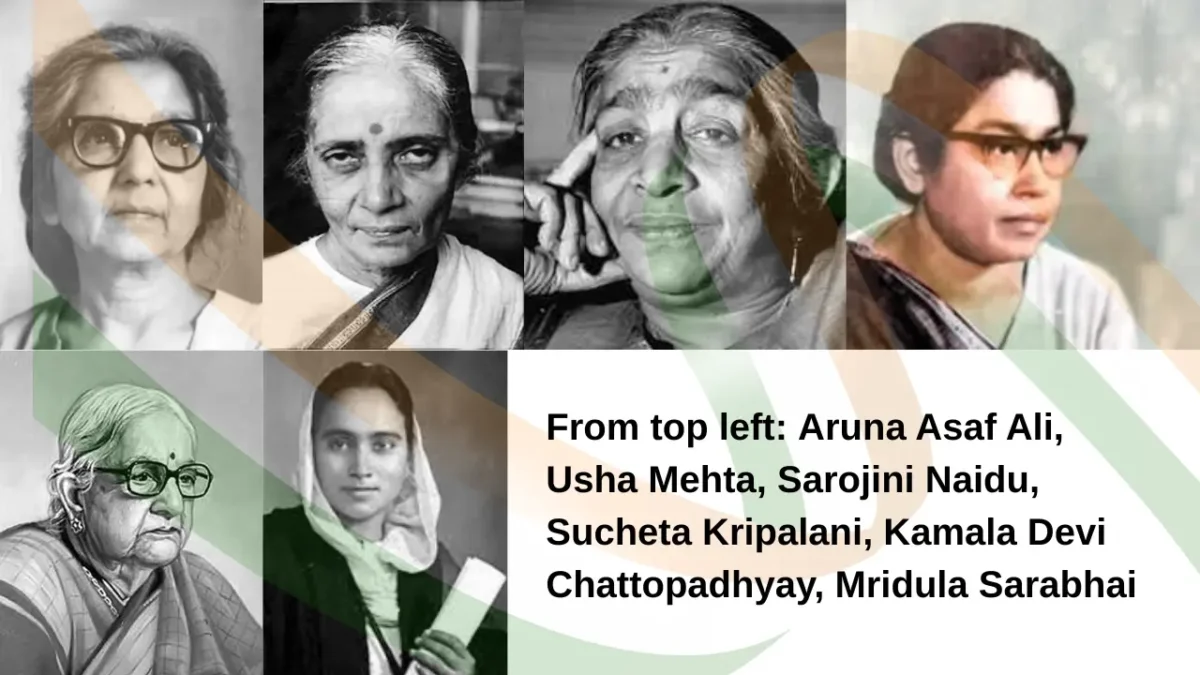
Aruna Asaf Ali

Known as the “Heroine of 1942“, she hoisted the national flag at the Gowalia Tank Maidan in Bombay in defiance of British orders. Her symbolic act of defiance made her a national icon.

Usha Mehta

A student activist, she set up the secret Congress Radio to broadcast uncensored news and Gandhiji’s messages, playing a crucial role in keeping the public informed.

Sarojini Naidu

Despite ill health, Naidu continued to inspire and mobilize women across India, urging them to join the movement and resist colonial rule.

Sucheta Kripalani & Mridula Sarabhai

They played active roles in organizing underground resistance, coordinating volunteers, and sustaining communication with imprisoned leaders.

Kamaladevi Chattopadhyay

A noted social reformer, she encouraged women to join nationalist politics, breaking traditional gender barriers in the process.

3. Grassroots Participation and Everyday Resistance

Women across India—especially from rural regions—engaged in protests, sabotage, and mobilization:

  • Organizing prabhat pheris (morning marches)
  • Boycotting foreign goods and picketing liquor shops
  • Spreading nationalist literature and messages
  • Assisting in sabotage of British communication networks

In regions like Midnapore and Ballia, women contributed to forming parallel governments when British authority collapsed temporarily.

4. Intersectionality: Caste, Class, and Regional Diversity

The movement saw participation across social divides:

  • Peasant women from Bihar, Bengal, and Maharashtra joined in sabotage and protests.
  • Dalit and tribal women engaged through local networks despite systemic marginalization.
  • Muslim women took part in marches in Delhi, Bombay, and Lucknow, contributing to the secular nature of the movement.

This mass involvement highlights the inclusive nature of the movement and its capacity to unite across social divisions.

5. Repression and Sacrifice

The British crackdown on female activists was ruthless:

  • Many were lathi-charged and imprisoned without trial
  • Women faced physical abuse and public humiliation
  • Some women were martyred or died in custody

Yet their resolve remained unshaken, turning them into symbols of moral resistance.

6. Legacy and Historical Significance

The Quit India Movement redefined Indian womanhood by elevating women from domestic spaces to the center of nationalist resistance. It:

  • Empowered women politically and socially
  • Inspired future leaders and reformers
  • Contributed to women’s representation in the Constituent Assembly

As historian Geraldine Forbes noted, the movement became a “watershed in the political socialization of Indian women.”

Conclusion

The Quit India Movement of 1942 was not only a fight against colonialism but also a significant milestone in India’s gender history. Women were not mere supporters; they were leaders, strategists, and symbols of resistance. Their contributions remain a powerful testimony to the transformative power of grassroots activism and collective courage.
Previous Post

20 MCQs on Caste Census in India

Next Post

The Mandal Commission in India: Origins, Recommendations, and Impact

Next Post
Mandal Commission in India

The Mandal Commission in India: Origins, Recommendations, and Impact

Recent Posts

  • What is Sanchar Saathi App — Uses, Features and the Ongoing Controversy December 3, 2025
  • Know About Gangaikonda Cholapuram: The Imperial Capital of the Cholas July 27, 2025
  • Rajendra Chola I (1014-1044) – The Conqueror of the Ganges and Ocean July 27, 2025
  • Rajaraja Chola I (985-1014) – Architect of Chola Supremacy July 27, 2025
  • Rajadhiraja Chola I (1044-1054) – Warrior King of the Chola Dynasty July 27, 2025
  • Ram Nath Thakur: A Socialist Stalwart and Parliamentarian from Bihar July 24, 2025
  • Karpoori Thakur: The Champion of the Marginalised and Socialist Icon of Bihar July 24, 2025

Categories

  • Ancient Indian History (15)
  • Articles (4)
  • Books (12)
  • Environment (1)
  • Essay (1)
  • Exam Alert (5)
  • General Knowledge (10)
  • General Science (7)
  • Human Geography (1)
  • Indian Economy (17)
  • Indian Geography (19)
  • Indian National Movement (53)
  • Indian Polity (26)
  • Medieval Indian History (16)
  • Model Test Paper (6)
  • Modern Indian History (17)
  • Multiple Choice Questions (MCQs) (5)
  • National News (32)
  • Physical Geography (6)
  • Previous Years Questions (PYQs) (6)
  • Science & Technology (6)
  • Social Welfare (5)
  • Toppers Story (20)
  • UP PCS 2022 – Prelims – General Studies I (4)
  • UP PSC Civil Services (5)
  • UPSC Civil Services (6)
  • UPSC CSE 2024 Prelims GS 1 (4)
  • UPSC CSE 2025 Prelims GS1 (18)

About Us

CSEguide.com is an online platform dedicated to helping Civil Services Exam (CSE) aspirants by providing study materials, preparation strategies, and guidance. It offers resources such as subject-wise notes, current affairs updates, and tips for cracking the UPSC exam. The website aims to simplify exam preparation with structured content and expert insights.

Quick Links

Join us

Contact us

Privacy Policy

Sitemap (HTML)

Sitemap (XML)


  • Home
  • Contact us

© 2025 JNews - Premium WordPress news & magazine theme by Jegtheme.

No Result
View All Result
  • Home
  • UPSC
    • UPSC Civil Services
    • UPSC Prelims 2025 Exam Date
    • Exam Statistics
    • Eligibility Criteria
    • Syllabus
    • Books
    • Previous Year Questions
    • Websites for Preparation
    • Toppers Story
  • Study Material
    • Ancient Indian History
    • Medieval Indian History
    • Modern Indian History
    • Indian National Movement
    • Indian Polity
    • Indian Geography
    • Indian Economy
    • General Science
    • General Knowledge
  • Papers
    • UPSC Previous Year Question Papers
    • UPSC Essay Paper – 2007-2024
    • UPSC CSE 2025 Prelims GS1
    • UPSC CSE 2024 Prelims GS 1
    • Previous Years Question (PYQs)
    • Multiple Choice Questions (MCQs)
    • Practice MCQs
    • Model Test Paper
  • Current News
    • National News
    • General Knowledge
    • Articles
  • UP PSC
    • UP PSC Civil Services
    • UP PCS 2022 – Prelims – General Studies I
  • Exam Alert
  • Join us

© 2025 JNews - Premium WordPress news & magazine theme by Jegtheme.