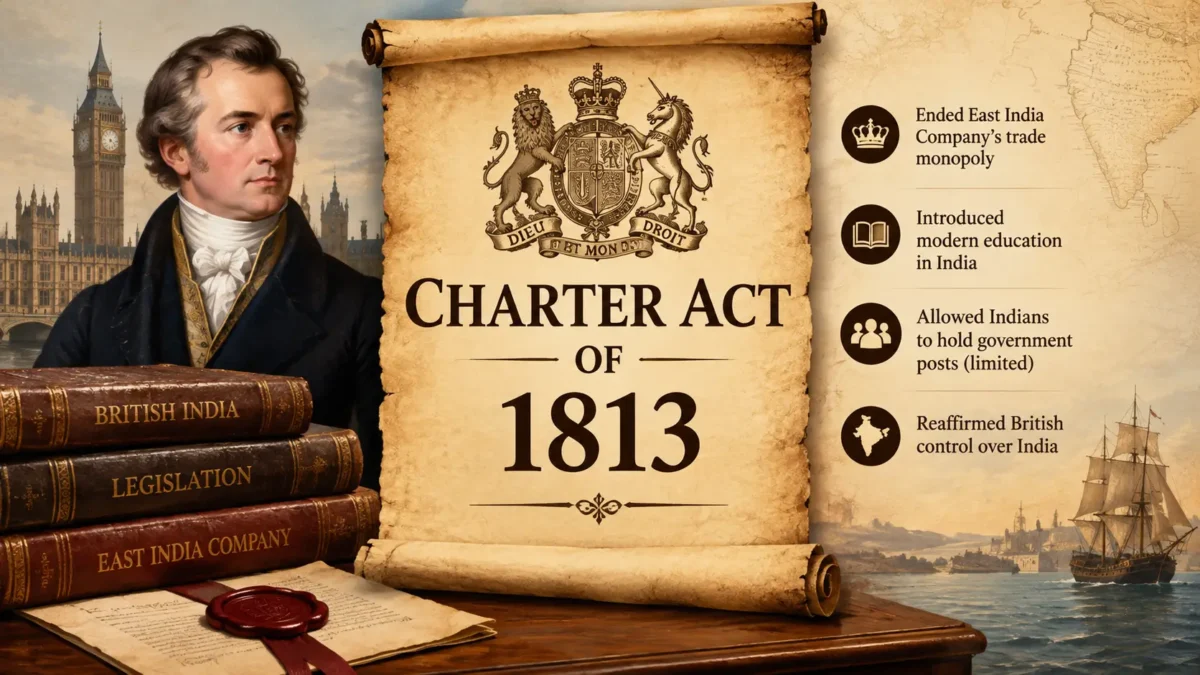
The Charter Act 1813 or the Charter Act of 1813 was an important British parliamentary legislation that renewed the East India Company’s authority to administer its territories in India while introducing significant changes to its commercial privileges. The Act ended the Company’s monopoly over trade with India, except for the tea trade and trade with China. It also asserted the sovereignty of the British Crown over the Company’s Indian territories, permitted Christian missionary activity under the prescribed legal framework and provided for an annual allocation of at least one lakh rupees for the promotion of education, literature and scientific knowledge.
The Act marked a significant stage in the evolution of British colonial administration. It did not transfer the Company’s territories directly to the Crown, nor did it end the Company’s political authority in India. Instead, it continued Company rule within a framework of increasing parliamentary supervision and altered the relationship between the Company, British merchants and Indian society.
Historical Background of the Charter Act 1813
The East India Company began as a trading organisation but gradually acquired political and territorial power in India. The Battle of Plassey in 1757 and the Battle of Buxar in 1764 strengthened its position in Bengal. In 1765, the Company received the Diwani rights, which gave it authority to collect revenue in Bengal, Bihar and Orissa. The Company consequently became responsible not only for trade but also for revenue collection, administration and territorial expansion.
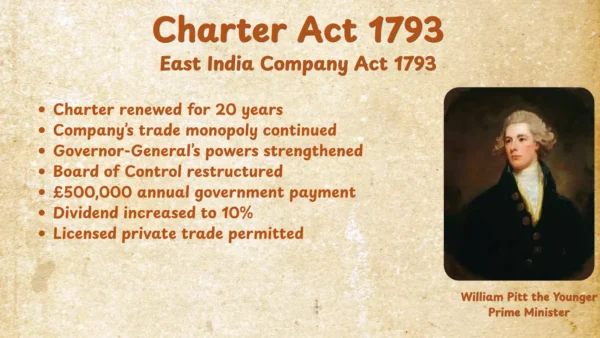
The growing political role of the Company led the British Parliament to introduce measures regulating its activities. The Regulating Act of 1773 was an early attempt to supervise Company administration. The Act of Settlement of 1781 clarified aspects of the relationship between the Company’s administration and the Supreme Court at Calcutta. Pitt’s India Act of 1784 established the Board of Control and strengthened British governmental supervision. The Charter Act of 1793 subsequently renewed the Company’s charter and continued its trade privileges for another twenty years.
By the early nineteenth century, British merchants outside the Company increasingly demanded access to Indian markets. Industrial and commercial interests in Britain opposed the Company’s exclusive trading privileges. At the same time, religious groups and educational reformers pressed for greater freedom for missionary activity and more attention to education in India.
These commercial, political and religious debates influenced the parliamentary discussions preceding the Charter Act 1813. The resulting legislation renewed the Company’s charter but introduced changes that weakened its exclusive commercial position and expanded the scope of British intervention in Indian affairs.
Important Facts about the Charter Act 1813
| Particular | Details |
|---|---|
| Common name | Charter Act 1813 / Charter Act of 1813 |
| Official statutory name | East India Company Act 1813 |
| Royal assent | 22 July 1813 |
| British monarch | King George III (ruled from 1760 to 1820) |
| British Prime Minister | Lord Liverpool (served from 1812 to 1827) |
| Governor-General of Bengal | Lord Minto I (July 1807 – October 1813) |
| Term of renewed charter | Twenty years |
| Trade monopoly | Ended for trade with India, except for tea and trade with China |
| Annual education allocation | At least one lakh rupees, subject to the statutory provision concerning surplus revenues |
| Missionary activity | Permitted under the prescribed legal framework |
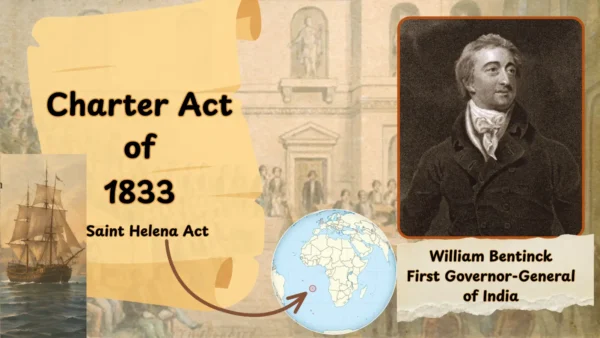
| Next major legislation | Charter Act of 1833 |
| Repealed by | The Government of India Act 1915 |
Main Provisions of the Charter Act 1813
1. Renewal of the Company’s Charter and Territorial Possessions
- Renewal of the Company’s charter: The East India Company’s charter and administration of British territories in India were continued for a further term of 20 years, beginning on 10 April 1814.
- Continuation of territorial possessions: The Company’s existing territorial acquisitions in India and specified other Asian territories continued under its possession and government, along with their revenues.
- British Crown’s sovereignty: The Act expressly preserved the sovereignty of the British Crown over the territories administered by the Company. The Company continued to govern these territories subject to the powers and controls established by Parliament.
- Continuation of parliamentary control: The Company’s civil and military administration and management of territorial revenues remained subject to the supervision, direction and control prescribed by parliamentary legislation.
- Power to terminate the grant: The Act provided a mechanism for ending the Company’s renewed term and specified exclusive privileges through three years’ notice after 10 April 1831, subject to the statutory conditions, including the settlement of specified amounts due to the Company.
2. Trade and Commercial Provisions
- End of the Company’s general trade monopoly in India: From 10 April 1814, British subjects were permitted to trade with India in common with the East India Company, subject to the regulations and restrictions prescribed by the Act.
- Continuation of the China trade monopoly: The Company retained its exclusive trading privileges in the dominions of the Emperor of China for the renewed term.
- Continuation of the tea trade monopoly: The Company retained its exclusive right to trade in tea. Other British traders could not independently conduct the protected tea trade unless authorised under the applicable provisions.
- Licensing of private traders: Private traders were permitted to engage in trade under the Act, but their activities remained subject to licensing requirements, geographical restrictions and other prescribed conditions.
- Regulation of shipping: Private ships engaged in trade were required to comply with rules relating to navigation, manifests, customs clearance and the ports to which they could travel.
- Restrictions on military stores: The Act restricted the export of military stores to specified Asian territories and Company-controlled areas without the required authorisation.
- Regulation of trade destinations: Private traders required special licences for certain destinations within the Company’s charter limits. The Act assigned licensing responsibilities to the Company and the Board of Control according to the relevant circumstances.
- Penalties for unauthorised trade: The Act provided for penalties and forfeitures in cases of unlawful trading, breach of licensing conditions and related violations.
3. Education and Promotion of Learning
- Annual allocation of one lakh rupees: The Act directed that a sum of not less than one lakh rupees be set aside annually from the surplus territorial revenues, after meeting the specified expenses and interest on debt.
- Promotion of Indian literature: The allocated funds were intended for the revival and improvement of literature and the encouragement of learned Indians.
- Promotion of scientific knowledge: The Act also provided for the introduction and promotion of knowledge of the sciences among the inhabitants of British territories in India.
- Schools and public lectures: The Governor-General in Council could establish or regulate schools, public lectures and other institutions for the purposes specified in the Act.
- Government control over institutions: Such institutions were subject to regulations made by the relevant government, while appointments and certain institutional matters remained subject to the statutory powers of the Board of Control.
4. Christian Missionaries and Religious Establishment
- Permission for religious activity: The Act facilitated the entry and residence of persons, including Christian missionaries, for lawful purposes under the applicable authorisation and licensing arrangements. It is widely regarded as an important step towards permitting organised missionary activity in British India.
- Establishment of a Bishop in India: The Act provided for the establishment of a Bishop in India through royal letters patent, along with three Archdeacons for the principal Presidencies.
- Ecclesiastical administration: The Act made provisions relating to the functions, jurisdiction and salaries of the Bishop and Archdeacons, subject to the conditions established by law and the relevant letters patent.
- Maintenance of the church establishment: The Act provided for the support of the established Church in British territories in India through specified arrangements and expenses.
- Limits on episcopal jurisdiction: The Bishop’s jurisdiction and functions were subject to the limits prescribed by the relevant letters patent and statutory provisions.
5. Board of Control and Government Supervision
- Continuation of the Board of Control: The Board of Control continued to supervise the Company’s political, territorial and administrative affairs under the existing parliamentary framework.
- Control over territorial administration: The Board’s authority extended to matters relating to the civil and military government of the Company’s territories and their revenues.
- Control over specified licences: The Board exercised powers concerning licences for certain traders and destinations, including the ability to direct the issue of licences in circumstances specified by the Act.
- Supervision of educational institutions: The Board had statutory powers over specified colleges and seminaries, including the approval of rules and certain appointments.
- Continuation of existing statutory controls: Earlier parliamentary provisions concerning the supervision of the Company’s affairs continued insofar as they were not repealed or inconsistent with the 1813 Act.
6. Financial Provisions and Company Accounts
- Separation of commercial and territorial accounts: The Company was required to maintain distinct accounts for its territorial, political and commercial affairs. This helped distinguish the finances of territorial administration from the Company’s trading business.
- Separate presentation of financial statements: The Company’s accounts and financial statements were to be prepared and arranged so that the receipts, expenditure, debts and assets of the relevant branches of its affairs could be identified separately.
- Application of territorial revenues: Territorial revenues were subject to statutory rules governing the payment of administrative expenses, interest on debt and other specified obligations before the application of any surplus.
- Shareholders’ dividends: The Act continued and regulated arrangements for dividends on the Company’s capital stock. The applicable statutory provisions distinguished dividends paid from the Company’s separate fund and those payable from commercial profits.
- Use of surplus revenues: The Act prescribed how surplus territorial revenues and commercial profits were to be applied towards specified financial obligations, debt reduction and other statutory purposes.
- Financial reporting and parliamentary oversight: The Company’s accounts and financial information remained subject to the reporting and oversight arrangements laid down by Parliament.
7. Civil Service and Military Training
- Continuation of the civil-service college: The Act provided for the continuation of the Company’s college in England for the education of young men intended for its civil service in India.
- Continuation of military training: It also provided for the continuation of the military seminary established to train young men intended for military service in India.
- Rules for educational institutions: The Company’s Court of Directors was required to frame rules for these institutions, subject to review and approval by the Board of Control.
- Training requirement for civil-service entrants: A person appointed as a writer to the Presidencies was required to satisfy the prescribed college attendance and certification requirements.
- Control over senior institutional appointments: Certain appointments and offices at the college and military seminary required the approval prescribed by the Act.
8. Taxation and Local Government Powers
- Power to impose taxes: The Act authorised the Governor-General in Council and the respective Presidency governments to impose duties and taxes within their jurisdictions, subject to the statutory restrictions.
- Taxation in principal towns: Special approval requirements applied to certain duties and taxes imposed in Calcutta, Madras, Bombay and Prince of Wales Island.
- Power to make tax regulations: The relevant governments were authorised to make laws and regulations concerning specified duties and taxes.
- Penalties for non-payment: The Act authorised fines, penalties and forfeitures for failure to pay applicable taxes or for violating relevant tax regulations.
- Taxation of persons under specified court jurisdictions: The Act included provisions concerning taxes payable by persons subject to the jurisdiction of the Supreme Courts and other specified courts.
9. Judicial Administration and Legal Provisions
- Administration of justice: The Act contained provisions intended to regulate the administration of justice within the Company’s territories and to clarify aspects of the operation of courts.
- Jurisdiction over British subjects: It included provisions concerning British subjects in India and the relationship between the Company’s judicial institutions and the courts exercising jurisdiction over them.
- Role of the Supreme Courts: The Act addressed matters relating to the Supreme Courts at Calcutta and Madras, the Recorder’s Court at Bombay and other specified judicial institutions.
- Tax-related judicial proceedings: Provisions enabled specified legal proceedings in connection with the enforcement of tax obligations against persons within the jurisdiction of the relevant courts.
- Appeals and judicial remedies: The Act dealt with aspects of the relationship between the Company’s courts and the royal courts, including specified appeal and legal-remedy arrangements.
- Legal validity of specified proceedings: It contained provisions dealing with the validity and treatment of certain acts, proceedings and arrangements under the existing legal framework.
10. Military Administration and Indian Troops
- Rules for Indian troops: The Act confirmed and regulated the authority of the Company’s Presidency governments to make rules and articles of war governing Indian officers and soldiers in their service.
- Courts-martial: The governments were empowered to regulate the constitution, procedure and administration of justice by courts-martial dealing with Indian officers and soldiers.
- Confirmation of earlier military rules: Certain existing laws, articles of war and established usages concerning Indian troops and courts-martial were confirmed, subject to the conditions specified in the Act.
- Discipline and military justice: The Act provided a statutory framework for maintaining military discipline and handling specified military offences within the Company’s forces.
11. Other Regulatory Provisions
- Regulation of private shipping and cargo: The Act prescribed requirements relating to ship manifests, cargo declarations, customs procedures and the legal conditions for private trade.
- Restrictions on unauthorised residence and trade: It regulated the movement, residence and commercial activities of British subjects in specified areas within the Company’s charter limits.
- Penalties and forfeitures: The Act provided penalties, forfeitures and other legal consequences for breaches of its trading and licensing provisions.
- Continuation of earlier laws: Earlier statutory provisions continued to operate where they were not repealed or inconsistent with the new Act.
- Parliamentary authority: The Company’s continued administration and commercial privileges remained subject to the authority of Parliament and subsequent legislation.
Also Read Associated Acts:
- East India Company Act
- Regulating Act 1773
- Amending Act 1781
- Act of 1786
- Pitts India Act 1784
- Charter Act 1793
- Charter Act 1813
- Charter Act 1833
- Charter Act 1853
- Government of India Act 1858
This article is part of broader article – xyz
Significance of the Charter Act 1813
1. Beginning of Wider Commercial Competition
The removal of the Company’s monopoly over trade with India opened the market to other British merchants. This was a major change in colonial economic policy and reflected the growing influence of commercial interests in Britain.
2. Recognition of British Sovereignty over Indian Territories
The explicit assertion of Crown sovereignty clarified that the Company’s territorial administration operated under British imperial authority. This helped reinforce the constitutional and political framework within which the Company exercised power.
3. A Landmark in the History of Education
The annual allocation for literature, learning and scientific knowledge became an important reference point in the history of state-supported education in India. Although its immediate implementation was limited and the direction of expenditure remained contested, the provision established a legislative basis for public expenditure on education.
4. Expansion of Missionary Activity
The Act enabled Christian missionaries to operate within a clearer legal framework. Their activities contributed to the development of some educational institutions and printing initiatives, while also generating debates over religion, culture and colonial intervention.
5. Continued Parliamentary Control
The renewal of the Company’s charter did not remove the authority of the British Parliament. Instead, the Act continued Company administration within a framework of imperial supervision and further defined the relationship between political authority, commercial activity and territorial revenues.
Limitations of the Charter Act 1813
- Limited educational implementation: Although the Act provided for annual educational expenditure, it did not create a comprehensive educational system or clearly determine how funds should be distributed among competing educational priorities.
- Continued colonial rule: The Company retained its territorial administration, and the Act did not introduce representative government for the Indian population.
- Partial removal of the trade monopoly: The Company retained exclusive privileges in tea and trade with China.
- Commercial priorities remained influential: The opening of Indian trade primarily reflected changing British commercial interests and did not establish an equal trading relationship between India and Britain.
- Religious and cultural tensions: The expansion of missionary activity raised concerns about religious conversion and cultural interference, contributing to debates over the relationship between colonial rule and Indian society.
- No transfer of power to the Crown’s direct administration: Although Crown sovereignty was asserted, the Company continued to govern its territories until the changes introduced in 1858.
Comparison Between the Charter Acts of 1793 and 1813
| Basis | Charter Act of 1793 | Charter Act of 1813 |
|---|---|---|
| Company’s charter | Renewed for another twenty years. | Renewed for another twenty years. |
| Trade with India | Company’s exclusive privileges continued. | Company’s monopoly ended for trade with India, subject to exceptions. |
| Tea trade and China | Company retained its exclusive commercial position under the existing framework. | Company retained its exclusive privileges in tea and trade with China. |
| Education | No comparable annual allocation for Indian education. | Provided for at least one lakh rupees annually, subject to the statutory conditions concerning surplus revenue. |
| Missionary activity | Did not introduce the 1813 framework permitting missionary activity in India. | Permitted missionary activity under prescribed legal arrangements. |
| Crown sovereignty | Continued the existing system of Company rule under parliamentary supervision. | Explicitly asserted Crown sovereignty over British territories in India. |
| Overall significance | Primarily continued the Company’s existing commercial and administrative position. | Combined renewal of Company rule with important changes in trade, education and religious activity. |
Difference Between the Charter Act 1813 and the Charter Act 1833
The Charter Acts of 1813 and 1833 represented different stages in the transformation of Company rule.
- Charter Act of 1813: Ended the Company’s monopoly over trade with India, except for tea and trade with China, while continuing its territorial administration.
- Charter Act of 1833: Ended the Company’s remaining commercial activities and transformed it into an administrative body responsible for governing its Indian territories on behalf of the British state.
- Legislative centralisation: The 1833 Act also strengthened legislative centralisation by making the Governor-General of Bengal the Governor-General of India and establishing a more centralised legislative framework.
- Common feature: Both Acts continued the gradual process through which the British Parliament reshaped the Company’s political, commercial and administrative role.
Conclusion
The Charter Act 1813 was a turning point in the constitutional and economic history of British India. It renewed the Company’s charter but weakened its commercial monopoly, asserted the sovereignty of the British Crown over its Indian territories, permitted missionary activity under statutory arrangements and provided for annual expenditure on education and scientific knowledge.
Its importance lies not in transferring power directly to the Crown, but in changing the framework within which Company rule operated. The Act opened Indian trade to wider British commercial participation and established an important legislative basis for public expenditure on education. When studied alongside the Charter Act of 1793 and the Charter Act of 1833, it illustrates the gradual transformation of the East India Company from a privileged trading organisation into an increasingly regulated instrument of British territorial rule.
PYQs and MCQs Related to Charter Act 1813
Previous Year Questions (PYQs) and Multiple Choice Questions (MCQs) related with Charter Act 1813 and other related acts are given below. Every effort has been made to provide the correct answer with explanation. However, if you think or have doubt or query related to any question or its answer or explanation, please Contact Us and write an email to us.
Question xx. Consider the following statements about the Charter Act of 1813.
1. It ended the East India Company’s trade monopoly in India except for trade in tea and trade with China.
2. It asserted the sovereignty of the British Crown over the Indian territories held by the Company.
3. The revenues of India were now controlled by the British Parliament.
Which of the statements given above is/are correct?
(a) 1 and 2 only
(b) 2 and 3 only
(c) 1 and 3 only
(d) 1, 2 and 3
Answer: (a) 1 and 2 only
Explanation: The Charter Act of 1813 ended the East India Company’s monopoly over trade with India, permitting private British merchants to participate in Indian trade, subject to the prescribed conditions. However, the Company retained its monopoly over the tea trade and trade with China. It asserted Crown sovereignty over the Company’s territories. Statement 3 is incorrect: the Act did not transfer control of Indian revenues to Parliament in the manner stated.
Question xx. The monopoly of the East India Company in India’s trade was abolished in which year?
(a) 1793
(b) 1803
(c) 1813
(d) 1833
Answer: (c) 1813
Explanation: The Charter Act of 1813 ended the Company’s monopoly over most trade with India, while retaining its monopoly over tea and trade with China.
Question xx. Which of the following is one of the reasons for considering the Charter Act of 1813 important for India?
(a) It banned propaganda by Christian missionaries in India.
(b) It emphasized industrialization in India.
(c) It made a financial allocation for the education of Indian people.
(d) It approved the development of a railway system in India.
Answer: (c) It made a financial allocation for the education of Indian people.
Explanation: The Charter Act of 1813 provided for an annual allocation of at least one lakh rupees for the promotion of literature and learning and the encouragement of scientific knowledge in India.
Question 1. The Charter Act of 1813 renewed the East India Company’s charter for which period?
(a) Ten years
(b) Fifteen years
(c) Twenty years
(d) Thirty years
Answer: (c) Twenty years.
Explanation: The Charter Act of 1813 renewed the East India Company’s charter for another twenty years, allowing it to continue administering its Indian territories. However, the Act restricted its commercial monopoly by opening most trade with India to private British merchants, while retaining its monopoly over the tea trade and commerce with China.
Question 2. Which of the following best describes the change introduced by the Charter Act of 1813 in the Company’s trade monopoly?
(a) It abolished all commercial privileges of the Company.
(b) It ended the Company’s monopoly over trade with India but retained its privileges in tea and trade with China.
(c) It transferred all Indian trade to the British Crown.
(d) It prohibited private British merchants from trading with India.
Answer: (b) It ended the Company’s monopoly over trade with India but retained its privileges in tea and trade with China.
Explanation: The Charter Act of 1813 ended the East India Company’s monopoly over trade with India, permitting private British merchants to participate in Indian trade, subject to the prescribed conditions. However, the Company retained its monopoly over the tea trade and trade with China. The Act therefore reduced the Company’s commercial privileges without ending all its trading rights or transferring the administration of India to the British Crown.
Question 3. The annual allocation of at least one lakh rupees under the Charter Act of 1813 was associated with:
(a) Construction of military forts only
(b) Payment of dividends to Company shareholders
(c) Promotion of literature, learning and scientific knowledge in India
(d) Establishment of elected legislative councils
Answer: (c) Promotion of literature, learning and scientific knowledge in India.
Explanation: The Charter Act of 1813 directed the allocation of at least one lakh rupees annually for the revival and improvement of literature and the encouragement of learned Indians, as well as the promotion of scientific knowledge among the inhabitants of British India. This provision marked an important step in the development of British India’s education policy.
Question 4. Which of the following Acts explicitly asserted the sovereignty of the British Crown over British territories in India while renewing the Company’s charter?
(a) Regulating Act of 1773
(b) Pitt’s India Act of 1784
(c) Charter Act of 1793
(d) Charter Act of 1813
Answer: (d) Charter Act of 1813.
Explanation: The Charter Act of 1813 asserted the Crown’s sovereignty over the Company’s Indian territories while renewing the Company’s charter for another twenty years. The Company continued to administer its territories, but its authority operated under British parliamentary control.
Question 5. Consider the following statements about the Charter Act of 1813:
1. It ended the Company’s monopoly over trade with India, subject to specified exceptions.
2. It provided for an annual allocation of at least one lakh rupees for specified educational and literary purposes.
3. It transferred the administration of India directly from the Company to the British Crown.
Which of the statements given above are correct?
(a) 1 and 2 only
(b) 1 and 3 only
(c) 2 and 3 only
(d) 1, 2 and 3
Answer: (a) 1 and 2 only.
Explanation: Statement 1 is correct because the Act ended the Company’s monopoly over trade with India, except for the tea trade and commerce with China. Statement 2 is correct because it provided for an annual allocation of at least one lakh rupees for educational, literary and scientific purposes. Statement 3 is incorrect because the Company continued to administer India after 1813. The transfer of authority to the British Crown occurred under the Government of India Act of 1858.
Question 6. Which Act ended the East India Company’s remaining commercial activities and made it primarily an administrative body?
(a) Charter Act of 1793
(b) Charter Act of 1813
(c) Charter Act of 1833
(d) Government of India Act of 1858
Answer: (c) Charter Act of 1833.
Explanation: The Charter Act of 1833 ended the East India Company’s remaining commercial activities, including its trade in tea and with China. The Company became an administrative body responsible for governing its Indian territories. It continued to rule India until the Government of India Act of 1858 transferred administration to the British Crown.
Question 7. The educational provision of the Charter Act of 1813 is important because it:
(a) Introduced universal compulsory primary education.
(b) Established the first universities in India.
(c) Provided a legislative basis for allocating public revenue to education and scientific knowledge.
(d) Made English the sole medium of instruction throughout India.
Answer: (c) Provided a legislative basis for allocating public revenue to education and scientific knowledge.
Explanation: The Charter Act of 1813 earmarked at least one lakh rupees annually for educational and literary purposes and the promotion of scientific knowledge. It did not introduce universal compulsory primary education, establish universities, or make English the sole medium of instruction. The provision was an important early step in the formal allocation of public funds for education in British India.
Question 8. Which of the following best describes the principal commercial change introduced by the Charter Act of 1813?
(a) It abolished all Company trade.
(b) It ended the Company’s general monopoly over trade with India, subject to exceptions.
(c) It transferred all Indian trade to the British Crown.
(d) It prohibited private British traders from trading with India.
Answer: (b) It ended the Company’s general monopoly over trade with India, subject to exceptions.
Explanation: The Act opened most Indian trade to other British merchants under prescribed conditions. However, the Company retained its exclusive privileges concerning the tea trade and commerce with China.
Question 9. Which two trading privileges did the East India Company retain under the Charter Act of 1813?
(a) Trade in cotton and silk
(b) Trade in spices and textiles
(c) Trade in tea and trade with China
(d) Trade in all Indian agricultural products
Answer: (c) Trade in tea and trade with China
Explanation: The Act ended the Company’s general monopoly over trade with India but retained its exclusive privileges concerning tea and trade with China. These exceptions allowed the Company to continue important parts of its commercial operations.
Question 10. The Charter Act of 1813 expressly affirmed the sovereignty of which authority over the Company’s Indian territories?
(a) The British Crown
(b) The Court of Directors alone
(c) The Governor-General of Bengal
(d) The British merchants trading in India
Answer: (a) The British Crown
Explanation: The Act expressly asserted the sovereignty of the Crown over the Company’s territorial possessions in India. The Company continued to administer its territories, but its authority operated under British sovereignty and parliamentary control.
Question 11. What annual amount did the Charter Act of 1813 direct to be set aside for specified educational and literary purposes?
(a) Rs. 10,000
(b) Rs. 50,000
(c) Rs. 1 lakh
(d) Rs. 10 lakh
Answer: (c) Rs. 1 lakh
Explanation: The Act provided for an annual allocation of not less than one lakh rupees from the prescribed revenues for the revival and improvement of literature, encouragement of learned Indians, and promotion of scientific knowledge among the inhabitants of British India.
Question 12. Consider the following statements about the educational provision of the Charter Act of 1813:
1. It provided for an annual allocation of one lakh rupees for specified educational and literary purposes.
2. It established compulsory primary education throughout British India.
3. It referred to the promotion of scientific knowledge among the inhabitants of British territories in India.
Which of the statements given above is/are correct?
(a) 1 only
(b) 1 and 2 only
(c) 1 and 3 only
(d) 1, 2 and 3
Answer: (c) 1 and 3 only
Explanation: Statements 1 and 3 are correct because the Act provided an annual educational allocation and referred to the promotion of scientific knowledge. Statement 2 is incorrect because the Act did not establish compulsory primary education throughout British India.
Question 13. Which of the following was associated with the Charter Act of 1813?
(a) Establishment of the University of Calcutta
(b) Provision for a Bishop in India and three Archdeacons
(c) Introduction of universal adult franchise
(d) Creation of the Federal Court of India
Answer: (b) Provision for a Bishop in India and three Archdeacons
Explanation: The Act provided for a Bishop in India and three Archdeacons under the prescribed legal arrangements. These provisions contributed to the development of the Anglican Church establishment in India. The University of Calcutta was established later, in 1857.
Question 14. What was the significance of the Charter Act of 1813 for Christian missionaries?
(a) It prohibited missionary activity throughout India.
(b) It facilitated missionary entry and religious activity under prescribed legal arrangements.
(c) It made Christianity the compulsory religion of British India.
(d) It transferred all religious institutions to the Court of Directors.
Answer: (b) It facilitated missionary entry and religious activity under prescribed legal arrangements.
Explanation: The Act permitted missionaries to enter and reside in British India under prescribed licensing and regulatory arrangements. It marked an important change in official policy by providing a legal framework for missionary activity without making Christianity the compulsory religion of the population.
Question 15. Which body continued to supervise the political and administrative affairs of the East India Company under the existing statutory framework?
(a) Indian National Congress
(b) Board of Control
(c) Federal Public Service Commission
(d) Supreme Court of India
Answer: (b) Board of Control
Explanation: Established under Pitt’s India Act of 1784, the Board of Control supervised the Company’s political, territorial and administrative affairs on behalf of the British government. The Charter Act of 1813 continued the existing framework of parliamentary oversight.
Question 16. Which of the following institutions in England was associated with the training of the Company’s civil-service recruits?
(a) Fort William College
(b) Haileybury College
(c) University of Oxford exclusively
(d) Serampore College
Answer: (b) Haileybury College
Explanation: Haileybury College in England was associated with the education of young men preparing to serve in the East India Company’s civil service. It provided instruction for recruits before their appointment to administrative positions in India.
Question 17. Which institution was associated with military training for service in India under the Company’s arrangements?
(a) Addiscombe Military Seminary
(b) Indian Military Academy
(c) National Defence Academy
(d) Staff College, Camberley, exclusively
Answer: (a) Addiscombe Military Seminary
Explanation: Addiscombe Military Seminary in England trained cadets for military service associated with the East India Company’s forces in India. It was distinct from Haileybury College, which was associated with civil-service education.
Question 18. Consider the following statements regarding the trade provisions of the Charter Act of 1813:
1. It ended the Company’s general monopoly over trade with India.
2. It ended the Company’s exclusive tea-trading privilege.
3. It retained the Company’s exclusive trading privilege concerning China.
Which of the statements given above is/are correct?
(a) 1 only
(b) 1 and 2 only
(c) 1 and 3 only
(d) 1, 2 and 3
Answer: (c) 1 and 3 only
Explanation: Statement 1 is correct because the Act ended the Company’s general monopoly over Indian trade. Statement 2 is incorrect because the Company retained its exclusive privilege concerning tea. Statement 3 is correct because its exclusive privilege concerning trade with China also continued.
Question 19. Which of the following was a feature of the Charter Act of 1813?
(a) Introduction of separate accounting for territorial and commercial affairs
(b) Abolition of the Board of Control
(c) Transfer of all Company territories to elected Indian representatives
(d) Establishment of provincial autonomy
Answer: (a) Introduction of separate accounting for territorial and commercial affairs
Explanation: The Act provided for distinctions in the Company’s accounts relating to territorial administration and commercial operations. The Board of Control was not abolished, and the Act did not introduce provincial autonomy or elected Indian government.
Question 20. The Charter Act of 1813 included provisions concerning taxation. Which statement is correct?
(a) It abolished all taxes in Presidency towns.
(b) It provided statutory powers concerning specified duties and taxes.
(c) It transferred all taxation powers to village councils.
(d) It introduced a uniform income tax across India.
Answer: (b) It provided statutory powers concerning specified duties and taxes.
Explanation: The Act contained provisions relating to the legal authority to impose and collect specified duties and taxes under prescribed conditions. It did not abolish all taxes, transfer taxation powers to village councils, or introduce a uniform income tax throughout India.
Question 21. Which of the following statements about the Charter Act of 1813 is incorrect?
(a) It renewed the Company’s charter for another 20 years.
(b) It ended the Company’s general monopoly over trade with India, subject to exceptions.
(c) It retained the Company’s exclusive privileges concerning tea and trade with China.
(d) It abolished the Company’s political and territorial administration in India immediately.
Answer: (d) It abolished the Company’s political and territorial administration in India immediately.
Explanation: The Act renewed the Company’s charter and continued its political and territorial administration in India. It modified the Company’s commercial privileges but did not transfer the administration of India to the British Crown. That transfer occurred under the Government of India Act of 1858.
Question 22. The educational allocation under the Charter Act of 1813 was intended to support which of the following?
(a) Only the construction of military barracks
(b) Literature, learned Indians and scientific knowledge
(c) Only European commercial schools
(d) Only the training of Company soldiers
Answer: (b) Literature, learned Indians and scientific knowledge
Explanation: The Act provided for an annual allocation of at least one lakh rupees for the revival and improvement of literature, encouragement of learned Indians and promotion of scientific knowledge among the inhabitants of British India. The provision was not restricted to military or commercial training.
Question 23. Consider the following pairs:
1. Haileybury College — Civil-service training
2. Addiscombe Military Seminary — Military training
3. Board of Control — Supervision of Company affairs
Which of the pairs given above are correctly matched?
(a) 1 only
(b) 1 and 2 only
(c) 2 and 3 only
(d) 1, 2 and 3
Answer: (d) 1, 2 and 3
Explanation: Haileybury College was associated with the education of civil-service recruits, while Addiscombe Military Seminary trained cadets for military service connected with the Company’s Indian forces. The Board of Control supervised the Company’s political and administrative affairs under the British government’s statutory framework.
Question 24. Which statement best describes the relationship between the Charter Act of 1813 and the British Crown?
(a) The Company became completely independent of the Crown.
(b) The Act expressly preserved the Crown’s sovereignty over the Company’s territorial possessions.
(c) The Crown surrendered all control over Indian affairs.
(d) The Company became a dominion government elected by Indians.
Answer: (b) The Act expressly preserved the Crown’s sovereignty over the Company’s territorial possessions.
Explanation: The Act asserted the Crown’s sovereignty over the Company’s Indian territories while allowing the Company to continue administering them. It did not make the Company independent or introduce an elected Indian government.
Question 25. Which of the following was NOT introduced by the Charter Act of 1813?
(a) An annual educational and literary allocation of one lakh rupees
(b) Provision for a Bishop and three Archdeacons
(c) End of the Company’s general monopoly over trade with India, subject to exceptions
(d) Introduction of provincial autonomy under elected ministries
Answer: (d) Introduction of provincial autonomy under elected ministries
Explanation: Provincial autonomy under elected ministries was associated with the Government of India Act of 1935, not the Charter Act of 1813. The 1813 Act dealt with trade, education, ecclesiastical arrangements and the Company’s administration.
Question 26. What was one major consequence of ending the Company’s general trade monopoly over India?
(a) Other British traders could trade with India subject to prescribed regulations.
(b) All foreign trade with India was permanently prohibited.
(c) The British Crown ceased to exercise sovereignty over Indian territories.
(d) The Company’s territorial administration was abolished immediately.
Answer: (a) Other British traders could trade with India subject to prescribed regulations.
Explanation: The Act allowed other British merchants to participate in Indian trade under prescribed licensing and regulatory conditions. The Company retained its exclusive privileges concerning tea and trade with China, while continuing its political and territorial administration.
Descriptive and Short-Answer Questions Related to Charter Act 1813
1. What was the main objective of the Charter Act of 1813?
Hint Answer: To renew the East India Company’s charter for 20 years, end most of its trade monopoly, and strengthen British parliamentary oversight.
2. For how many years was the East India Company’s charter renewed under the Charter Act of 1813?
Hint Answer: 20 years.
3. Which trade monopolies of the East India Company were abolished by the Charter Act of 1813?
Hint Answer: The Company’s monopoly over trade with India was ended, allowing other British merchants to trade in India subject to licensing and regulatory requirements.
4. Which two areas of trade remained under the East India Company’s monopoly after the Charter Act of 1813?
Hint Answer: Trade in tea and trade with China.
5. What provision did the Charter Act of 1813 make for the promotion of education in India?
Hint Answer: It provided for funds to promote literature and encourage learned Indians, as well as the introduction and promotion of scientific knowledge.
6. How much money was earmarked annually for education under the Charter Act of 1813?
Hint Answer: At least one lakh rupees annually.
7. How did the Charter Act of 1813 facilitate the activities of Christian missionaries in India?
Hint Answer: It permitted Christian missionaries to enter British India and undertake religious and educational activities, subject to prescribed regulations.
8. What did the Charter Act of 1813 establish regarding the sovereignty of the British Crown over the Company’s Indian territories?
Hint Answer: It explicitly asserted the Crown’s sovereignty over the territories held by the Company in India.
9. Why is the Charter Act of 1813 considered an important milestone in the history of education in India?
Hint Answer: It marked an early statutory commitment by the British government to allocate public funds for education and the promotion of knowledge in India.
10. Mention two major differences between the Charter Acts of 1813 and 1833.
Hint Answer: The Act of 1813 ended the Company’s monopoly over most Indian trade but retained the tea and China trade. The Act of 1833 ended the Company’s remaining commercial activities and made it primarily an administrative body.
11. What role did the British Parliament play in regulating the East India Company through the Charter Act of 1813?
Hint Answer: Parliament renewed the Company’s charter under statutory conditions, asserted Crown sovereignty over its Indian territories, and modified its commercial privileges.
12. Why did the Charter Act of 1813 not completely end the East India Company’s commercial activities?
Hint Answer: The Company retained its monopoly over tea trade and trade with China. Its remaining commercial activities were ended by the Charter Act of 1833.
13. Discuss the major provisions of the Charter Act of 1813. How did it change the commercial and administrative position of the East India Company?
Hint Answer: Discuss the 20-year charter renewal, the end of most of the Company’s Indian trade monopoly, the retention of tea and China trade, the annual education grant of at least one lakh rupees, missionary entry, and the assertion of Crown sovereignty. Explain how these provisions reduced the Company’s exclusive commercial privileges while preserving its governing role.
14. Explain the significance of the Charter Act of 1813 in the development of education under British rule in India. What were the limitations of its educational provision?
Hint Answer: Explain the annual allocation of at least one lakh rupees for literature, learned Indians, and scientific knowledge. Discuss the ambiguity surrounding implementation, the absence of a detailed educational system, and debates over how the funds should be used.
15. How did the Charter Act of 1813 reflect the growing influence of British commercial interests over the policies of the East India Company?
Hint Answer: British merchants and manufacturers sought access to Indian markets. The removal of the Company’s monopoly over most Indian trade reflected these commercial pressures, while the tea and China trade remained protected.
16. Examine the relationship between the Charter Act of 1813 and the expansion of Christian missionary activity in India.
Hint Answer: The Act permitted missionaries to enter British India under regulation, facilitating religious propagation and educational activities. Discuss the role of missionary schools and the resulting debates over religion, education, and colonial policy.
17. Compare the Charter Acts of 1813 and 1833 in terms of trade, administration and the changing role of the East India Company.
Hint Answer: The Act of 1813 ended most of the Company’s trade monopoly but retained tea and China trade. The Act of 1833 ended its commercial functions, centralized legislative authority, and strengthened its role as an administrative agency. It also made the Governor-General of Bengal the Governor-General of India.
18. Trace the gradual strengthening of British parliamentary control over the East India Company from the Regulating Act of 1773 to the Charter Act of 1813.
Hint Answer: Trace the Regulating Act of 1773, Pitt’s India Act of 1784, the Charter Act of 1793, and the Charter Act of 1813. Explain the gradual growth of parliamentary supervision, the establishment of dual control, periodic charter renewal, and the assertion of Crown sovereignty over the Company’s Indian territories.
References and Sources
- Digital Library, Parliament of India: Charter Act 1813
- Wikipedia: Charter Act 1813
- “Comprehensive Modern Indian History: From 1707 To The Modern Times” written by Brijesh Singh and published by S. Chand. Check Amazon / Flipkart / S Chand website.