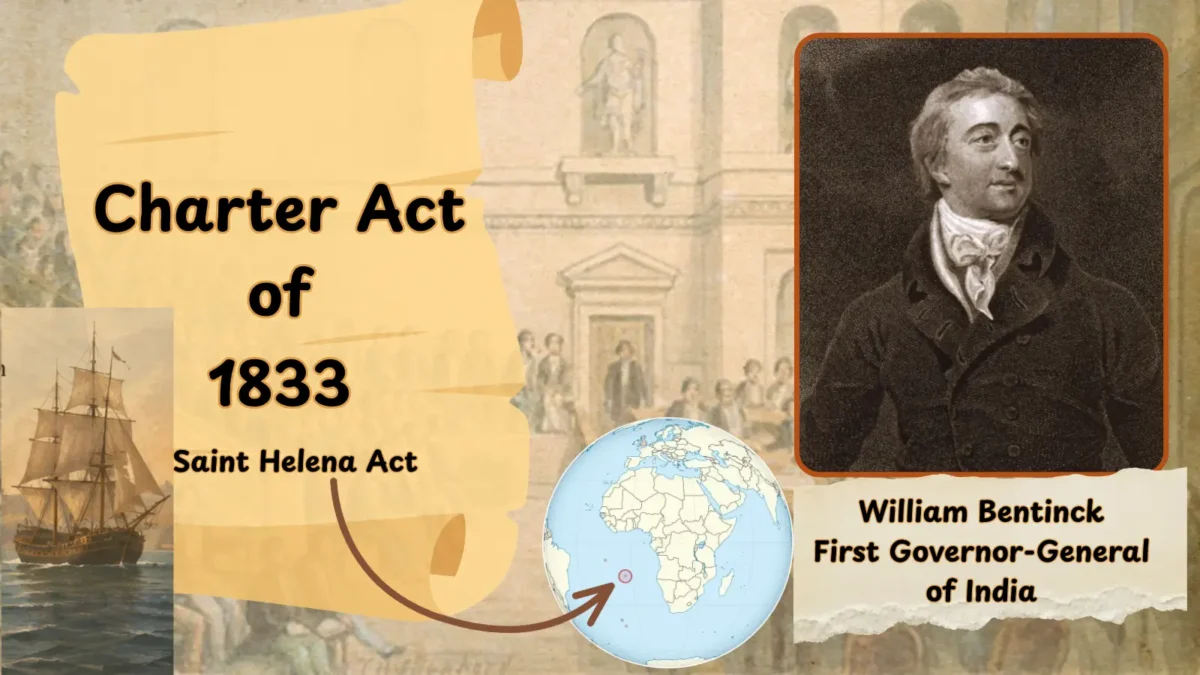
The Charter Act 1833 or the Charter Act of 1833, also known as Saint Helena Act of 1833, was one of the most important legislative measures passed by the British Parliament concerning the administration of India. It renewed the East India Company’s charter for another twenty years but fundamentally changed the Company’s role by ending its remaining commercial activities. The Company continued to govern its Indian territories, but it no longer operated as a commercial trading organisation.
The Charter Act 1833 designated the Governor-General of Bengal as the Governor-General of India, centralised legislative authority in the Governor-General in Council and provided for the appointment of a Law Member. It also laid the foundation for the establishment of the First Law Commission in 1834, which played a major role in the codification of Indian laws.
Another important feature was Section 87, which declared that a person should not be disqualified from Company employment solely because of religion, place of birth, descent or colour. Although this provision expressed an important principle of equality in public employment, its implementation remained limited under colonial rule.
Historical Background of the Charter Act 1833
The East India Company began as a commercial organisation but gradually acquired political power in India. The Battle of Plassey in 1757 and the Battle of Buxar in 1764 strengthened its position in Bengal. In 1765, the Company received the Diwani rights of Bengal, Bihar and Orissa, giving it authority to collect revenue in these territories.
The Company’s growing political responsibilities led the British Parliament to introduce a series of legislative measures. The Regulating Act of 1773 attempted to regulate Company administration. The Act of Settlement of 1781 clarified aspects of the relationship between the Supreme Court at Calcutta and the Company’s administration. Pitt’s India Act of 1784 established the Board of Control, strengthening the British government’s supervision over the Company.
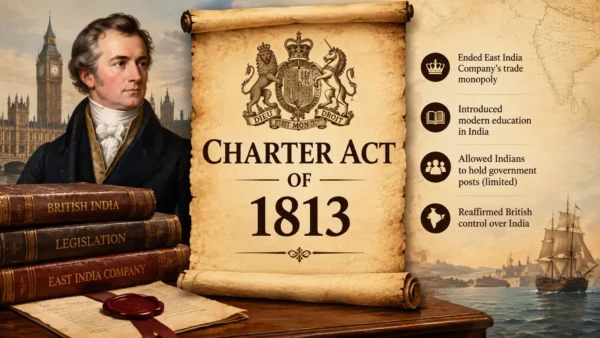
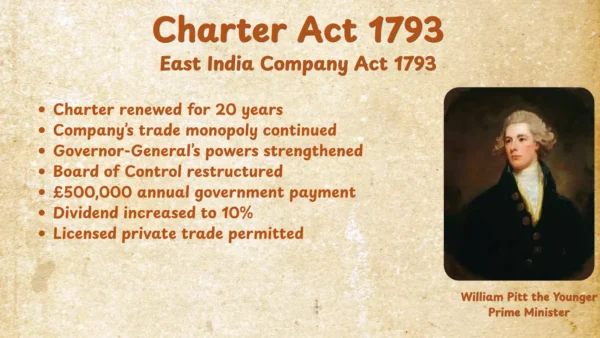
The Charter Act of 1793 renewed the Company’s charter and continued its exclusive trade privileges. The Charter Act of 1813 subsequently ended the Company’s monopoly over trade with India, except for tea and trade with China. These developments reflected the growing influence of British merchants who wanted access to Indian markets.
By 1833, the Company’s commercial monopoly had increasingly come into conflict with the interests of British free-trade advocates. Parliament also sought a more centralised system of administration and a more systematic approach to legislation across British India. The Charter Act 1833 responded to these developments by ending the Company’s remaining commercial activities and strengthening its administrative and legislative framework.
Important Facts about the Charter Act 1833
| Particular | Details |
|---|---|
| Common name | Charter Act of 1833 |
| Other name | Saint Helena Act |
| Official name | Government of India Act 1833 |
| Royal assent | 28 August 1833 |
| Commencement | 22 April 1834 |
| British monarch | King William IV (ruled from 1830 to 1837) |
| British Prime Minister | Earl Grey (served from 1830 to 1834) |
| Governor-General of Bengal | William Bentinck (July 1828 – April 1834) |
| Governor-General of India | William Bentinck (April 1834 – March 1835) was the first to hold this designation. |
| Commercial position of the Company | Its remaining commercial activities were terminated. |
| Legislative authority | Centralised in the Governor-General in Council. |
| First Law Member | Thomas Babington Macaulay, appointed in 1834. |
| First Law Commission | Established in 1834 under Macaulay’s chairmanship. |
| Important provision on public employment | Section 87 addressed disqualification based solely on religion, place of birth, descent or colour. |
| Next major Charter Act | Charter Act of 1853. |
Main Provisions of the Charter Act 1833
The Charter Act 1833, also known as the Government of India Act, 1833, was passed by the British Parliament on 28 August 1833. It reorganised the administration of British India, ended the East India Company’s commercial activities, centralised legislative powers and introduced important provisions concerning public employment and legal reform. Its principal provisions took effect on 22 April 1834.
1. Commercial and Economic Provisions
- End of the East India Company’s commercial activities: The Company was required to discontinue its commercial business and dispose of commercial assets, subject to the arrangements prescribed by the Act. It ceased to function as a trading corporation and continued primarily as an administrative agency.
- End of the China trade monopoly: The Company’s exclusive right to trade with China was abolished.
- End of the tea trade monopoly: The Company’s exclusive privilege of trading in tea was abolished. These changes completed the process of ending its principal trading monopolies, which had already been substantially curtailed in 1813.
- Company property held for the Crown: The Company’s territorial revenues and property were to be held in trust for the Crown for the purposes of governing India, subject to the Company’s liabilities and statutory arrangements.
- Continuation of Company government: The Company retained the administration of British territories in India under parliamentary supervision until 30 April 1854, subject to the Act and subsequent legislation.
- Financial settlement with the Company: The Act provided for the Company’s capital stock and dividend arrangements, while separating its commercial affairs from the administration of Indian territories.
2. Centralisation of Administration
- Governor-General of India: The Governor-General of Bengal became the Governor-General of India. Lord William Bentinck, who was Governor-General of Bengal, became the first Governor-General of India under the Act.
- Central control over civil and military administration: Superintendence, direction and control of the civil and military government of the Company’s Indian territories were vested in the Governor-General of India in Council.
- Centralisation of legislative authority: The Governor-General in Council received authority to make laws for the whole of British India, reducing the independent legislative role previously exercised by the Bombay and Madras Presidencies.
- Four ordinary council members: The Governor-General’s Council had four ordinary members. Three were to be selected from persons who were or had been Company servants with at least ten years of service; the fourth was a person who was not a Company servant and was appointed subject to royal approval.
- Law member: The fourth ordinary member was authorised to participate and vote in meetings concerned with making laws and regulations. This provision created a dedicated legal role within the central government.
- Commander-in-Chief as an extraordinary member: The Act permitted the appointment of the Company’s Commander-in-Chief in India, or in specified circumstances the Commander-in-Chief of the Bengal forces, as an extraordinary member of the Council.
- Appointment of the Governor-General: Vacancies in the office were filled by the Court of Directors, subject to the approval of the Crown under the prescribed procedure.
- Parliamentary supremacy retained: The British Parliament retained its authority to legislate for India and to alter, supersede or repeal laws made by the Governor-General in Council.
3. Legislative Provisions
- All-India legislative authority: The Governor-General in Council could make laws and regulations applicable throughout British India, subject to the exceptions and restrictions in the Act.
- Power to amend and repeal laws: The Council could repeal, amend or alter existing laws and regulations, as well as make new laws within its statutory authority.
- Coverage of persons and institutions: The legislative authority extended to British subjects, Indians, foreigners, courts of justice and other persons and institutions within the territories covered by the Act.
- Restrictions on legislative power: The Council could not override the Act itself, specified military laws, parliamentary authority, Crown prerogatives or the protected rights and constitutional position of the Company.
- Transmission of laws to Britain: Laws and regulations made by the Governor-General in Council had to be transmitted to England and laid before both Houses of Parliament.
- Limited local legislative independence: Bombay and Madras lost their previous independent legislative authority in the centralised arrangement. The Act strengthened the central government’s control over legislation for British India.
4. Indian Civil Services and Public Employment
- Non-discrimination in eligibility for employment: Section 87 declared that no Indian or natural-born British subject resident in the territories should be disqualified from holding a place or employment under the Company solely because of religion, place of birth, descent or colour.
- Principle of equal eligibility: The provision established an important principle against discrimination in public employment. However, it did not itself introduce open competitive examinations or guarantee Indians equal practical access to senior posts.
- Regulation of civil-service recruitment: The Act included provisions for estimating civil-service vacancies, nominating candidates and admitting selected candidates to the Company’s college at Haileybury, under the prescribed system.
- Examination of candidates: Candidates for admission to Haileybury were to be examined and ranked according to the rules laid down by the competent authorities.
5. Law, Judiciary and Legal Reform
- Indian Law Commission: Section 53 provided for the appointment of an Indian Law Commission, with no more than five members at any one time, to examine existing laws and legal institutions and recommend reforms.
- Consolidation and codification of laws: The Commission was to investigate written and customary laws, judicial procedures and court jurisdictions, and recommend measures for consolidating and improving the law.
- Review of courts and police: The Commission was directed to examine existing courts, their powers and procedures, and police establishments, and to suggest improvements.
- Common legal principles: The Act contemplated laws applicable across different classes of inhabitants, while directing attention to local circumstances, religious differences, customs and social practices.
- Reform of judicial administration: The Act envisaged improvements in judicial establishments and police arrangements, although it did not instantly establish a completely uniform judicial system for every part of India.
6. Education and Missionary Activities
- Continuation of educational expenditure: The Act continued the statutory provision for setting aside an annual sum of one lakh rupees for the revival and improvement of literature and for the encouragement of learned Indians and the promotion of scientific knowledge among the inhabitants of British India.
- Missionary activity: The Act’s provisions facilitated the residence and activities of persons entering British India under the applicable rules, including Christian missionaries. It also required legal protection for Indians against insult or outrage concerning their persons, religions and opinions in connection with the removal of restrictions on European entry.
- Historical significance for education: The one-lakh-rupee provision had originally appeared in the Charter Act of 1813; the 1833 Act continued the wider administrative and legislative framework rather than introducing that allocation for the first time.
7. European Entry and Protection of Indians
- Greater freedom of entry and residence: The Act permitted natural-born British subjects to travel to and reside in specified territories without the former general licensing restrictions, subject to the statutory conditions.
- Disclosure requirements: British subjects who were not natives of the territories were required to provide prescribed information about their names, destinations and intended activities upon arrival.
- Protection against insult and outrage: The Governor-General in Council was required to make laws or regulations to protect the inhabitants from insult and outrage affecting their persons, religions or opinions.
8. Revenue, Property and Administrative Accountability
- Territorial revenues for government: Revenues from the Company’s Indian territories were to be applied to the purposes of government under the statutory framework, rather than treated as ordinary commercial profits for the Company’s own use.
- Company liabilities and assets: The Act provided for the handling of the Company’s property, debts, contracts and obligations as part of the settlement between the Company and the Crown.
- Oversight of expenditure: The existing system of supervision by the British government and the Board of Control continued, subject to the changes introduced by the Act.
- Continuation of Company administration under supervision: The Company remained responsible for governing the territories entrusted to it, but operated under the strengthened central and parliamentary framework established by the Act.
9. Other Important Provisions
- Continuation of existing laws: Earlier statutory provisions relating to the Governor-General of Bengal continued to apply where they were consistent with the new Act, with the necessary changes in designation.
- Council meetings within India: The Governor-General in Council could assemble at places within the territories as provided by the Act. Special arrangements applied when the Council met in certain Presidencies.
- Territorial arrangements: The Act addressed the Company’s territorial possessions and property, including specific arrangements relating to St Helena, which was separated from the Company’s Indian governing responsibilities.
- Duration of the arrangement: The Act continued the Company’s governing role until 30 April 1854, subject to parliamentary authority and subsequent legislation.
Also Read Associated Acts:
- East India Company Act
- Regulating Act 1773
- Amending Act 1781
- Act of 1786
- Pitts India Act 1784
- Charter Act 1793
- Charter Act 1813
- Charter Act 1833
- Charter Act 1853
- Government of India Act 1858
This article is part of broader article – xyz

Why Charter Act 1833 is also known as Saint Helena Act?
The Charter Act 1833 is also known as the Saint Helena Act because Section 112 transferred the island of Saint Helena from the East India Company to the British Crown. The Act was later officially given the short title Saint Helena Act 1833 under the Statute Law Revision Act, 1948.
Saint Helena island is located in the South Atlantic Ocean, west of Africa.
In 1815, after the defeat at Battle of Waterloo and subsequent abdication, the French ruler Napoleon Bonaparte was exiled to Saint Helena island. Napoleon died in the island in May 1821.
Significance of the Charter Act 1833
1. Transformation of the East India Company
The termination of the Company’s commercial activities marked the end of its role as a trading organisation. It continued to exercise territorial and administrative authority, but its primary function was now governance rather than commerce.
2. Administrative Unification
The designation of the Governor-General of India and the strengthening of central authority contributed to a more unified administrative structure. The reform reduced the independent legislative authority of the presidencies and strengthened the central government’s role in governing British India.
3. Beginning of a More Centralised Legislative System
The Act concentrated legislative authority in the Governor-General in Council. This was a significant step towards a common legislative framework across the Company’s territories and reduced the earlier differences in legislative authority between the central government and the presidencies.
4. Development of Codified Law
The provision for a Law Member and a Law Commission institutionalised legal reform. The subsequent work of the First Law Commission contributed to the preparation of important legal codes, including the draft that became the Indian Penal Code in 1860.
5. Recognition of a Principle of Equality in Employment
Section 87 expressed a principle against disqualification from Company employment on specified grounds. Although practical equality remained limited, the provision became an important part of the history of public employment and colonial constitutional development.
6. Expansion of European Commercial Activity
The removal of important restrictions on European settlement and landholding supported the wider opening of India’s economy to European commercial interests. This was consistent with the shift towards a freer commercial environment during the nineteenth century.
Limitations of the Charter Act of 1833
- No representative government: The Act did not establish an elected legislature or provide meaningful popular representation for Indians in the central government.
- Limited practical equality: The non-discrimination provision did not immediately remove the institutional and practical barriers that restricted Indian access to senior Company employment.
- Concentration of legislative authority: The removal of independent legislative powers from Bombay and Madras strengthened central control but reduced the autonomy of the presidencies.
- Continued colonial administration: The Company retained political authority over its Indian territories, and the Act did not introduce self-government.
- Limited immediate legal uniformity: Although the Act encouraged the consolidation and codification of laws, the process required years of work by commissions and subsequent legislatures.
- No immediate abolition of slavery: The Act addressed the issue through provisions concerning amelioration and abolition, but further legislative measures were required.
Comparison Between the Charter Acts of 1813 and 1833
| Basis | Charter Act of 1813 | Charter Act of 1833 |
|---|---|---|
| Company’s charter | Renewed for another twenty years. | Renewed for another twenty years. |
| Commercial activities | Ended the Company’s monopoly over trade with India, except for tea and trade with China. | Ended the Company’s remaining commercial activities, including tea and trade with China. |
| Governor-General | Continued the existing designation and administrative framework. | Redesignated the Governor-General of Bengal as the Governor-General of India. |
| Legislative authority | Continued the existing legislative structure. | Centralised legislative authority in the Governor-General in Council. |
| Presidencies | Continued the existing framework of presidential administration. | Removed the independent legislative powers of Bombay and Madras under the earlier arrangement. |
| Law Member | Did not establish the fourth Law Member under the 1833 framework. | Provided for a fourth ordinary member, the Law Member. |
| Law Commission | Did not provide for the First Law Commission established under the 1833 framework. | Provided for an Indian Law Commission, established in 1834. |
| Public employment | Did not contain the same specific provision as Section 87 of the 1833 Act. | Declared that disqualification from Company employment should not be based solely on specified grounds such as religion, place of birth, descent or colour. |
| Overall significance | Opened Indian trade to other British merchants while retaining the Company’s territorial administration. | Ended the Company’s commercial role and strengthened administrative and legislative centralisation. |
Difference Between the Charter Act of 1833 and the Charter Act of 1853
The Charter Acts of 1833 and 1853 were important stages in the development of the Company’s administration, but they introduced different kinds of changes.
- Charter Act of 1833: Ended the Company’s commercial activities, designated the Governor-General of Bengal as the Governor-General of India and centralised legislative authority.
- Charter Act of 1853: Separated the legislative and executive functions of the Governor-General’s Council more clearly and expanded the legislative council’s composition.
- Civil service: The 1853 Act opened the way for recruitment through open competitive examination, although the detailed system was developed through subsequent arrangements.
- Charter renewal: Unlike earlier Charter Acts, the 1853 Act did not renew the Company’s charter for another fixed twenty-year period.
Conclusion
The Charter Act of 1833 was a major constitutional milestone in the development of British rule in India. It ended the East India Company’s remaining commercial activities, redesignated the Governor-General of Bengal as the Governor-General of India and centralised legislative authority. It also provided for a Law Member, laid the foundation for the First Law Commission and expressed a principle against specified forms of discrimination in Company employment.
At the same time, the Act did not establish representative government or end colonial rule. Its reforms strengthened the administrative machinery of British India rather than transferring political power to Indians. Studied alongside the Charter Acts of 1813 and 1853, the legislation illustrates the gradual transformation of the East India Company from a commercial enterprise into a primarily administrative instrument of British imperial rule.
PYQs and MCQs Related to Charter Act 1833
Previous Year Questions (PYQs) and Multiple Choice Questions (MCQs) related with Charter Act 1833 and other related acts are given below. Every effort has been made to provide the correct answer with explanation. However, if you think or have doubt or query related to any question or its answer or explanation, please Contact Us and write an email to us.
Question 1. Consider the following statements regarding the Charter Act of 1833:
1. It ended the commercial activities of the East India Company.
2. It abolished the Company’s monopoly over trade with China and the tea trade.
3. It transferred the administration of India directly to the British Crown.
Which of the statements given above is/are correct?
(a) 1 and 2 only
(b) 2 and 3 only
(c) 1 and 3 only
(d) 1, 2 and 3
Answer: (a) 1 and 2 only.
Explanation: The Charter Act of 1833 ended the East India Company’s commercial activities, including its remaining tea and China trade monopolies. However, the Company continued to administer its Indian territories under British parliamentary supervision. The transfer of government to the British Crown took place under the Government of India Act, 1858.
Question 2. Who became the first Governor-General of India under the Charter Act of 1833?
(a) Lord Cornwallis
(b) Lord William Bentinck
(c) Lord Wellesley
(d) Lord Dalhousie
Answer: (b) Lord William Bentinck.
Explanation: The Charter Act of 1833 redesignated the Governor-General of Bengal as the Governor-General of India. Lord William Bentinck, who was serving as Governor-General of Bengal, became the first Governor-General of India under this arrangement.
Question 3. Which of the following was the most significant constitutional effect of the Charter Act of 1833?
(a) Introduction of provincial autonomy
(b) Establishment of direct Crown rule in India
(c) Centralisation of legislative power in the Governor-General in Council
(d) Introduction of separate electorates
Answer: (c) Centralisation of legislative power in the Governor-General in Council.
Explanation: The Act centralised legislative authority by empowering the Governor-General in Council to make laws for the whole of British India, subject to statutory limitations. Bombay and Madras lost their previous independent legislative authority under the new arrangement. Provincial autonomy and separate electorates were introduced much later through other constitutional developments.
Question 4. Consider the following statements about the Charter Act of 1833:
1. It provided for the appointment of a fourth ordinary member to the Governor-General’s Council.
2. The fourth ordinary member was authorised to participate in legislative business.
3. The fourth ordinary member possessed the same voting role in all executive business as the other ordinary members.
Which of the statements given above is/are correct?
(a) 1 only
(b) 1 and 2 only
(c) 2 and 3 only
(d) 1, 2 and 3
Answer: (b) 1 and 2 only.
Explanation: The Act added a fourth ordinary member to the Governor-General’s Council, with a specific role in legislative proceedings. The member was not a full participant in all executive business on the same basis as the other ordinary members. This provision helped establish a distinct legal and legislative function within the central administration.
Question 5. Who was the first Law Member appointed to the Governor-General’s Council under the Charter Act of 1833?
(a) Lord Macaulay
(b) Sir Elijah Impey
(c) Warren Hastings
(d) Lord Cornwallis
Answer: (a) Lord Macaulay.
Explanation: Thomas Babington Macaulay became the first Law Member of the Governor-General’s Council in 1834. His appointment was associated with the development of legal codification in British India. He later played an important role in the work of the First Law Commission.
Question 6. With reference to the Indian Law Commission under the Charter Act of 1833, consider the following statements:
1. The Act provided for the appointment of a Law Commission.
2. The Commission was expected to examine existing laws and recommend their consolidation and improvement.
3. The Commission immediately replaced all existing Indian laws with a single uniform civil code.
Which of the statements given above is/are correct?
(a) 1 and 2 only
(b) 2 and 3 only
(c) 1 and 3 only
(d) 1, 2 and 3
Answer: (a) 1 and 2 only.
Explanation: Section 53 of the Charter Act 1833 provided for an Indian Law Commission to investigate existing laws and legal institutions and recommend improvements. The First Law Commission was established in 1834, with Macaulay as its chairman. The Act did not immediately replace all existing laws or create a uniform civil code.
Question 7. Which of the following correctly describes Section 87 of the Charter Act of 1833?
(a) It introduced universal adult franchise in India.
(b) It prohibited the disqualification of a person from Company employment solely on specified grounds such as religion, place of birth, descent or colour.
(c) It introduced competitive examinations for recruitment to the Indian Civil Service.
(d) It reserved half of all government posts for Indians.
Answer: (b) It prohibited disqualification from Company employment solely on specified grounds.
Explanation: Section 87 of the Charter Act 1833 declared that no Indian or natural-born British subject resident in the Company’s territories should be disqualified from holding employment under the Company solely because of religion, place of birth, descent or colour. It established an important principle of eligibility for public employment, but did not introduce competitive examinations or job reservations.
Question 8. Consider the following statements regarding the educational provision associated with the Charter Act of 1833:
1. The annual provision of one lakh rupees for education had originally been introduced by the Charter Act of 1813.
2. The Charter Act of 1833 introduced the first statutory educational grant for India.
3. The earlier provision covered the revival and improvement of literature and the promotion of scientific knowledge among the inhabitants of British India.
Which of the statements given above is/are correct?
(a) 1 and 3 only
(b) 2 only
(c) 1 and 2 only
(d) 1, 2 and 3
Answer: (a) 1 and 3 only.
Explanation: The Charter Act of 1813 introduced the annual one-lakh-rupee provision for educational and related purposes. The provision supported the revival and improvement of literature, the encouragement of learned Indians and the promotion of scientific knowledge. It is therefore incorrect to attribute the first introduction of this grant to the Charter Act of 1833.
Question 9. Which of the following statements about the East India Company’s position after the Charter Act of 1833 is correct?
(a) The Company immediately ceased to exist.
(b) The Company continued as a commercial enterprise but lost its administrative powers.
(c) The Company ceased commercial activities but continued to administer Indian territories.
(d) The Company transferred all Indian territories to the Mughal emperor.
Answer: (c) The Company ceased commercial activities but continued to administer Indian territories.
Explanation: The Charter Act 1833 ended the Company’s commercial operations and retained its governing responsibilities. The Company continued to administer British territories in India under parliamentary supervision until the transfer of government to the Crown in 1858. Thus, the Act transformed the Company’s role rather than abolishing it outright.
Question 10. Which of the following legislative changes was introduced by the Charter Act of 1833?
(a) Bombay and Madras received independent legislative authority.
(b) The Governor-General in Council acquired legislative authority extending across British India.
(c) Indian princely states obtained representation in a central legislature.
(d) A bicameral central legislature was established.
Answer: (b) The Governor-General in Council acquired legislative authority extending across British India.
Explanation: The Charter Act of 1833 strengthened central legislative authority and reduced the independent legislative powers of the Bombay and Madras Presidencies. It did not establish a bicameral legislature or provide representation for princely states in a central legislature.
Question 11. Consider the following statements about the trade provisions of the Charter Act of 1833:
1. The Act ended the East India Company’s tea trade monopoly.
2. The Act ended the Company’s monopoly over trade with China.
3. The Act abolished all British commercial interests in India.
Which of the statements given above is/are correct?
(a) 1 only
(b) 1 and 2 only
(c) 2 and 3 only
(d) 1, 2 and 3
Answer: (b) 1 and 2 only.
Explanation: The Charter Act 1833 ended the Company’s remaining monopolies over the tea trade and commerce with China, completing its transition away from commercial activity. It did not abolish British private trade or commercial interests in India. Instead, the Company itself ceased trading and continued primarily as an administrative authority.
Question 12. Under the Charter Act of 1833, the Company’s territorial revenues and property were to be held primarily for which purpose?
(a) Distribution as commercial profits among private British merchants
(b) Financing the restoration of the Mughal Empire
(c) The administration and government of its Indian territories, subject to statutory arrangements
(d) Exclusive expenditure on missionary activities
Answer: (c) The administration and government of its Indian territories, subject to statutory arrangements.
Explanation: The Charter Act 1833 separated the Company’s commercial role from its administrative responsibilities. Its territorial revenues and property were to be applied to government purposes under the statutory framework, while the Act also dealt with the Company’s liabilities and financial arrangements.
Question 13. Which one of the following statements best explains the significance of the Charter Act of 1833 in the constitutional development of British India?
(a) It introduced provincial autonomy and responsible government.
(b) It established direct British Crown rule.
(c) It strengthened centralisation and established a more unified legislative framework for British India.
(d) It introduced separate electorates for religious communities.
Answer: (c) It strengthened centralisation and established a more unified legislative framework for British India.
Explanation: The Act centralised legislative authority in the Governor-General in Council and strengthened the central administration. Direct Crown rule began in 1858, while provincial autonomy and separate electorates were introduced through later constitutional reforms.
Question 14. Consider the following statements regarding the duration of the East India Company’s governing role under the Charter Act of 1833:
1. The Act continued the Company’s governing role subject to parliamentary authority.
2. The Act permanently guaranteed the Company the right to govern India.
3. The Company’s governing role was subsequently ended by the Government of India Act, 1858.
Which of the statements given above is/are correct?
(a) 1 and 3 only
(b) 2 only
(c) 1 and 2 only
(d) 1, 2 and 3
Answer: (a) 1 and 3 only.
Explanation: The Charter Act 1833 continued the Company’s administration under parliamentary supervision but did not grant it permanent governing rights. The Government of India Act, 1858 transferred the Company’s governing responsibilities to the British Crown following the Revolt of 1857.
Question 15. Which of the following was NOT a provision of the Charter Act of 1833?
(a) Appointment of a Law Member to the Governor-General’s Council
(b) Establishment of an Indian Law Commission
(c) Introduction of open competitive examinations for the Indian Civil Service
(d) Centralisation of legislative authority
Answer: (c) Introduction of open competitive examinations for the Indian Civil Service.
Explanation: The Charter Act of 1833 established a principle against specified forms of discrimination in public employment, but it did not introduce open competitive recruitment. The Charter Act of 1853 introduced open competition for recruitment to the Company’s civil services, with implementation developing through subsequent arrangements.
Question 16. Consider the following pairs:
1. Charter Act of 1813 — End of the Company’s trade monopoly in India, except tea and China trade
2. Charter Act of 1833 — End of the Company’s remaining tea and China trade monopolies
3. Government of India Act, 1858 — Transfer of government from the Company to the British Crown
How many of the pairs given above are correctly matched?
(a) Only one
(b) Only two
(c) All three
(d) None
Answer: (c) All three.
Explanation: The Charter Act of 1813 ended most of the Company’s Indian trade monopoly while retaining the tea and China trade exceptions. The Charter Act of 1833 abolished those remaining commercial monopolies. The Government of India Act, 1858 subsequently transferred the administration of India from the Company to the Crown.
Question 17. The Charter Act of 1833 provided for the appointment of a Law Commission primarily to:
(a) Draft a constitution for an independent India
(b) Examine existing laws and recommend their consolidation and reform
(c) Establish elected legislative councils in every province
(d) Abolish all personal laws immediately
Answer: (b) Examine existing laws and recommend their consolidation and reform.
Explanation: The Indian Law Commission was intended to examine the legal system, existing laws, judicial institutions and procedures, and recommend improvements. Its work contributed to the gradual development and codification of Indian law. It did not draft a constitution for independent India or immediately abolish all personal laws.
Question 18. Consider the following statements about the entry of Europeans into India under the Charter Act of 1833:
1. The Act relaxed earlier restrictions on the entry and residence of natural-born British subjects in the Company’s territories.
2. The Act required measures to protect inhabitants against specified forms of insult and outrage concerning their persons, religions and opinions.
3. The Act prohibited all Europeans from residing in India.
Which of the statements given above is/are correct?
(a) 1 and 2 only
(b) 2 and 3 only
(c) 1 and 3 only
(d) 1, 2 and 3
Answer: (a) 1 and 2 only.
Explanation: The Charter Act 1833 relaxed restrictions on the entry and residence of natural-born British subjects, subject to statutory conditions. It also provided for protective measures concerning inhabitants’ persons, religions and opinions. It did not prohibit Europeans from residing in India; rather, it facilitated their entry under the prescribed legal framework.
Question 19. Which of the following statements about the Governor-General’s legislative powers under the Charter Act of 1833 is correct?
(a) The Governor-General could legislate only for Bengal.
(b) The Governor-General in Council could make laws for British India, subject to the limitations imposed by law.
(c) The Governor-General could repeal Acts of the British Parliament.
(d) The Governor-General had no authority to amend existing regulations.
Answer: (b) The Governor-General in Council could make laws for British India, subject to statutory limitations.
Explanation: The Charter Act 1833 granted the Governor-General in Council broad legislative authority across British India, including the power to amend or repeal existing laws and regulations within its competence. These powers remained subject to the Act, parliamentary legislation and other statutory restrictions. The Governor-General could not repeal Acts of the British Parliament.
Question 20. Consider the following statements regarding the Charter Act of 1833:
1. It strengthened the central government’s authority over legislation.
2. It introduced the principle that Indians should not be disqualified from Company employment solely on specified grounds such as religion, place of birth, descent or colour.
3. It introduced representative elections for the central legislature.
4. It transferred the government of India directly to the British Crown.
Which of the statements given above is/are correct?
(a) 1 and 2 only
(b) 1, 2 and 3 only
(c) 2, 3 and 4 only
(d) 1, 2, 3 and 4
Answer: (a) 1 and 2 only.
Explanation: The Charter Act of 1833 centralised legislative authority and established an important statutory principle against specified forms of discrimination in Company employment. It did not introduce representative elections for a central legislature, nor did it transfer government directly to the Crown. The transfer of power to the Crown occurred in 1858.
Question 21. The Charter Act of 1833 is also known as:
(a) The Regulating Act
(b) The Saint Helena Act
(c) The Pitt’s India Act
(d) The Indian Councils Act
Answer: (b) The Saint Helena Act
Explanation: The Charter Act of 1833 is also known as the Saint Helena Act because Section 112 transferred the island of Saint Helena from the East India Company to the British Crown. The Act was later officially given the short title Saint Helena Act 1833 under the Statute Law Revision Act, 1948.
References and Sources
- Digital Library, Parliament of India: Charter Act 1833
- Wikipedia: Charter Act 1833
- “Comprehensive Modern Indian History: From 1707 To The Modern Times” written by Brijesh Singh and published by S. Chand. Check Amazon / Flipkart / S Chand website.