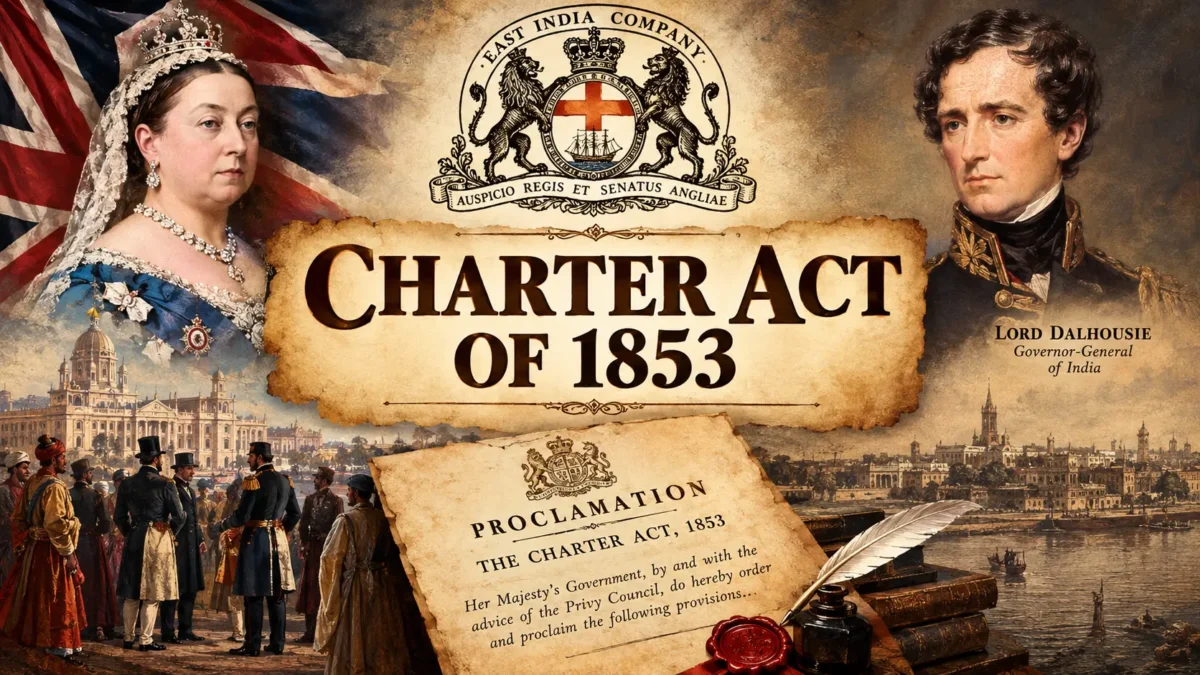
The Government of India Act 1853, commonly known as the Charter Act of 1853, was passed by the British Parliament on August 20, 1853, and served as the final act in the series of Charter Acts regulating the East India Company before direct British Crown rule began in 1858. It introduced important changes in the legislative machinery of British India, advanced the principle of open competitive recruitment to civil services, and continued the Company’s administration without specifying another fixed 20-year term.
The Charter Act of 1853 was an important legislative measure in the constitutional history of British India. It was the last of the Charter Acts passed between 1793 and 1853 and introduced significant changes in the administration of the East India Company. Unlike the earlier Charter Acts, it did not renew the Company’s charter for another fixed period of twenty years. Instead, the Company continued to hold its Indian territories and revenues in trust for the Crown until Parliament decided otherwise.
The Act separated the legislative and executive functions of the Governor-General’s Council more clearly, expanded the legislative council, introduced a system of open competition for recruitment to the Company’s covenanted civil service and reduced the number of Directors of the Company. It also made administrative changes concerning Bengal and strengthened the role of the British government in the Company’s affairs.
The Charter Act of 1853 is particularly significant because it introduced important changes in legislative administration and civil service recruitment shortly before the Revolt of 1857 and the transfer of Indian administration to the British Crown in 1858.
Historical Background of the Charter Act of 1853
The East India Company began as a commercial organisation but gradually acquired political and territorial power in India. The Battle of Plassey in 1757, the Battle of Buxar in 1764 and the grant of Diwani rights in 1765 strengthened its position in Bengal and expanded its responsibilities in revenue collection and administration.
The British Parliament introduced several legislative measures to regulate the Company’s activities. The Regulating Act of 1773 established the office of Governor-General of Bengal and the Supreme Court at Calcutta. The Act of Settlement of 1781 clarified aspects of the relationship between the Supreme Court and the Company’s administration. Pitt’s India Act of 1784 established the Board of Control, creating a system of dual control involving the British government and the Company’s Court of Directors.
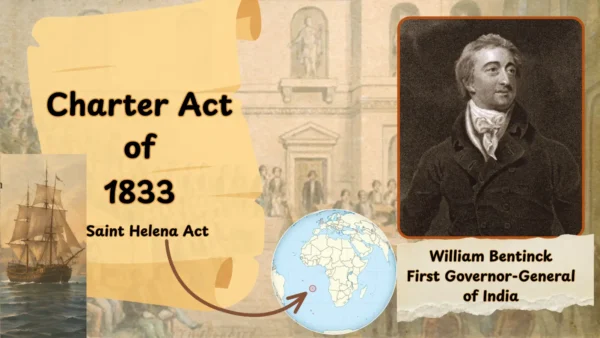
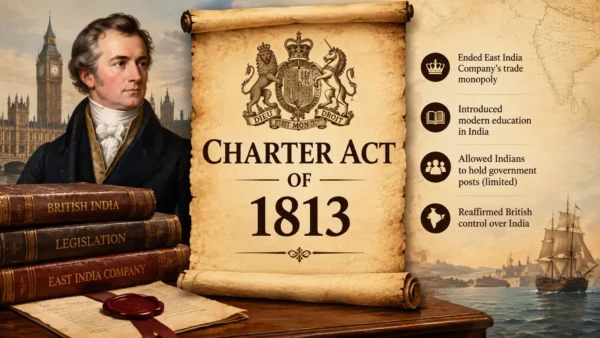
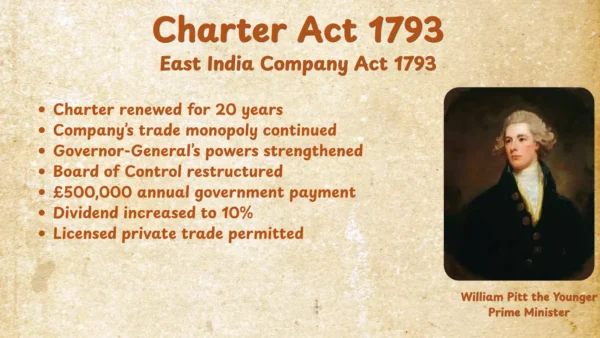
The Charter Act of 1793 renewed the Company’s charter and continued its trade privileges. The Charter Act of 1813 ended its monopoly over trade with India, except for tea and trade with China. The Charter Act of 1833 subsequently ended the Company’s remaining commercial activities and centralised legislative authority in the Governor-General in Council.
Despite these reforms, concerns continued about the Company’s administration, the concentration of authority, the system of appointments to public offices and the need for more effective law-making. The system of patronage used to appoint civil servants attracted criticism because appointments could depend on nominations by the Directors rather than open competition among qualified candidates.
In 1852, parliamentary committees examined the affairs and administration of the Company. Their inquiries contributed to the preparation of new legislation. Parliament passed the Charter Act of 1853 to introduce further administrative and legislative changes while leaving the future duration of Company rule open to parliamentary decision.
Indian Political Associations and the Charter Act of 1853
Indian political associations directly influenced the public and parliamentary debate surrounding the renewal of the East India Company’s Charter, although their influence on the Act’s final provisions cannot be conclusively established.
The British Indian Association, established in Calcutta in 1851, petitioned the British Parliament in 1852 for constitutional and administrative reforms, including a legislature with a more representative character. The Madras Native Association, led by Gazulu Lakshminarasu Chetty, and the Bombay Association, established in 1852, submitted petitions during the 1853 Charter renewal debate. These representations sought investigations into the Company’s administration, relief from taxation and judicial grievances, improved public works, and greater Indian participation in governance. The Madras petition was presented in the House of Lords on 25 February 1853, while the Bombay petition followed on 4 March 1853.
Their demands received parliamentary attention, and Indian grievances were explicitly discussed during the proceedings. However, Parliament did not accept all their proposals: the demand to postpone renewal pending a comprehensive inquiry, for example, was not adopted in the form requested.
The Charter Act subsequently expanded the Governor-General’s legislative council by adding members for legislative business, but it did not establish an elected Indian legislature. Nor is there sufficient evidence to attribute the introduction of competitive civil service recruitment directly to these associations.
Important Facts about the Charter Act of 1853
| Particular | Details |
|---|---|
| Common name | Charter Act of 1853 |
| Official name | Government of India Act 1853 |
| British monarch | Queen Victoria (ruled from 1837 to 1901) |
| British Prime Minister | Lord Aberdeen (served from 1852 to 1855) |
| Governor-General of India | Lord Dalhousie (January 1848 – February 1856) |
| Nature of charter renewal | No fixed twenty-year period was specified. |
| Commercial position of the Company | Its commercial activities had already ended under the Charter Act of 1833. |
| Legislative reform | Legislative functions were separated more clearly from executive functions. |
| Civil service reform | Open competition was introduced as the basis for recruitment to the covenanted civil service under the prescribed arrangements. |
| Number of Company Directors | Reduced from 24 to 18. |
| First competitive examination for the Indian Civil Service | Held in London in 1855, following the implementation of the new recruitment arrangements. |
| Next major constitutional change | Government of India Act of 1858, which transferred administration from the Company to the Crown. |
Main Provisions of the Charter Act of 1853
The Charter Act of 1853, also known as the Government of India Act 1853, was passed by the British Parliament to regulate the administration of the territories governed by the East India Company. It introduced significant changes in the Company’s administration in Britain and India, the recruitment of civil servants, and the legislative machinery of British India. The following are its major provisions.
1. Continuation of the East India Company’s Rule
- Continuation of Company Administration: The Act allowed the East India Company to continue administering its Indian territories and collecting their revenues. However, the Company held these territories and revenues in trust for the British Crown, subject to Parliament’s authority.
- No Fixed Period for the Company’s Charter: Unlike the Charter Acts of 1793, 1813 and 1833, the Act did not prescribe another fixed 20-year period for the Company’s rule. Its authority continued until Parliament decided otherwise, making it possible for Parliament to terminate Company rule without waiting for the expiry of another 20-year term.
- Continued Parliamentary Supremacy: The British Parliament retained the authority to determine the future of the Company’s administration in India. The Act did not transfer the government of India directly to the Crown; that transfer took place under the Government of India Act 1858.
2. Changes in the Court of Directors and Board of Control
- Reduction in the Number of Directors: The number of members of the East India Company’s Court of Directors was reduced from 24 to 18. This reduced the size of the body responsible for managing the Company’s affairs in Britain.
- Nomination of Directors by the Crown: Out of the 18 directors, six were to be nominated by the British Crown. This increased the Crown’s direct influence over the composition of the Court of Directors.
- Reduction in the Quorum of Directors: The quorum required for a meeting of the Court of Directors was reduced from 13 to 10. This change also made it possible for Crown-nominated directors to form a majority at a meeting attended by the minimum quorum, if all six were present.
- Formation of Functional Subcommittees: The Act provided for the organisation of the Court of Directors’ work through three subcommittees dealing with judicial, financial and political matters. Each subcommittee consisted of six directors, allowing the Court to distribute its responsibilities among specialised groups.
- Continuation of the Secret Committee: The existing Secret Committee of three directors continued under the arrangements governing the Company’s administration. It was associated with the handling of confidential political and diplomatic communications concerning India.
- Payment of the Board of Control’s Officials: The Act dealt with the salaries of the President and other officers of the Board of Control, which supervised the Company’s political and administrative affairs on behalf of the British Government. Their remuneration was to be paid by the Company under the statutory arrangements, with salaries fixed under the authority of the Crown.
3. Civil Service Recruitment Reforms
- Introduction of Open Competitive Recruitment: The Act provided for the recruitment of civil servants through open competition rather than relying exclusively on nominations by the Court of Directors. This marked an important shift towards merit-based recruitment in the higher civil services of the Company.
- End of the Directors’ Exclusive Patronage: The Court of Directors lost its exclusive patronage over appointments to the covenanted civil service. Vacancies were to be filled according to competitive selection rules framed under the authority of the Board of Control.
- Eligibility of British Subjects: The competitive recruitment arrangements were opened to eligible natural-born subjects of the British Crown, subject to the applicable rules. In principle, this opened the covenanted civil service to Indians who met the prescribed eligibility requirements, although practical barriers to entry remained substantial.
- Macaulay Committee of 1854: Following the Act, a committee chaired by Thomas Babington Macaulay was appointed in 1854 to develop the system of competitive recruitment to the Indian Civil Service. Its recommendations helped shape the examination system; the committee itself was a subsequent development, not a provision directly created by the Act.
4. Changes in the Governor-General’s Council
- Law Member Became a Full Member: The fourth ordinary member of the Governor-General’s Council, introduced under the Charter Act of 1833 for legislative work, was made a full member with the right to participate and vote in executive business. This strengthened the position of the law member within the central executive administration.
- Separation of Executive and Legislative Functions: The Act distinguished the legislative functions of the Governor-General’s Council from its executive functions. When dealing with legislation, the Council was enlarged by additional members who did not participate in its ordinary executive business merely by virtue of their legislative membership.
- Appointment of Additional Members: Six additional members, known as legislative councillors, were provided for legislative purposes. Their participation expanded the Council’s capacity to examine and discuss proposed laws.
- Chief Justice as a Legislative Councillor: The Chief Justice of the Supreme Court at Calcutta was included in the enlarged legislative council. This brought senior judicial expertise into the legislative process without making the Chief Justice an elected representative.
- Participation of Another Judge: One other judge of the Supreme Court at Calcutta was also included in the legislative council. The arrangement provided an additional judicial perspective in the consideration of legislation.
- Provincial Legislative Representation: Four additional legislative councillors were drawn from the civil services, one associated with each of the presidencies or provinces of Bengal, Bombay, Madras and the North-Western Provinces. They were appointed through the prescribed provincial arrangements and were not elected by the public.
- Commander-in-Chief in the Council: The Commander-in-Chief was included in the enlarged legislative council’s composition. This ensured that the senior military authority was represented in the Council’s proceedings under the statutory arrangements.
- Provision for a Vice-President: The Governor-General was empowered to nominate a vice-president for the Council under the applicable provisions. This provided an arrangement for presiding over Council business when required.
5. Legislative Reforms and Procedure
- Establishment of a Distinct Legislative Wing: The expanded legislative council functioned separately from the Council’s ordinary executive proceedings when considering laws. This was an important step in the institutional development of a central legislative body in British India.
- Public Legislative Proceedings: Legislative business was conducted in public rather than being dealt with entirely through confidential proceedings. This increased the visibility of legislative discussions and provided a more formal setting for examining proposed laws.
- Oral Discussion of Legislative Business: Discussions in the Council, when acting in its legislative capacity, were conducted orally rather than solely through written communications. This facilitated debate and the consideration of different views on proposed legislation.
- Stages of Legislative Bills: Bills were subjected to formal stages of consideration, including reference to select committees where applicable. These procedures made the legislative process more structured and developed practices that contributed to the later evolution of legislative institutions in India.
- Publication of Legislative Proceedings: Reports of legislative proceedings were officially published. This provided a record of the Council’s deliberations and improved public access to information about law-making.
- Rules for Legislative Proceedings: Formal standing orders were adopted to regulate the conduct of legislative business. These rules helped establish a more systematic procedure for introducing, discussing and considering proposed laws.
- Governor-General’s Assent: The Governor-General’s assent remained necessary under the applicable legislative arrangements. The enlarged Council did not become an independent legislature capable of overriding the executive authority of the Governor-General.
- Legislative Veto and Executive Control: The Governor-General retained important powers over legislation, including the ability to withhold assent under the statutory framework. Therefore, the reforms expanded legislative discussion without establishing responsible government or democratic legislative supremacy.
6. Changes in the Administration of Bengal
- Separate Governor for Bengal: The Act provided for the appointment of a separate Governor for the Presidency of Bengal, distinct from the Governor-General of India. The measure was intended to reduce the administrative burden on the Governor-General, who was responsible for the affairs of the wider Indian territories.
- Interim Appointment of a Lieutenant-Governor: Pending the appointment of a separate Governor, the Court of Directors could authorise the Governor-General in Council to appoint a qualified covenanted Company servant of the prescribed service standing as Lieutenant-Governor. This offered an alternative administrative arrangement for Bengal.
7. Creation and Reorganisation of Presidencies and Provinces
- Power to Establish a New Presidency: The Court of Directors was empowered, subject to the direction and control of the Board of Control, to establish one new presidency within the Company’s territories. It could also determine which territories would fall under that presidency.
- Appointment of Lieutenant-Governors: Where a new presidency had not been established, the statutory framework permitted the appointment of a Lieutenant-Governor for a specified territory. The relevant authority could define the territory and the extent of the Lieutenant-Governor’s powers.
- Reorganisation of Territorial Jurisdictions: The Act enabled the competent authorities to alter the territorial distribution of presidencies and lieutenant-governorships. These provisions gave the Company greater flexibility in organising the administration of its expanding territories.
- Application of Existing Administrative Rules: The Act extended relevant existing legal provisions concerning the administration of presidencies to a new presidency established under its authority. This covered matters such as appointments, vacancies, the powers and duties of governors, and the administration of their councils.
8. Judicial, Administrative and Service-Related Provisions
- Approval of Certain Council Appointments: The Act subjected appointments by the Court of Directors to specified ordinary councils in India to the approval of the Crown, formally signified under the prescribed procedure involving the President of the Board of Control. This strengthened oversight of appointments to important administrative offices.
- Regulations for Sick Leave and Furlough: The Act enabled the Court of Directors, under the direction and control of the Board of Control, to make regulations concerning sick leave and furlough for Company officers serving in India. Such regulations could permit eligible officers to reside outside the Company’s charter limits without forfeiting their salaries, subject to the applicable conditions.
- Remuneration of Certain Senior Officials: The Act prescribed salary arrangements for specified senior offices, including the Commander-in-Chief of the forces in India and Lieutenant-Governors. These provisions formed part of the statutory framework for the administration and remuneration of senior officials.
- Military Administrative Arrangements: The Act included provisions concerning the relationship between the command of Her Majesty’s forces and the Company’s forces in India. These provisions addressed the organisation and administration of the military establishment under British authority.
9. Overall Constitutional Significance
- Last of the Charter Acts: The Charter Act of 1853 was the last of the major Charter Acts passed to regulate the East India Company’s administration. Unlike the preceding Charter Acts, it did not provide a fresh fixed 20-year period for the Company’s rule.
- Development of Central Legislative Institutions: The Act introduced a more elaborate legislative council with additional members and formal procedures. It contributed to the gradual development of a distinct legislative institution in British India.
- Move Towards Merit-Based Civil Services: By ending the Court of Directors’ exclusive patronage over covenanted civil service appointments and providing for open competition, the Act marked an important step towards a competitive recruitment system.
- Continued British Control: Despite the legislative and administrative reforms, the Act did not introduce democratic self-government or transfer authority to Indian representatives. Effective control remained with British institutions and the East India Company’s governing machinery, subject to Parliament’s authority.
Also Read Associated Acts:
- East India Company Act
- Regulating Act 1773
- Amending Act 1781
- Act of 1786
- Pitts India Act 1784
- Charter Act 1793
- Charter Act 1813
- Charter Act 1833
- Charter Act 1853
- Government of India Act 1858
This article is part of broader article – xyz
Significance of the Charter Act of 1853
- Development of Legislative Institutions: The Act expanded the legislative council and established a clearer distinction between legislative and executive work. This contributed to the development of more formal legislative procedures in British India.
- Beginning of Competitive Civil Service Recruitment: The introduction of open competition marked a major change in the recruitment of senior Company officials. It weakened the traditional system of appointment through patronage and established competitive examination as the principle for recruitment to the covenanted civil service.
- Increased British Government Supervision: The reduction in the number of Company Directors and the appointment of six Directors by the Crown increased the British government’s influence over the Company. The Act continued the long-term process of strengthening official supervision over Company administration.
- Administrative Reorganisation: The provision for a separate administration of Bengal helped distinguish provincial responsibilities from the wider duties of the Governor-General of India. This was an important development in the organisation of colonial administration.
- Flexibility in the Future of Company Rule: By not specifying a new fixed twenty-year period for the Company’s continuation, the Act left Parliament free to reconsider the arrangement whenever it chose. This made the legislation different from the preceding Charter Acts.
Limitations of the Charter Act of 1853
- No representative democracy: The expanded legislative council did not consist of elected representatives of the Indian population.
- Limited Indian participation: Although the civil service recruitment principle was opened to eligible candidates, the examination’s location and other practical barriers made access difficult for many Indians.
- Continued colonial rule: The Act did not transfer power to Indians or introduce responsible government.
- Executive dominance: The legislative council remained within the colonial administrative structure, and the executive continued to exercise substantial authority.
- Continued centralisation: The Act did not restore independent legislative authority to the provincial presidencies.
- No immediate transfer to the Crown: Company rule continued after 1853 and ended only when the Government of India Act of 1858 transferred administration to the British Crown.
Comparison Between the Charter Acts of 1833 and 1853
| Basis | Charter Act of 1833 | Charter Act of 1853 |
|---|---|---|
| Company’s commercial role | Ended the Company’s remaining commercial activities. | Continued the Company’s administrative role after its commercial activities had already ended. |
| Charter renewal | Renewed the charter for another twenty years. | Did not specify a new fixed twenty-year period. |
| Legislative structure | Centralised legislative authority in the Governor-General in Council. | Expanded the legislative council and separated legislative work more clearly from executive functions. |
| Legislative council | Established the centralised legislative framework. | Added six members for legislative business, including judicial and provincial representatives. |
| Law Member | Provided for a fourth ordinary member primarily associated with legislative business. | Made the Law Member a full member of the Governor-General’s Council. |
| Civil service | Contained provisions concerning eligibility for Company employment, but patronage remained influential in recruitment practice. | Introduced open competition for recruitment to the covenanted civil service under the prescribed arrangements. |
| Company Directors | Retained the existing Court of Directors structure. | Reduced the number of Directors from 24 to 18, with six appointed by the Crown. |
| Overall significance | Ended the Company’s commercial activities and strengthened central legislative authority. | Developed legislative institutions and changed civil service recruitment while leaving the future of Company rule open to Parliament. |
Difference Between the Charter Act of 1853 and the Government of India Act of 1858
The Charter Act of 1853 and the Government of India Act of 1858 were passed at different stages in the development of British rule. The first introduced administrative and legislative reforms while Company rule continued; the second ended the Company’s governing role.
| Basis | Charter Act of 1853 | Government of India Act of 1858 |
|---|---|---|
| Governing authority | The East India Company continued to administer its territories. | Administration was transferred from the Company to the British Crown. |
| Company’s political role | Continued under parliamentary supervision. | The Company’s governing role ended. |
| Administrative structure in Britain | Retained the existing system of Company Directors and the Board of Control, with changes to the Court of Directors. | Created the office of Secretary of State for India, assisted by the Council of India. |
| Historical context | Passed before the Revolt of 1857. | Passed following the Revolt of 1857. |
| Overall significance | Reformed the Company’s administration and legislative institutions. | Introduced direct Crown rule in India. |
PYQs and MCQs Related to Charter Act of 1853
Previous Year Questions (PYQs) and Multiple Choice Questions (MCQs) related to the Charter Act of 1853 and other related Acts are given below. Every effort has been made to ensure that the answers and explanations are accurate. However, if you find any errors or have any doubts or queries regarding a question, answer, or explanation, please Contact Us by email.
Question 1. Consider the following statements regarding the Charter Act of 1853:
1. It renewed the East India Company’s charter for another fixed period of 20 years.
2. It allowed the Company to continue administering its Indian territories without specifying another fixed 20-year term.
3. It transferred the administration of India directly to the British Crown.
Which of the statements given above is/are correct?
(a) 1 only
(b) 2 only
(c) 1 and 3 only
(d) 2 and 3 only
Answer: (b) 2 only.
Explanation: Unlike the earlier Charter Acts, the Charter Act of 1853 did not renew the Company’s charter for another fixed 20-year period. The Company continued to administer its Indian territories subject to British parliamentary authority. Direct Crown rule was introduced by the Government of India Act, 1858.
Question 2. Consider the following statements regarding the Court of Directors under the Charter Act of 1853:
1. The number of directors was reduced from 24 to 18.
2. Six directors were to be nominated by the British Crown.
3. All other directors were to be elected by the British Parliament.
Which of the statements given above is/are correct?
(a) 1 and 2 only
(b) 2 and 3 only
(c) 1 and 3 only
(d) 1, 2 and 3
Answer: (a) 1 and 2 only.
Explanation: The Charter Act of 1853 reduced the Court of Directors from 24 to 18 members and provided for the nomination of six directors by the Crown. The remaining 12 continued to be elected under the Company’s existing arrangements. The Act did not provide for the election of all directors by Parliament.
Question 3. With reference to the civil service reforms associated with the Charter Act of 1853, consider the following statements:
1. The Act ended the Court of Directors’ exclusive patronage over appointments to the covenanted civil service.
2. It provided for open competitive recruitment to the civil services.
3. The Macaulay Committee was established by the Act itself in 1853.
Which of the statements given above is/are correct?
(a) 1 and 2 only
(b) 2 and 3 only
(c) 1 and 3 only
(d) 1, 2 and 3
Answer: (a) 1 and 2 only.
Explanation: The Charter Act of 1853 provided for open competitive recruitment and ended the Court of Directors’ exclusive patronage over civil service appointments. The Macaulay Committee was appointed in 1854, after the Act, to develop the competitive examination system. Therefore, it is incorrect to describe the committee as having been established by the Act itself.
Question 4. Consider the following statements regarding the legislative reforms introduced by the Charter Act of 1853:
1. It introduced additional members into the Governor-General’s Council for legislative purposes.
2. It distinguished the Council’s legislative functions from its executive functions.
3. It established a fully independent legislature outside the authority of the Governor-General.
Which of the statements given above is/are correct?
(a) 1 only
(b) 1 and 2 only
(c) 2 and 3 only
(d) 1, 2 and 3
Answer: (b) 1 and 2 only.
Explanation: The Charter Act of 1853 expanded the Governor-General’s Council by adding six members for legislative purposes and distinguished legislative business from ordinary executive business. However, it did not establish an independent legislature outside the Governor-General’s authority. The legislative machinery remained part of the British colonial administrative system.
Question 5. Which of the following were included among the six additional legislative members provided for under the Charter Act of 1853?
1. The Chief Justice of the Supreme Court at Calcutta
2. One other judge of the Supreme Court at Calcutta
3. One representative associated with each of the presidencies or provinces of Bengal, Bombay, Madras and the North-Western Provinces
4. Four members elected directly by the Indian population
Select the correct answer using the code given below:
(a) 1 and 2 only
(b) 1, 2 and 3 only
(c) 2, 3 and 4 only
(d) 1, 2, 3 and 4
Answer: (b) 1, 2 and 3 only.
Explanation: The six additional legislative members included the Chief Justice, one other judge of the Supreme Court at Calcutta, and four members associated with Bengal, Bombay, Madras and the North-Western Provinces. These provincial members were appointed under the prescribed arrangements rather than elected directly by the Indian population. The Charter Act of 1853 did not introduce popular elections to the legislative council.
Question 6. Consider the following statements about the Charter Act of 1853:
1. It provided for a separate Governor for Bengal, distinct from the Governor-General of India.
2. It provided for an interim administrative arrangement involving a Lieutenant-Governor pending the appointment of a separate Governor.
3. It immediately established provincial autonomy in Bengal.
Which of the statements given above is/are correct?
(a) 1 and 2 only
(b) 2 and 3 only
(c) 1 and 3 only
(d) 1, 2 and 3
Answer: (a) 1 and 2 only.
Explanation: The Charter Act of 1853 provided for a separate Governor for Bengal to reduce the administrative burden on the Governor-General. It also provided an interim arrangement under which a Lieutenant-Governor could be appointed pending the appointment of a separate Governor. These provisions did not establish provincial autonomy in the constitutional sense later associated with the Government of India Act, 1935.
Question 7. Which one of the following best explains the constitutional significance of the Charter Act of 1853?
(a) It introduced dyarchy in the provinces.
(b) It transferred Indian administration from the Company to the Crown.
(c) It advanced legislative institutional development and competitive civil service recruitment.
(d) It introduced separate electorates for religious communities.
Answer: (c) It advanced legislative institutional development and competitive civil service recruitment.
Explanation: The Charter Act of 1853 expanded the legislative council and provided for open competitive recruitment to the covenanted civil service. Dyarchy in the provinces was introduced under the Government of India Act, 1919, while separate electorates had been introduced earlier under the Indian Councils Act, 1909. The transfer of government to the Crown took place in 1858.
Question 8. Consider the following pairs:
Act — Provision
1. Charter Act of 1813 — End of the Company’s monopoly over Indian trade, subject to specified exceptions
2. Charter Act of 1833 — End of the Company’s commercial activities
3. Charter Act of 1853 — Transfer of Indian administration to the British Crown
How many of the above pairs are correctly matched?
(a) Only one
(b) Only two
(c) All three
(d) None
Answer: (b) Only two.
Explanation: Pairs 1 and 2 are correctly matched. The Charter Act of 1813 ended the Company’s trade monopoly in India, except for its monopoly over the tea trade and trade with China, while the Charter Act of 1833 ended the Company’s remaining commercial activities. The transfer of Indian administration to the Crown occurred under the Government of India Act, 1858, not the Charter Act of 1853.
Question 9. With reference to the legislative council under the Charter Act of 1853, consider the following statements:
1. The additional legislative members participated in legislative business rather than ordinary executive business by virtue of their additional membership.
2. The Act introduced a more elaborate procedure for the consideration of legislation.
3. The legislative council became a democratically elected body responsible to the Indian population.
Which of the statements given above is/are correct?
(a) 1 only
(b) 1 and 2 only
(c) 2 and 3 only
(d) 1, 2 and 3
Answer: (b) 1 and 2 only.
Explanation: The Charter Act of 1853 enlarged the legislative council and developed a more formal process for considering laws. The additional legislative members were not thereby made members of the ordinary executive council. The Council was not democratically elected, nor was it responsible to the Indian population.
Question 10. Consider the following statements regarding the relationship between the Charter Act of 1853 and the Indian Civil Service:
1. The Act marked a shift away from appointment based exclusively on the patronage of the Court of Directors.
2. Competitive recruitment was developed further through measures taken after the Act.
3. The Act ensured that Indians and Britons immediately enjoyed equal practical opportunities to enter the civil service.
Which of the statements given above is/are correct?
(a) 1 and 2 only
(b) 2 and 3 only
(c) 1 and 3 only
(d) 1, 2 and 3
Answer: (a) 1 and 2 only.
Explanation: The Charter Act of 1853 established the basis for competitive recruitment and curtailed the Court of Directors’ exclusive patronage over appointments. Subsequent measures, including the work of the Macaulay Committee in 1854, helped develop the examination system. The formal opening of recruitment did not ensure equal practical opportunities, given the examination’s organisation, location and other barriers faced by Indians.
Question 11. Consider the following statements about the East India Company after the Charter Act of 1853:
1. It continued to administer British territories in India.
2. It ceased to function as a commercial enterprise following the earlier reforms of 1833.
3. It immediately lost all its administrative authority to the British Crown in 1853.
Which of the statements given above is/are correct?
(a) 1 only
(b) 1 and 2 only
(c) 2 and 3 only
(d) 1, 2 and 3
Answer: (b) 1 and 2 only.
Explanation: By 1853, the East India Company had already ceased its commercial activities under the Charter Act of 1833. It nevertheless continued to administer its Indian territories after the Charter Act of 1853. Its governing authority was transferred to the British Crown only in 1858.
Question 12. Which of the following statements best distinguishes the Charter Act of 1853 from the Charter Act of 1833?
(a) The 1833 Act introduced open competitive civil service recruitment, whereas the 1853 Act ended the Company’s commercial activities.
(b) The 1833 Act ended the Company’s commercial activities, whereas the 1853 Act provided for open competitive civil service recruitment and expanded the legislative council.
(c) The 1833 Act transferred administration to the Crown, whereas the 1853 Act introduced provincial autonomy.
(d) The 1833 Act introduced separate electorates, whereas the 1853 Act established dyarchy.
Answer: (b) The 1833 Act ended the Company’s commercial activities, whereas the 1853 Act provided for open competitive civil service recruitment and expanded the legislative council.
Explanation: The Charter Act of 1833 completed the transition of the East India Company from a commercial organisation to an administrative authority. The Charter Act of 1853 introduced important changes in civil service recruitment and legislative institutions. Neither Act transferred Indian administration directly to the Crown or introduced provincial dyarchy.
Question 13. Consider the following statements regarding the Charter Act of 1853:
1. It empowered the competent authorities to establish a new presidency within the Company’s territories under the prescribed conditions.
2. It provided for arrangements involving Lieutenant-Governors in the administration of territories.
3. It directly created all the provinces that formed British India by the beginning of the twentieth century.
Which of the statements given above is/are correct?
(a) 1 and 2 only
(b) 2 and 3 only
(c) 1 and 3 only
(d) 1, 2 and 3
Answer: (a) 1 and 2 only.
Explanation: The Charter Act of 1853 provided powers for establishing a new presidency and for appointing Lieutenant-Governors under specified administrative arrangements. These powers facilitated the reorganisation of territories under Company rule. However, it did not directly establish every province that existed in British India in the early twentieth century.
Question 14. Consider the following statements regarding the constitutional developments associated with the Charter Act of 1853:
1. It was the last of the Charter Acts passed to regulate the East India Company’s administration.
2. It contributed to the development of a distinct legislative institution in British India.
3. It established responsible government at the provincial level.
4. It transferred sovereignty over India from the East India Company to the British Crown.
Which of the statements given above are correct?
(a) 1 and 2 only
(b) 1, 2 and 3 only
(c) 2, 3 and 4 only
(d) 1, 2, 3 and 4
Answer: (a) 1 and 2 only.
Explanation: The Charter Act of 1853 was the last Charter Act and marked an important stage in the evolution of legislative institutions in India. It did not introduce responsible provincial government or transfer administration to the Crown. Responsible government developed through later constitutional reforms, while the Government of India Act, 1858 transferred the Company’s governing authority to the Crown.
Descriptive and Short-Answer Questions Related to Charter Act of 1853
These descriptive and short-answer questions on the Charter Act of 1853 are designed for UPSC, UP PCS, and other state and university examinations. They cover the major provisions, administrative reforms, civil service recruitment, legislative changes, and constitutional significance of the Act.
1. What was the main objective of the Charter Act of 1853?
Hint Answer: To introduce administrative and legislative reforms in the East India Company’s government, modify the structure of the Court of Directors, and provide for open competitive recruitment to the civil services.
2. Why is the Charter Act of 1853 known as the last of the Charter Acts?
Hint Answer: It was the last major Charter Act passed by the British Parliament to regulate the East India Company’s administration. Unlike earlier Charter Acts, it did not renew the Company’s charter for another fixed period of 20 years.
3. What changes did the Charter Act of 1853 introduce in the Court of Directors of the East India Company?
Hint Answer: It reduced the number of directors from 24 to 18. Six directors were to be nominated by the British Crown, increasing the Crown’s influence over the Company’s governing body.
4. Explain the significance of the Charter Act of 1853 in the development of the Indian Civil Services.
Hint Answer: The Act provided for open competitive recruitment to the covenanted civil services, ending the Court of Directors’ exclusive patronage over appointments. The Macaulay Committee, appointed in 1854, subsequently helped develop the competitive examination system.
5. What were the major changes introduced by the Charter Act of 1853 in the legislative machinery of British India?
Hint Answer: The Act added six legislative members to the Governor-General’s Council and distinguished legislative proceedings from ordinary executive business. It also developed a more formal legislative procedure, marking an important step in the evolution of central legislative institutions in India.
6. How did the Charter Act of 1853 change the composition of the Governor-General’s legislative council?
Hint Answer: Six additional legislative members were included: the Chief Justice and one other judge of the Supreme Court at Calcutta, along with four members associated with Bengal, Bombay, Madras and the North-Western Provinces. These provincial members were appointed under prescribed arrangements and were not elected by the Indian population.
7. What provisions did the Charter Act of 1853 make concerning the administration of Bengal?
Hint Answer: It provided for the appointment of a separate Governor for Bengal, distinct from the Governor-General of India. Pending that appointment, an arrangement could be made for a Lieutenant-Governor, helping reduce the administrative burden on the Governor-General.
8. Distinguish between the Charter Act of 1833 and the Charter Act of 1853.
Hint Answer: The Charter Act of 1833 ended the East India Company’s commercial activities and centralised legislative authority under the Governor-General in Council. The Charter Act of 1853 advanced competitive civil service recruitment, expanded the legislative council, and did not renew the Company’s charter for another fixed 20-year period.
9. Did the Charter Act of 1853 introduce representative government or transfer power to the British Crown? Explain briefly.
Hint Answer: No. The Act expanded legislative participation through appointed officials but did not introduce elected representation or responsible government. The transfer of the Company’s governing authority to the British Crown took place under the Government of India Act, 1858.
10. Assess the constitutional significance of the Charter Act of 1853 in the evolution of British administration in India.
Hint Answer: The Act was significant for separating legislative business from ordinary executive proceedings, expanding the legislative council, and introducing the principle of open competitive civil service recruitment. It also strengthened the Crown’s influence over the Company’s administration. However, it did not establish democratic government, and ultimate authority remained with British institutions.
References and Sources
- Government of India Act, 1853
- Government of India Act, 1853
- “Comprehensive Modern Indian History: From 1707 To The Modern Times” written by Brijesh Singh and published by S. Chand. Check Amazon / Flipkart / S Chand website.