The National Technical Research Organisation (NTRO) is an important technical intelligence agency of India that supports national security through specialised technological capabilities. For UPSC Civil Services aspirants, NTRO is a relevant topic under General Studies Paper III, particularly the syllabus areas covering internal security, cybersecurity, communication networks, emerging technologies, and the role of security agencies. Understanding NTRO requires more than memorising its full form; aspirants should understand its broad mandate, the importance of technical intelligence, its relationship with other security institutions, and the challenges associated with technology-driven intelligence gathering.
National Technical Research Organisation (NTRO): Key Facts for UPSC
- Full form: National Technical Research Organisation.
- Established: 2004.
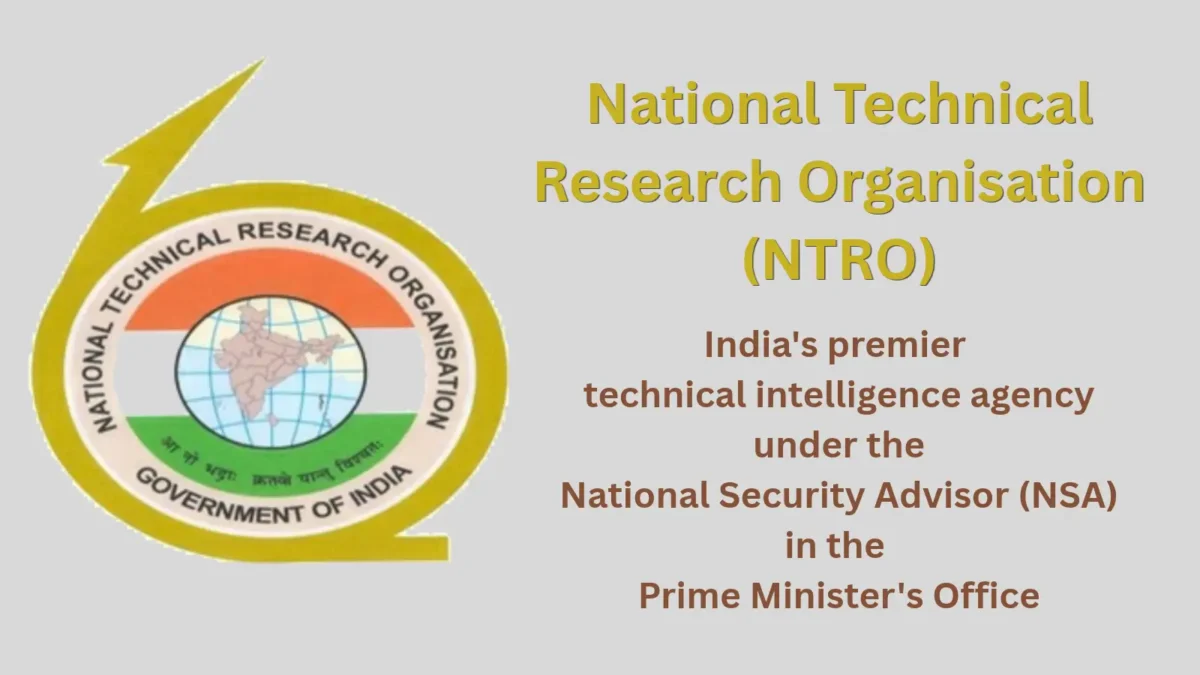
- Nature: A specialised technical intelligence organisation of the Government of India.
- Institutional association: Associated with the national security establishment under the National Security Adviser and the Prime Minister’s Office framework.
- Broad role: Developing and using technical capabilities for intelligence collection, analysis, strategic monitoring, and national security.
- Important associated institution: National Critical Information Infrastructure Protection Centre (NCIIPC), which is responsible for protecting critical information infrastructure.
- UPSC relevance: GS Paper III — national security, internal security, cyber threats, intelligence agencies, and emerging technologies.
Exam note: The operational details, intelligence methods, and classified activities of NTRO are not fully available in the public domain. Aspirants should focus on its publicly established institutional role and avoid treating unverified media claims as official information.
What Is the National Technical Research Organisation?
The National Technical Research Organisation is a specialised organisation that strengthens India’s intelligence capabilities through technical expertise and advanced information-gathering technologies. Traditional intelligence may depend on human sources, field reporting, and the analysis of information obtained through interpersonal networks. Technical intelligence complements these methods by using technological systems to collect, process, interpret, and assess relevant information.
Technical intelligence can involve the analysis of communications-related information, imagery, remote-sensing inputs, digital information, and other technology-derived data, depending on the capabilities and authorisations of the responsible organisation. Such information can help decision-makers understand developments that may affect national security, strategic interests, and the protection of critical infrastructure. The precise systems and operational techniques used by intelligence organisations should not be assumed unless confirmed by reliable public sources.
NTRO is therefore important because national security increasingly depends on the ability to understand complex technological environments. Satellite-based observation, digital communications, cyber threats, unmanned systems, and sophisticated information networks have expanded the range of challenges confronting intelligence agencies. A specialised technical intelligence organisation can help the government develop the technological capacity needed to assess these challenges.
Establishment and Background of NTRO
NTRO was established in 2004. Its creation formed part of India’s broader effort to strengthen national security and intelligence capabilities in the period following the Kargil conflict of 1999. The conflict exposed important weaknesses in intelligence assessment, coordination, surveillance, and the flow of information between relevant institutions. Subsequent reviews of India’s security arrangements encouraged reforms intended to improve intelligence collection, coordination, and the use of technology.
The Kargil Review Committee and the subsequent Group of Ministers review are important in understanding the broader background of India’s intelligence and security reforms. These reviews highlighted the need to improve the country’s ability to collect and assess intelligence and to strengthen coordination among different agencies. NTRO emerged within this wider reform environment as a specialised technical intelligence organisation.
For UPSC, the historical context is important because it connects NTRO with the larger question of intelligence reform in India. The establishment of specialised institutions reflects the recognition that national security cannot depend exclusively on conventional surveillance or human intelligence. It also requires technological expertise, analytical capacity, coordination, and the ability to respond to rapidly changing security threats.
Mandate and Functions of NTRO
1. Technical Intelligence
One of NTRO’s broad purposes is to strengthen India’s technical intelligence capacity. Technical intelligence refers to intelligence obtained or developed through technological means rather than relying exclusively on human sources. Depending on the context, technical intelligence may include information derived from communications systems, imagery, remote sensing, digital systems, and other specialised technical sources. The value of such information depends on its reliability, relevance, analysis, and lawful use.
2. Support for National Security Decision-Making
Security decisions require timely, credible, and carefully assessed information. Technical intelligence can help relevant authorities identify patterns, evaluate potential threats, and improve situational awareness. NTRO’s significance lies in its contribution to the wider national intelligence framework, where information collected or analysed through specialised technical capabilities can support informed assessments and strategic decision-making.
3. Technological Capability Development
Modern intelligence work requires specialised expertise in areas such as data processing, remote sensing, advanced computing, communications technology, and cyber-related analysis. Building domestic technical capabilities is strategically important because excessive dependence on external technologies can create vulnerabilities involving supply chains, access, reliability, and technological autonomy. NTRO is relevant to India’s broader effort to develop specialised technical expertise for national security purposes.
4. Contribution to Cybersecurity
Cybersecurity has become a major component of national security because government systems, financial networks, communication platforms, energy infrastructure, transport systems, and other essential services increasingly depend on digital technologies. Technical intelligence can contribute to understanding technology-related threats and the broader security environment. However, NTRO should not be confused with every organisation involved in cybersecurity: different institutions have distinct responsibilities for incident response, critical infrastructure protection, law enforcement, policy, and intelligence.
5. Support for Strategic Monitoring and Situational Awareness
Strategic monitoring involves developing an informed understanding of developments that may affect national interests. Technology-derived information can complement diplomatic reporting, human intelligence, military assessments, and open-source information. Its usefulness depends on the ability to combine different sources, assess uncertainty, and communicate findings to the appropriate decision-makers. Technical systems generate data, but effective intelligence also requires interpretation and sound judgement.
NTRO and the National Critical Information Infrastructure Protection Centre (NCIIPC)
The National Critical Information Infrastructure Protection Centre (NCIIPC) is an important institution associated with the protection of India’s critical information infrastructure and operates under NTRO’s institutional ambit. Critical information infrastructure refers to computer resources whose disruption or destruction could have a debilitating impact on national security, the economy, public health, or safety. Its protection is essential because attacks on interconnected digital systems can affect services far beyond the initial target.
Critical infrastructure may include important digital systems supporting sectors such as power, banking and financial services, telecommunications, transport, and other essential services. The precise designation of protected systems is governed by the applicable legal and administrative framework. Protecting such infrastructure involves identifying vulnerabilities, improving security practices, coordinating responses, and increasing resilience against cyber incidents.
NCIIPC’s role should be distinguished from that of the Indian Computer Emergency Response Team (CERT-In). NCIIPC focuses on protecting critical information infrastructure, whereas CERT-In performs broader national functions relating to cybersecurity incident response under its applicable mandate. Their work may complement one another, but the two institutions are not interchangeable.
NTRO, IB, R&AW, NIA, CERT-In and NCIIPC: Differences
UPSC questions on security agencies frequently test whether candidates understand the difference between intelligence collection, criminal investigation, cybersecurity incident response, and infrastructure protection. The following comparison provides a conceptual overview of the principal distinctions relevant to NTRO.
| Organisation | Broad role | Key distinction |
|---|---|---|
| NTRO | Specialised technical intelligence | Strengthens technology-based intelligence capabilities. |
| Intelligence Bureau (IB) | Domestic intelligence and internal security | Focuses on intelligence relevant to security within India. |
| Research and Analysis Wing (R&AW) | External intelligence | Focuses on intelligence concerning developments outside India. |
| National Investigation Agency (NIA) | Investigation of offences within its statutory jurisdiction | Investigates specified offences under applicable law; it is not simply an intelligence agency. |
| CERT-In | National cybersecurity incident response | Handles cybersecurity incident-response functions under its mandate. |
| NCIIPC | Protection of critical information infrastructure | Focuses on safeguarding designated critical information infrastructure. |
The distinction is especially important in Mains answers. Intelligence organisations gather, assess, or disseminate intelligence within their respective mandates; investigative agencies investigate offences under applicable laws; and cybersecurity institutions perform specialised incident-response or infrastructure-protection functions. Coordination is necessary because a single security incident may involve intelligence collection, technical analysis, criminal investigation, and the restoration of affected systems.
Why Is NTRO Important for India’s National Security?
1. Changing Nature of Security Threats
Security threats increasingly extend beyond conventional military conflict. State and non-state actors may exploit digital networks, advanced technologies, communication systems, and vulnerabilities in essential infrastructure. Technical intelligence can help authorities develop a better understanding of such threats and their potential implications.
2. Cybersecurity and Digital Dependence
India’s digital transformation has increased the importance of protecting interconnected systems. Disruption to essential digital services can affect economic activity, government operations, public confidence, and national security. Specialised technical capabilities are therefore an important component of a comprehensive security framework, alongside strong cybersecurity practices, incident response, and legal safeguards.
3. Intelligence-Led Decision-Making
Intelligence is valuable when it helps authorities make better decisions. Technical information can complement human intelligence, diplomatic reporting, military assessments, and publicly available information. Combining these sources can improve situational awareness and help decision-makers evaluate threats more systematically.
4. Strategic and Technological Autonomy
National security increasingly depends on advanced technological systems. Developing domestic expertise can reduce strategic dependence, improve the ability to evaluate emerging threats, and support the adaptation of technology to India’s security requirements. However, technological autonomy also requires skilled personnel, sustained research, secure supply chains, and investment in indigenous innovation.
Major Challenges Associated with Technical Intelligence
1. Rapid Technological Change
Technologies used for communication, encryption, artificial intelligence, data storage, and cyber operations evolve quickly. Intelligence organisations must continuously develop their expertise and adapt to new systems. A capability that is effective against one generation of technology may become less useful as new technologies emerge.
2. Data Overload and Analytical Limitations
Modern technical systems can generate enormous volumes of information. Collecting more data does not automatically produce better intelligence. Information must be filtered, verified, contextualised, and analysed by qualified personnel. Poor-quality data, false positives, incomplete information, or incorrect interpretation can result in misleading assessments.
3. Coordination Between Agencies
India’s security framework includes several intelligence, investigative, military, and cybersecurity institutions. Each institution has its own mandate, procedures, expertise, and information requirements. Fragmented information systems or unclear responsibilities can delay responses and reduce the value of otherwise useful intelligence. Secure information-sharing arrangements and clear coordination mechanisms are therefore essential.
4. Cybersecurity and Supply-Chain Risks
Technical intelligence systems depend on hardware, software, networks, storage, and specialised equipment. These components can themselves become targets of cyberattacks, espionage, sabotage, or supply-chain compromise. Secure procurement, robust access controls, regular assessments, and resilient system design are important for protecting sensitive capabilities.
5. Privacy, Civil Liberties and Legal Safeguards
Technology-enabled information collection can raise concerns about privacy, surveillance, and the potential misuse of personal information. National security is a legitimate public objective, but intelligence activities should operate within the applicable legal framework and appropriate authorisations. Clear rules, safeguards against misuse, secure handling of information, and suitable oversight mechanisms help reconcile security requirements with constitutional values and civil liberties.
6. Skilled Human Resources
Technical intelligence requires expertise in fields such as computer science, data analysis, communications, electronics, remote sensing, cryptology, and cybersecurity. Recruiting and retaining skilled professionals can be challenging because public institutions compete with private-sector organisations for specialised talent. Continuous training and collaboration with credible research institutions can help address these capacity gaps.
Reforms Needed to Strengthen India’s Technical Intelligence Framework
India should continue investing in indigenous research and development, secure digital infrastructure, advanced analytical tools, and specialised technical training. Domestic capability development can improve resilience and reduce exposure to external technological dependencies. Research partnerships should be structured carefully to protect sensitive information and maintain appropriate security standards.
Better coordination among intelligence agencies, cybersecurity institutions, law-enforcement bodies, and relevant ministries is equally important. Secure information-sharing platforms, clearly defined responsibilities, common response procedures, and regular joint exercises can reduce institutional fragmentation. Coordination must also respect each organisation’s legal mandate and the sensitivity of intelligence information.
India should strengthen critical infrastructure resilience through regular risk assessments, vulnerability management, incident-response planning, secure procurement, and the development of skilled cybersecurity personnel. Essential service providers should have appropriate mechanisms to identify threats, report incidents, recover operations, and learn from previous disruptions.
Finally, technical capability must be accompanied by accountability and safeguards. Appropriate authorisation, protection of sensitive data, secure record management, and oversight consistent with the applicable legal framework can help prevent misuse while maintaining operational effectiveness. The objective should be to create a technically advanced, coordinated, and legally responsible national security architecture.
NTRO and the UPSC Syllabus
NTRO is primarily relevant to General Studies Paper III under the broad themes of internal security, cybersecurity, communication networks, and the role of security agencies. It can also be connected with science and technology, particularly the application of advanced technologies to national security and the development of indigenous capabilities.
- GS Paper III: Various security forces and agencies and their mandate.
- GS Paper III: Challenges to internal security through communication networks and the basics of cybersecurity.
- GS Paper III: Emerging technologies and their implications for security.
- Essay: Technology, national security, privacy, and democratic accountability.
- Interview: Intelligence coordination, critical infrastructure protection, and India’s technological preparedness.
UPSC Previous Year Questions (PYQs) Related to NTRO
Important clarification: The following are genuine UPSC Mains questions on broader internal-security themes relevant to NTRO. They are not questions specifically asking about NTRO unless the wording explicitly says so. They are included because they provide a useful framework for preparing NTRO-related answers.
UPSC CSE Mains 2023 — GS Paper III
Question: What are the internal security challenges being faced by India? Give out the role of Central Intelligence and Investigative Agencies tasked to counter such threats.
Relevance to NTRO: This question directly provides an opportunity to discuss the role of technical intelligence within India’s wider security architecture. An answer should distinguish intelligence organisations from investigative agencies and explain why coordination, technological capability, and information-sharing are essential.
UPSC CSE Mains 2017 — GS Paper III
Question: Discuss the potential threats of cyberattack and the security framework to prevent it.
Relevance to NTRO: This question can be connected with the role of technical capabilities in understanding cyber threats and the responsibilities of institutions such as CERT-In and NCIIPC. Candidates should avoid suggesting that all cybersecurity functions belong to NTRO.
UPSC CSE Mains 2021 — GS Paper III
Question: Keeping in view India’s internal security, analyse the impact of cross-border cyber-attacks. Also discuss defensive measures against these sophisticated attacks.
Relevance to NTRO: This question provides a basis for discussing technical intelligence, threat assessment, critical infrastructure protection, inter-agency coordination, and the need to strengthen India’s cyber resilience.
For the original wording and complete papers, consult the official UPSC Previous Question Papers portal.
Practice MCQs on NTRO for UPSC Prelims
Question 1
Consider the following statements about the National Technical Research Organisation (NTRO):
1. It was established in 2004.
2. It is a specialised technical intelligence organisation.
3. Its principal function is to investigate all terrorism-related criminal cases in India.
Which of the statements given above are correct?
- (a) 1 only
- (b) 1 and 2 only
- (c) 2 and 3 only
- (d) 1, 2 and 3
Correct answer: (b) 1 and 2 only.
Explanation: NTRO was established in 2004 and is a specialised technical intelligence organisation. Investigating specified terrorism-related offences falls within the statutory jurisdiction of the National Investigation Agency and other competent law-enforcement authorities, not NTRO’s defining role.
Question 2
Which of the following best describes technical intelligence?
- (a) Intelligence obtained exclusively through interviews with human sources.
- (b) Intelligence derived through technological systems and technical analysis.
- (c) Information collected only from newspaper editorials.
- (d) Judicial evidence produced exclusively by courts.
Correct answer: (b).
Explanation: Technical intelligence uses technology-derived information and specialised analysis. It complements other sources of intelligence rather than necessarily replacing them.
Question 3
The National Critical Information Infrastructure Protection Centre (NCIIPC) is primarily associated with:
- (a) Conducting civil services examinations.
- (b) Investigating every category of cybercrime.
- (c) Protecting critical information infrastructure.
- (d) Managing India’s monetary policy.
Correct answer: (c).
Explanation: NCIIPC focuses on protecting critical information infrastructure whose disruption could have serious consequences for national security, the economy, public health, or safety.
Question 4
Consider the following pairs:
1. NTRO — Technical intelligence
2. NIA — Investigation of specified offences under its statutory jurisdiction
3. CERT-In — Cybersecurity incident response
4. NCIIPC — Protection of critical information infrastructure
How many of the pairs given above are correctly matched?
- (a) Only one
- (b) Only two
- (c) Only three
- (d) All four
Correct answer: (d) All four.
Explanation: Each organisation has a distinct principal role. Understanding these differences is important for both Prelims elimination techniques and analytical Mains answers.
Question 5
Which of the following is the most appropriate reason for developing indigenous technical intelligence capabilities?
- (a) To eliminate the need for all human intelligence.
- (b) To remove every legal restriction on surveillance.
- (c) To strengthen technological autonomy and reduce strategic dependence.
- (d) To transfer criminal investigations to technical intelligence agencies.
Correct answer: (c).
Explanation: Indigenous capabilities can strengthen resilience, technological autonomy, and the ability to address security requirements. They do not eliminate the need for human intelligence, legal safeguards, or specialised investigative agencies.
Question 6
Which of the following is the most appropriate distinction between NTRO and CERT-In?
- (a) Both organisations have exactly the same mandate.
- (b) NTRO is associated with technical intelligence, while CERT-In performs cybersecurity incident-response functions.
- (c) CERT-In investigates all national security offences, while NTRO conducts civil trials.
- (d) NTRO is responsible for regulating India’s banking interest rates.
Correct answer: (b).
Explanation: The organisations perform different functions within the broader security framework. Technical intelligence and cybersecurity incident response may complement one another, but they are not identical responsibilities.
UPSC Mains Long-Answer Questions on NTRO
The following questions are practice questions designed for answer-writing preparation. They are not claimed to be actual UPSC previous-year questions.
Question 1 — 10 Marks, 150 Words
What is the National Technical Research Organisation (NTRO)? Explain its significance in India’s national security architecture.
Question 2 — 10 Marks, 150 Words
Differentiate between NTRO, the Intelligence Bureau, R&AW, NIA, CERT-In, and NCIIPC with reference to their broad mandates.
Question 3 — 15 Marks, 250 Words
Technology has transformed the nature of intelligence gathering and national security. Discuss the role of specialised technical intelligence organisations in addressing India’s emerging security challenges.
Question 4 — 15 Marks, 250 Words
India’s critical information infrastructure is increasingly exposed to sophisticated cyber threats. Examine the importance of technical intelligence and institutional coordination in strengthening national cyber resilience.
Question 5 — 15 Marks, 250 Words
Discuss the major challenges facing India’s technical intelligence framework. Suggest measures to improve technological capability, coordination, and institutional effectiveness.
Question 6 — 15 Marks, 250 Words
National security and individual privacy may sometimes come into tension in the digital age. Examine how intelligence institutions can balance legitimate security requirements with legal safeguards and democratic accountability.
Model Answer Framework for Mains
Question: Technology has transformed the nature of intelligence gathering and national security. Discuss the role of specialised technical intelligence organisations in addressing India’s emerging security challenges.
Introduction: The growing use of digital communication, advanced surveillance technologies, satellite-based systems, and interconnected infrastructure has transformed national security. Specialised technical intelligence organisations such as NTRO contribute to India’s capacity to assess technology-related threats and strengthen strategic awareness.
Body — Role: Technical intelligence can complement human intelligence, support threat assessment, improve situational awareness, and contribute to the understanding of emerging technological risks. Specialised capabilities are also relevant to cybersecurity, strategic monitoring, and the protection of critical information infrastructure. NTRO must be understood as part of a wider ecosystem involving intelligence agencies, investigative institutions, cybersecurity bodies, and the armed forces.
Body — Challenges: Important challenges include rapid technological change, data overload, shortages of specialised personnel, fragmented information-sharing, cyber vulnerabilities, supply-chain risks, and concerns about privacy and misuse. Technical information is not automatically accurate or actionable; its value depends on verification, interpretation, and effective coordination.
Way forward: India should invest in indigenous research, specialised recruitment, secure technology infrastructure, inter-agency coordination, analytical training, and resilience testing. Clear legal safeguards and suitable oversight should accompany the development and use of technical capabilities.
Conclusion: Technical intelligence is an essential component of modern national security, but its effectiveness depends on the integration of technology, human expertise, institutional coordination, and accountability. A resilient and technologically capable intelligence framework can help India respond more effectively to evolving security threats.
Conclusion
The National Technical Research Organisation is an important component of India’s specialised technical intelligence framework. Its relevance has increased as national security becomes more closely connected with digital systems, advanced technologies, cyber threats, and critical infrastructure. For UPSC aspirants, the most useful approach is to understand NTRO’s broad mandate, distinguish it from investigative and cybersecurity agencies, and connect the topic with the GS Paper III syllabus.
A strong Mains answer should move beyond a description of the organisation. It should explain the changing nature of intelligence, the need for technological autonomy, the importance of coordination, and the need to balance national security with legal safeguards. This approach will help aspirants use NTRO as a relevant example in broader answers on internal security, cybersecurity, emerging technologies, and intelligence reform.
Sources and Further Reading
- National Technical Research Organisation — official website
- UNIDIR Cyber Policy Portal — NTRO institutional profile
- UPSC — Previous Question Papers
- Observer Research Foundation — India’s Enduring Challenge of Intelligence Reforms
Preparation tip: Revise NTRO alongside IB, R&AW, NIA, CERT-In, and NCIIPC. Focus on mandates, inter-agency coordination, cybersecurity, critical infrastructure, and the constitutional and legal safeguards relevant to national security.