What is the UPSC CSE – Civil Services Examination?
The UPSC CSE (Civil Services Examination) is conducted every year by Union Public Service Commission (UPSC) to recruit eligible candidates for various prestigious civil services and posts under the Government of India. It is one of the most competitive examinations in the country and provides an opportunity to enter India’s higher administrative, diplomatic, police, revenue, audit and other public services.
Popularly known as the UPSC CSE or UPSC Civil Services Examination or simply the UPSC exam, it is the principal direct recruitment examination for services such as the Indian Administrative Service (IAS), Indian Foreign Service (IFS), Indian Police Service (IPS), Indian Revenue Service (IRS) and several other Group A and Group B services.
The examination is conducted through a three-stage selection process consisting of the Civil Services (Preliminary) Examination, the Civil Services (Main) Examination and the Personality Test (Interview). Candidates must qualify at each successive stage to remain eligible for consideration for final selection.
The Civil Services Examination is designed to identify individuals with intellectual ability, analytical skills, administrative aptitude, integrity, leadership qualities and a commitment to public service. Selected candidates are appointed to different services according to their final merit rank, category, service preferences and the availability of vacancies, subject to the applicable rules.
- About UPSC
- UPSC CSE – Civil Services Exam
- UPSC CSE Eligibility
- UPSC CSE Age Limits
- UPSC CSE Attempts
- UPSC CSE Statistics
- UPSC CSE Exam Pattern
- UPSC CSE – Prelims Exam Pattern
- UPSC CSE – Mains Exam Pattern
- UPSC CSE Exam Pattern Changes
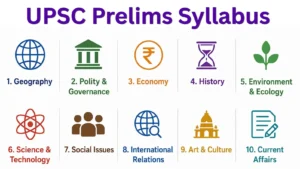
- UPSC CSE Prelims Syllabus
- UPSC CSE Prelims Books
- UPSC CSE Mains Syllabus
- UPSC CSE Mains Books
What is the Purpose of the UPSC CSE?
The primary purpose of the UPSC CSE (Civil Services Exam) is to select suitable candidates for the effective administration and governance of the country. Civil servants play an important role in implementing government policies, maintaining law and order, managing public resources, delivering public services and ensuring the functioning of government institutions.
India has a permanent civil service that continues to function irrespective of changes in the political leadership of the country. Civil servants assist elected governments in policy formulation and implementation while ensuring continuity, administrative efficiency and institutional stability.
Through the Civil Services Examination, the Government of India seeks to recruit capable individuals who can perform diverse responsibilities at the Union, State and district levels.
Some of the major objectives of the examination are:
- To recruit competent and suitable individuals for various All India Services and Central Civil Services.
- To ensure merit-based selection through a transparent and competitive examination.
- To identify candidates with administrative aptitude, analytical thinking and decision-making abilities.
- To recruit officers capable of implementing government policies and development programmes.
- To strengthen public administration, governance and delivery of public services.
- To provide equal opportunities to eligible candidates from different educational, social and economic backgrounds, subject to applicable reservation provisions.
History of the Civil Services Examination in India
The history of the Civil Services Examination in India can be traced to the development of the British administrative system during colonial rule. The modern civil services structure evolved gradually through several administrative reforms introduced by the British Government.
Beginning of the Civil Services in India
During the early period of British rule, appointments to the East India Company’s administrative services were largely controlled through patronage and nomination. The Charter Act of 1833 introduced an important principle by declaring that no Indian subject should be disqualified from holding any office under the Company by reason of religion, place of birth, descent or colour.
The Macaulay Committee, appointed in 1854, recommended introducing a system of competitive examinations for recruitment to the Indian Civil Service (ICS). Following these recommendations, competitive recruitment was introduced, and the first examination for the Indian Civil Service was held in London in 1855.
Initially, Indian candidates faced considerable difficulties in appearing for the examination because it was conducted in England and had an upper age limit that was subsequently reduced. Satyendranath Tagore became the first Indian to qualify for the Indian Civil Service in 1863.
Beginning of Civil Services Examination in India
For several decades, the competitive examination for the Indian Civil Service was conducted in London. The demand for conducting the examination in India gradually increased as part of the broader movement for greater Indian participation in administration.
Following the recommendations of the Islington Commission (1912), the Government of India Act, 1919 provided for the establishment of a Public Service Commission in India. Subsequently, the Lee Commission (1924) recommended the establishment of a Public Service Commission.
On 1 October 1926, the first Public Service Commission was established in India under the chairmanship of Sir Ross Barker. It was the predecessor of the present Union Public Service Commission.
The Government of India Act, 1935 provided for the establishment of the Federal Public Service Commission and Provincial Public Service Commissions. The Federal Public Service Commission came into existence on 1 April 1937.
UPSC after Independence
After India became independent on 15 August 1947, the Federal Public Service Commission was renamed the Union Public Service Commission. The Constitution of India, which came into force on 26 January 1950, accorded constitutional status to the Commission under Articles 315 to 323.
The UPSC subsequently continued to conduct competitive examinations for recruitment to various civil services and other posts under the Union Government. The present Civil Services Examination evolved through changes in its structure, syllabus, eligibility conditions and selection process over the years.
Which Authority Conducts the Civil Services Examination?
The Union Public Service Commission (UPSC), a constitutional body established under Article 315 of the Constitution of India, conducts the Civil Services Examination.
The Commission is responsible for conducting the examination in accordance with the rules notified by the Government of India. It issues examination notifications, receives applications, conducts the Preliminary and Main examinations, organises the Personality Test and recommends candidates for appointment to the participating services.
Although UPSC conducts the examination and recommends successful candidates, the Department of Personnel and Training (DoPT), Ministry of Personnel, Public Grievances and Pensions, Government of India, plays a major role in framing examination rules, coordinating service allocation and managing related administrative matters.
For more information, read our detailed article on About UPSC – Union Public Service Commission.
UPSC and Civil Services Examination: What is the Difference?
UPSC and the Civil Services Examination are closely related but are not the same thing. UPSC is the constitutional institution responsible for conducting various examinations and recruitment-related functions, whereas the Civil Services Examination is one of the examinations conducted by the Commission.
| Basis | UPSC | Civil Services Examination |
|---|---|---|
| Meaning | Union Public Service Commission | Civil Services Examination (CSE) |
| Nature | Constitutional body | Competitive recruitment examination |
| Constitutional provisions | Articles 315–323 | Conducted under examination rules notified by the Government |
| Primary function | Conducts examinations and performs recruitment-related functions | Selects candidates for specified civil services and posts |
| Scope | Conducts several examinations and recruitment processes | One of the major examinations conducted by UPSC |
Which Services are Recruited Through the UPSC CSE (Civil Services Examination)?
The Civil Services Examination is conducted to fill vacancies in various All India Services and Central Civil Services of the Union Government. These services include administrative, police, diplomatic, revenue, audit, accounts, railway, information, defence and other specialised administrative services.
The exact list of participating services and posts may vary depending on the examination year and the vacancies notified by the Government.
List of Services Under UPSC Civil Services Examination 2026
Under the Civil Services Examination Rules, 2026, recruitment is conducted for the following services and posts:
All India Services
- Indian Administrative Service (IAS)
- Indian Foreign Service (IFS)
- Indian Police Service (IPS)
Central Civil Services – Group A
- Indian Audit and Accounts Service (IA&AS)
- Indian Civil Accounts Service (ICAS)
- Indian Corporate Law Service (ICLS)
- Indian Defence Accounts Service (IDAS)
- Indian Defence Estates Service (IDES)
- Indian Information Service (IIS)
- Indian Postal Service (IPoS)
- Indian Post and Telecommunication Accounts and Finance Service (IP&TAFS)
- Indian Railway Management Service (Accounts)
- Indian Railway Management Service (Personnel)
- Indian Railway Management Service (Traffic)
- Indian Railway Protection Force Service (IRPFS)
- Indian Revenue Service (Customs and Indirect Taxes)
- Indian Revenue Service (Income Tax)
- Indian Trade Service (Grade III)
Central Civil Services – Group B
- Armed Forces Headquarters Civil Service (Section Officers’ Grade)
- Delhi, Andaman and Nicobar Islands, Lakshadweep, Daman and Diu and Dadra and Nagar Haveli Civil Service (DANICS)
- Delhi, Andaman and Nicobar Islands, Lakshadweep, Daman and Diu and Dadra and Nagar Haveli Police Service (DANIPS)
- Pondicherry Civil Service (PONDICS)
- Pondicherry Police Service (PONDIPS)
Important: The above list is based on the participating services specified in the Civil Services Examination Rules, 2026. Candidates should consult the notification for their respective examination year to verify the services and posts included in that year’s recruitment.
Difference Between All India Services and Central Civil Services
The services recruited through the Civil Services Examination are broadly classified into All India Services and Central Civil Services.
All India Services
All India Services are common to the Union and State Governments. Officers belonging to these services are recruited by the Union Government and are allocated to different State cadres or joint cadres. They serve under both the Union and State Governments during their careers, according to applicable service rules.
There are three All India Services:
- Indian Administrative Service (IAS): Responsible for public administration, policy implementation, district administration and various administrative functions.
- Indian Police Service (IPS): Responsible for police administration, law enforcement, internal security and maintenance of public order.
- Indian Forest Service (IFoS): Responsible for forest management, wildlife conservation and environmental protection.
Note: The Indian Forest Service (IFoS) is a separate All India Service and is recruited through a separate examination conducted by UPSC. Its Preliminary Examination is the same Civil Services Preliminary Examination, but its Main Examination is separate from the Civil Services Main Examination.
Central Civil Services
Central Civil Services are services administered by the Union Government. Officers belonging to these services generally work in Central Government ministries, departments, attached offices, field organisations and other specialised institutions.
Some examples include the Indian Foreign Service, Indian Revenue Service, Indian Audit and Accounts Service, Indian Civil Accounts Service and Indian Information Service.
UPSC Civil Services Examination Eligibility Criteria
A candidate must fulfil the prescribed eligibility conditions to appear in the Civil Services Examination. The major eligibility requirements relate to nationality, age, educational qualifications and the number of attempts. Certain services also prescribe specific physical and medical standards.
The eligibility conditions are specified in the examination rules and the annual notification issued by UPSC.
1. Nationality
The nationality requirement depends on the service for which a candidate seeks appointment.
For the Indian Administrative Service (IAS), Indian Foreign Service (IFS) and Indian Police Service (IPS), a candidate must be a citizen of India.
For other services, candidates may belong to the following categories, subject to the conditions and eligibility certificate requirements prescribed in the examination rules:
- A citizen of India.
- A subject of Nepal.
- A subject of Bhutan.
- A Tibetan refugee who came to India before 1 January 1962 with the intention of permanently settling in India.
- A person of Indian origin who has migrated from specified countries with the intention of permanently settling in India, subject to the prescribed conditions.
2. Educational Qualification
A candidate must possess a bachelor’s degree from a recognised university or an equivalent qualification to be eligible for the Civil Services Examination.
The degree must be awarded by a university established by an Act of the Central or State Legislature, an institution established by an Act of Parliament, or an institution recognised as a deemed university under Section 3 of the University Grants Commission Act, 1956.
Important points regarding educational qualification:
- Candidates from any academic discipline, including arts, science, commerce, engineering, medicine and other recognised fields, can apply.
- There is no requirement to have studied a particular subject at the graduation level.
- Candidates appearing in the final year of their qualifying degree examination may also apply provisionally, subject to the prescribed conditions.
- Candidates who qualify for the Personality Test must produce proof of passing the qualifying examination within the prescribed time limit.
3. Age Limit
For the Civil Services Examination, the minimum age is 21 years, while the upper age limit for candidates belonging to the General and Economically Weaker Sections (EWS) categories is 32 years, subject to the applicable age calculation date and relaxation provisions.
For the Civil Services Examination 2026, the candidate’s age is calculated as on 1 August 2026.
| Category | Minimum Age | Maximum Age |
|---|---|---|
| General / EWS | 21 years | 32 years |
| OBC | 21 years | 35 years |
| SC / ST | 21 years | 37 years |
| Persons with Benchmark Disabilities (PwBD) | 21 years | As per applicable category-wise relaxation |
The upper age limit is relaxed by three years for eligible OBC candidates and five years for eligible SC/ST candidates. PwBD candidates receive the prescribed relaxation, generally up to ten years, subject to the applicable category and examination rules. Certain defence personnel and ex-servicemen are also eligible for specified relaxations.
For the exact birth-date limits and applicable relaxations, candidates must refer to the notification of the relevant examination year.
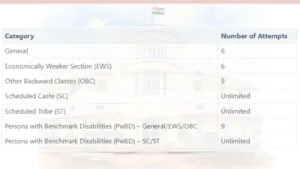
4. Number of Attempts
The number of attempts permitted in the Civil Services Examination varies according to the candidate’s category.
| Category | Maximum Number of Attempts |
|---|---|
| General / EWS | 6 |
| OBC | 9 |
| SC / ST | Unlimited, subject to the prescribed age limit |
| PwBD – General / EWS | 9 |
| PwBD – OBC | 9 |
| PwBD – SC / ST | Unlimited, subject to the prescribed age limit |
An important point is that merely submitting the application form does not count as an attempt. An attempt is counted when a candidate actually appears in at least one paper of the Civil Services Preliminary Examination. Even if the candidature is subsequently cancelled or the candidate is disqualified, the appearance is counted as an attempt.
5. Physical and Medical Standards
Candidates must satisfy the medical and physical standards prescribed for the services to which they may be allocated. These requirements vary depending on the nature of the service and the duties involved.
For example, the Indian Police Service has specific physical and medical requirements. Other services also have prescribed medical fitness standards.
Medical examination is an essential part of the selection and appointment process. Candidates called for the Personality Test are required to undergo the prescribed medical examination in accordance with the applicable rules.
UPSC Civil Services Examination Pattern
The Civil Services Examination consists of two successive examination stages:
- Civil Services (Preliminary) Examination: An objective-type screening examination for selecting candidates for the Main Examination.
- Civil Services (Main) Examination: A written examination followed by the Personality Test (Interview) for final selection.
Although the Main Examination includes both a written examination and an interview, the selection process is commonly described as having three stages: Prelims, Mains and Interview.
Stages of the UPSC Civil Services Examination
| Stage | Examination | Nature |
|---|---|---|
| Stage I | Preliminary Examination | Objective type (MCQs) |
| Stage II | Main Examination | Descriptive written examination |
| Stage III | Personality Test | Interview |
UPSC Civil Services Preliminary Examination
The Civil Services Preliminary Examination is the first stage of the selection process. It is conducted to screen candidates for admission to the Civil Services Main Examination.
The Preliminary Examination consists of two compulsory objective-type papers:
| Paper | Subject | Maximum Marks | Duration |
|---|---|---|---|
| Paper I | General Studies | 200 | 2 hours |
| Paper II | General Studies Paper II (CSAT) | 200 | 2 hours |
| Total | 400 |
General Studies Paper I
General Studies Paper I assesses the candidate’s knowledge of a wide range of subjects, including current affairs, history, geography, Indian polity, economy, environment and general science.
The marks obtained in this paper are used to determine the Preliminary Examination merit and the cut-off for qualifying for the Main Examination.
General Studies Paper II (CSAT)
General Studies Paper II, commonly known as the Civil Services Aptitude Test (CSAT), evaluates a candidate’s comprehension, logical reasoning, analytical ability, decision-making, problem-solving and basic numerical aptitude.
CSAT is a qualifying paper. A candidate must secure at least 33% marks, equivalent to 66 out of 200 marks, to qualify in this paper. However, merely securing the qualifying marks in CSAT does not guarantee qualification for the Main Examination. The candidate must also meet the prescribed cut-off in General Studies Paper I.
Negative Marking in Preliminary Examination
There is negative marking for incorrect answers in the Preliminary Examination. For every incorrect answer, one-third of the marks assigned to that question is deducted.
- Correct answer: Marks are awarded as assigned to the question.
- Incorrect answer: One-third of the marks assigned to the question is deducted.
- Unanswered question: No marks are deducted.
- More than one answer marked: Treated as an incorrect answer, even if one of the marked answers is correct.
The marks obtained in the Preliminary Examination are not counted in preparing the final merit list. The examination serves only as a screening stage.
UPSC Civil Services Main Examination
Candidates who qualify in the Preliminary Examination are eligible to appear in the Civil Services Main Examination, subject to the prescribed eligibility conditions.
The Main Examination is descriptive in nature and is designed to assess a candidate’s in-depth understanding of subjects, analytical ability, critical thinking, expression, problem-solving skills and suitability for public service.
The written examination consists of nine papers, of which seven papers are counted for determining merit and two are qualifying in nature.
Structure of the Main Examination
| Paper | Subject | Marks | Nature |
|---|---|---|---|
| Paper A | One Indian Language | 300 | Qualifying |
| Paper B | English | 300 | Qualifying |
| Paper I | Essay | 250 | Merit |
| Paper II | General Studies I | 250 | Merit |
| Paper III | General Studies II | 250 | Merit |
| Paper IV | General Studies III | 250 | Merit |
| Paper V | General Studies IV | 250 | Merit |
| Paper VI | Optional Subject – Paper I | 250 | Merit |
| Paper VII | Optional Subject – Paper II | 250 | Merit |
| Total | 2500 |
Out of the total 2500 marks, 300 marks each are assigned to the two qualifying language papers. The remaining 1750 marks are counted for merit ranking in the written examination.
Paper A – Indian Language
This paper carries 300 marks and is qualifying in nature. Candidates must select one language from the languages included in the Eighth Schedule to the Constitution of India, subject to the prescribed rules and exemptions.
The paper is intended to assess the candidate’s ability to read, understand and express ideas in an Indian language.
Paper B – English
The English paper carries 300 marks and is also qualifying in nature. It evaluates comprehension, precise writing, vocabulary, grammar and other language skills.
The marks obtained in Paper A and Paper B are not counted for the final merit ranking. Candidates must, however, obtain the prescribed qualifying marks in both papers.
Paper I – Essay
The Essay paper carries 250 marks. Candidates are required to write essays on topics covering a wide range of subjects. The paper assesses the ability to organise ideas, present arguments logically, maintain clarity of expression and provide a balanced perspective on different issues.
Paper II – General Studies I
General Studies Paper I carries 250 marks and covers Indian heritage and culture, history, geography of the world and society.
Major areas include:
- Indian culture, art forms, literature and architecture.
- Modern Indian history and the freedom struggle.
- Post-independence consolidation and reorganisation within the country.
- World history, including industrialisation, world wars and political ideologies.
- Indian society and its salient features.
- Social empowerment, communalism, regionalism and secularism.
- Physical geography of the world.
- Distribution of natural resources and geographical phenomena.
Paper III – General Studies II
General Studies Paper II carries 250 marks and focuses on governance, the Constitution, polity, social justice and international relations.
Major areas include:
- Indian Constitution and its features.
- Functions and responsibilities of the Union and State Governments.
- Parliament and State Legislatures.
- Executive and Judiciary.
- Constitutional, statutory and regulatory bodies.
- Government policies and interventions.
- Welfare schemes and social sector initiatives.
- Issues relating to health, education and human resources.
- Governance, transparency and accountability.
- India’s relations with neighbouring countries and major global powers.
- International institutions and organisations.
Paper IV – General Studies III
General Studies Paper III carries 250 marks and covers technology, economic development, biodiversity, environment, security and disaster management.
Major areas include:
- Indian economy and planning.
- Inclusive growth and resource mobilisation.
- Government budgeting.
- Agriculture and related issues.
- Food processing and agricultural marketing.
- Infrastructure and investment models.
- Science and technology developments.
- Information technology, space and biotechnology.
- Environmental conservation and biodiversity.
- Internal security and cyber security.
- Disaster management.
Paper V – General Studies IV
General Studies Paper IV carries 250 marks and deals with ethics, integrity and aptitude. It assesses the ethical and moral dimensions of a candidate’s decision-making and administrative conduct.
Major areas include:
- Ethics and human interface.
- Human values and attitude.
- Integrity and impartiality in public service.
- Emotional intelligence.
- Probity in governance.
- Ethical issues in public administration.
- Accountability and transparency.
- Case studies on ethical dilemmas.
Paper VI and Paper VII – Optional Subject
Candidates are required to choose one optional subject from the list prescribed by UPSC. The optional subject consists of two papers, each carrying 250 marks, making a total of 500 marks.
The optional subject allows candidates to demonstrate specialised knowledge and understanding of a particular academic discipline or subject area.
List of Optional Subjects in UPSC Mains
The optional subjects prescribed for the Civil Services Main Examination include the following:
- Agriculture
- Animal Husbandry and Veterinary Science
- Anthropology
- Botany
- Chemistry
- Civil Engineering
- Commerce and Accountancy
- Economics
- Electrical Engineering
- Geography
- Geology
- History
- Law
- Management
- Mathematics
- Mechanical Engineering
- Medical Science
- Philosophy
- Physics
- Political Science and International Relations
- Psychology
- Public Administration
- Sociology
- Statistics
- Zoology
In addition to these subjects, candidates can choose literature of one of the languages prescribed by UPSC, including Assamese, Bengali, Bodo, Dogri, Gujarati, Hindi, Kannada, Kashmiri, Konkani, Maithili, Malayalam, Manipuri, Marathi, Nepali, Odia, Punjabi, Sanskrit, Santhali, Sindhi, Tamil, Telugu and Urdu, as well as English literature.
UPSC Civil Services Personality Test (Interview)
The Personality Test is the final stage of the Civil Services Examination. Candidates who qualify in the written Main Examination are called for an interview conducted by a board constituted by UPSC.
The Personality Test carries 275 marks. It is not merely a test of academic knowledge or factual information. Its objective is to assess the overall suitability of a candidate for a career in public service.
The interview board may ask questions about the candidate’s educational background, home state, district, hobbies, interests, work experience, current affairs and other subjects of general interest.
The Personality Test broadly assesses the following qualities:
- Mental alertness and intellectual ability.
- Critical thinking and analytical skills.
- Clarity of expression and logical reasoning.
- Balance of judgement and decision-making ability.
- Depth and variety of interests.
- Leadership and social cohesion.
- Awareness of national and international developments.
- Integrity, honesty and ethical values.
- Suitability for a career in public administration.
There is no separate minimum qualifying mark prescribed for the Personality Test. The marks obtained are added to the marks of the seven merit-based written papers to determine the final ranking.
UPSC Civil Services Examination Marks Distribution
The final merit list is prepared on the basis of marks obtained in the seven merit-based papers of the Main Examination and the Personality Test.
| Examination Component | Marks | Counted for Final Merit? |
|---|---|---|
| Preliminary Examination | 400 | No |
| Qualifying Language Papers (Mains) | 600 | No |
| Seven Merit Papers (Mains) | 1750 | Yes |
| Personality Test | 275 | Yes |
| Total for Final Merit | 2025 | Yes |
Therefore, the final merit list is prepared out of 2025 marks, comprising 1750 marks from the written Main Examination and 275 marks from the Personality Test.
UPSC Civil Services Examination Syllabus
The Civil Services Examination syllabus covers a wide range of subjects relating to Indian history, geography, polity, economy, society, science and technology, environment, international relations, ethics and current affairs.
The syllabus is designed to assess not only factual knowledge but also conceptual understanding, analytical ability, critical thinking and the capacity to apply knowledge to real-world administrative situations.
The Preliminary Examination primarily tests general awareness and aptitude, while the Main Examination evaluates the candidate’s ability to analyse complex issues and present structured, well-reasoned answers.
The complete syllabus is prescribed in the official examination rules and notification issued by UPSC. Candidates should always refer to the official syllabus rather than relying exclusively on summaries or coaching material.
Language and Medium of the Civil Services Examination
The Civil Services Examination provides candidates with the option to write the Main Examination in English or in one of the languages included in the Eighth Schedule to the Constitution, subject to the prescribed rules.
The Preliminary Examination question papers are generally set in both Hindi and English. The compulsory language papers in the Main Examination assess proficiency in English and the selected Indian language, subject to applicable exemptions.
Candidates are required to indicate their preferred medium in the application process and follow the prescribed rules for the written examination and Personality Test.
How to Apply for the UPSC Civil Services Examination?
UPSC invites applications for the Civil Services Examination through its official online application portal. Candidates are required to complete the registration and application process within the dates specified in the examination notification.
The general application process involves the following steps:
- Visit the official UPSC website and access the online application portal.
- Complete the prescribed registration process and create the required candidate profile.
- Fill in the application form with personal, educational and other relevant details.
- Provide the required category, nationality and other eligibility information.
- Upload the documents, photograph and signature in the prescribed format, wherever required.
- Pay the examination fee, if applicable.
- Review the information entered in the application form.
- Submit the application and retain the confirmation and application details.
Candidates should carefully read the official notification before submitting the application. Incorrect information or failure to meet eligibility conditions may result in cancellation of candidature.
UPSC Civil Services Examination Fee
The examination fee is specified in the annual notification issued by UPSC. The fee and applicable exemptions should be checked in the notification for the relevant examination year.
Under the prevailing fee structure, candidates belonging to the General, OBC and EWS categories are ordinarily required to pay the prescribed application fee, while women candidates and candidates belonging to SC, ST and PwBD categories are exempt, subject to the applicable rules.
Selection Process of the UPSC Civil Services Examination
The selection process involves several stages, beginning with the submission of the application form and ending with the recommendation and allocation of successful candidates to different services.
- Notification: UPSC publishes the examination notification containing vacancies, eligibility conditions, examination dates and other relevant information.
- Application: Eligible candidates submit their applications online.
- Preliminary Examination: Candidates appear in the two objective-type papers.
- Preliminary Result: Candidates meeting the prescribed cut-off and qualifying conditions become eligible for the Main Examination.
- Main Examination: Qualified candidates appear in the nine descriptive papers.
- Main Written Result: Candidates who meet the prescribed standards are shortlisted for the Personality Test.
- Personality Test: Shortlisted candidates appear before the UPSC interview board.
- Medical Examination: Candidates undergo the prescribed medical examination.
- Final Result: UPSC prepares the final merit list based on the applicable examination rules.
- Service Allocation: Successful candidates are considered for service allocation based on rank, category, preferences, vacancies and applicable rules.
- Appointment and Training: Candidates receive appointment-related communication from the concerned authorities and undergo prescribed training.
How are Services Allocated After the Civil Services Examination?
Qualifying in the Civil Services Examination does not automatically guarantee allocation to a particular service. Service allocation depends on several factors, including the candidate’s final rank, category, service preferences, number of vacancies and eligibility for the service concerned.
For example, a candidate who secures a sufficiently high rank and places the Indian Administrative Service among the preferred services may be considered for IAS allocation, subject to the vacancies and applicable rules.
The allocation process is coordinated by the Department of Personnel and Training in accordance with the prescribed rules and policies.
Some of the important factors considered in service allocation are:
- Final merit rank in the Civil Services Examination.
- Category and applicable reservation provisions.
- Service preferences submitted by the candidate.
- Number of vacancies available in different services.
- Eligibility and medical suitability for the concerned service.
Cadre Allocation in IAS and IPS
The Indian Administrative Service and Indian Police Service are All India Services. Officers selected for these services are allocated to State cadres or joint cadres in accordance with the applicable cadre allocation policy.
Cadre allocation is different from service allocation. Service allocation determines whether a candidate is appointed to IAS, IPS or another service, whereas cadre allocation determines the State or joint cadre to which an IAS or IPS officer is assigned.
Cadre allocation is governed by the relevant government policy and rules. The candidate’s preferences, category, merit position, vacancies and applicable allocation principles may be relevant to the process.
Training of Candidates Selected Through the Civil Services Examination
After selection and allocation, candidates undergo training designed to prepare them for the responsibilities of their respective services.
The training structure varies across services. Many successful candidates allocated to Group A services attend the Foundation Course conducted at the Lal Bahadur Shastri National Academy of Administration (LBSNAA), Mussoorie, or designated partner institutions.
The Foundation Course is intended to familiarise officer trainees with India’s political, economic, social and administrative environment and to develop the knowledge, skills and attitudes required for public service.
Training of IAS Officers
IAS officer trainees undergo professional training at LBSNAA. The training includes academic instruction, field exposure, administrative studies, physical activities and practical assignments. It prepares officers for district administration and other responsibilities in the State and Central Governments.
Training of IPS Officers
IPS officer trainees undergo professional police training at the Sardar Vallabhbhai Patel National Police Academy (SVPNPA), Hyderabad. The training covers police administration, law, investigation, internal security, leadership and practical police duties.
Training of Indian Foreign Service Officers
Indian Foreign Service officer trainees undergo training through the relevant institutions of the Ministry of External Affairs, including the Foreign Service Institute, and subsequently receive language and diplomatic training before their foreign postings.
Other Central Civil Services have their own designated training academies and institutions.
Roles and Responsibilities of Civil Servants
Civil servants are responsible for carrying out a wide range of administrative and public service functions. Their duties depend on the service, department, level of seniority and posting.
Some of the important responsibilities include:
- Implementing laws, government policies and development programmes.
- Maintaining administrative efficiency and accountability.
- Managing public resources and government expenditure.
- Ensuring effective delivery of public services.
- Maintaining law and order and public safety in relevant administrative roles.
- Advising the government on policy and administrative matters.
- Coordinating disaster response and emergency management.
- Promoting transparency, integrity and good governance.
- Protecting citizens’ rights and ensuring compliance with applicable laws.
How Many Candidates Apply and Get Selected Through the Civil Services Examination?
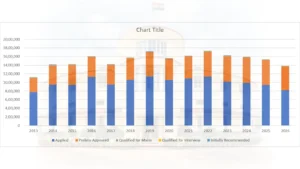
The Civil Services Examination attracts a very large number of applicants every year. However, only a proportion of applicants actually appear in the Preliminary Examination, and an even smaller number qualify for the Main Examination and Personality Test.
The final number of candidates recommended for appointment depends on the vacancies notified by the Government for the particular examination year. Vacancies may differ considerably from one year to another and are distributed among the participating services and applicable reservation categories.
For accurate year-wise information, candidates should refer to the official UPSC examination statistics, annual reports and final result notifications. It is important to distinguish between the number of applicants, candidates who actually appeared, candidates who qualified for subsequent stages and candidates finally recommended for appointment.
Difference Between IAS, IPS, IFS and IRS
Although these services are recruited through the Civil Services Examination, their responsibilities and areas of work are different.
| Service | Full Form | Major Area of Work |
|---|---|---|
| IAS | Indian Administrative Service | Administration, governance and policy implementation |
| IPS | Indian Police Service | Police administration, law enforcement and internal security |
| IFS | Indian Foreign Service | Diplomacy and India’s international relations |
| IRS (IT) | Indian Revenue Service (Income Tax) | Direct taxation and income tax administration |
| IRS (C&IT) | Indian Revenue Service (Customs and Indirect Taxes) | Customs, GST and indirect tax administration |
| IA&AS | Indian Audit and Accounts Service | Government audit and public financial accountability |
| ICAS | Indian Civil Accounts Service | Government accounting and financial management |
Note: IFS refers to the Indian Foreign Service in the context of the Civil Services Examination. It should not be confused with IFoS, which stands for the Indian Forest Service.
Important Facts About the UPSC Civil Services Examination
- The Civil Services Examination is conducted by the Union Public Service Commission.
- UPSC is a constitutional body under Articles 315–323 of the Constitution of India.
- The examination is conducted under rules notified by the Government of India.
- The examination consists of Preliminary, Main and Personality Test stages.
- The Preliminary Examination consists of two objective-type papers of 200 marks each.
- CSAT is a qualifying paper with a minimum qualifying requirement of 33%.
- The Main Examination consists of nine written papers.
- Two Main Examination papers are qualifying in nature.
- Seven Main Examination papers are counted for merit and carry 1750 marks.
- The Personality Test carries 275 marks.
- The final merit list is prepared out of 2025 marks.
- The Preliminary Examination marks are not included in the final merit calculation.
- Graduates from recognised universities in any discipline can apply, subject to other eligibility conditions.
- Candidates can choose an optional subject from the prescribed list.
- IAS, IPS and Indian Foreign Service candidates must be Indian citizens.
- The Indian Forest Service is recruited through a separate examination, although its Preliminary Examination is common with the Civil Services Examination.
Frequently Asked Questions About UPSC Civil Services Examination
1. What is the UPSC Civil Services Examination?
The UPSC Civil Services Examination is a national-level competitive examination conducted by the Union Public Service Commission to recruit candidates for various All India Services and Central Civil Services, including IAS, IPS, Indian Foreign Service and IRS.
2. What is the full form of UPSC CSE?
UPSC CSE stands for Union Public Service Commission Civil Services Examination.
3. Who conducts the Civil Services Examination in India?
The Union Public Service Commission conducts the Civil Services Examination under the rules notified by the Government of India.
4. Is UPSC and IAS the same?
No. UPSC is the constitutional commission that conducts the Civil Services Examination, while IAS is one of the All India Services for which candidates are recruited through the examination.
5. How many stages are there in the UPSC Civil Services Examination?
There are three stages: Preliminary Examination, Main Examination and Personality Test (Interview).
6. How many papers are there in UPSC Prelims?
There are two compulsory papers in the Preliminary Examination: General Studies Paper I and General Studies Paper II (CSAT). Each paper carries 200 marks.
7. Is CSAT qualifying in UPSC Prelims?
Yes. CSAT is a qualifying paper. Candidates must secure at least 33% marks, or 66 out of 200, to qualify in it.
8. How many papers are there in UPSC Mains?
The Main Examination consists of nine papers, including two qualifying language papers, one Essay paper, four General Studies papers and two optional subject papers.
9. How many marks are considered for the final merit list?
The final merit list is prepared out of 2025 marks, comprising 1750 marks from the seven merit-based Main Examination papers and 275 marks from the Personality Test.
10. What is the minimum educational qualification for UPSC CSE?
A bachelor’s degree from a recognised university or an equivalent qualification is required. Candidates from any recognised academic discipline can apply.
11. What is the age limit for the UPSC Civil Services Examination?
The minimum age is 21 years. The upper age limit for General and EWS candidates is 32 years, with applicable relaxations for reserved categories and other eligible candidates.
12. How many attempts are allowed in UPSC CSE?
General and EWS candidates are allowed six attempts, OBC candidates nine attempts and SC/ST candidates unlimited attempts subject to the prescribed age limit. PwBD candidates have category-specific attempt limits.
13. Can final-year graduation students apply for UPSC?
Yes. Candidates appearing in the qualifying degree examination may apply provisionally, subject to the conditions and deadlines specified in the examination rules.
14. Is there negative marking in UPSC Prelims?
Yes. One-third of the marks assigned to a question is deducted for every incorrect answer. No marks are deducted for unanswered questions.
15. Is the UPSC Preliminary Examination counted for final merit?
No. The marks obtained in the Preliminary Examination are used only for screening candidates for the Main Examination and are not counted in the final merit list.
16. How many optional subjects are there in UPSC Mains?
There are 25 non-literature optional subjects and literature subjects in the languages prescribed by UPSC. Candidates must choose one optional subject consisting of two papers.
17. Can an engineering or medical graduate appear for UPSC CSE?
Yes. Candidates with recognised engineering, medical, commerce, science, arts or other bachelor’s degrees can apply, subject to the prescribed eligibility conditions.
18. Is the Indian Forest Service examination the same as the Civil Services Examination?
No. The Indian Forest Service Examination is a separate examination conducted by UPSC. However, its Preliminary Examination is common with the Civil Services Preliminary Examination.
19. What is the difference between IFS and IFoS?
IFS generally refers to the Indian Foreign Service, which deals with diplomacy and international relations. IFoS refers to the Indian Forest Service, which deals with forests, wildlife and environmental conservation.
20. Does UPSC decide which service a successful candidate receives?
UPSC recommends candidates based on their examination performance. Service allocation is undertaken by the Government in accordance with the prescribed rules, considering merit rank, category, service preferences, vacancies and eligibility.
21. Is the UPSC Civil Services Examination conducted every year?
UPSC generally conducts the Civil Services Examination annually. The examination schedule, notification dates and vacancies are published in the official annual calendar and examination notification.
22. Where can candidates find the official UPSC syllabus?
The official syllabus is published in the Civil Services Examination notification and rules available on the UPSC website.
Official Sources and Important Links
Candidates should refer to official government documents and UPSC notifications for the latest examination rules, eligibility conditions, syllabus and other information.
- Union Public Service Commission – Official Website
- UPSC Online Application Portal
- Department of Personnel and Training (DoPT)
- DoPT – Foundation Course and Training
- Lal Bahadur Shastri National Academy of Administration
For the most accurate information, candidates should always read the Civil Services Examination notification and rules applicable to the particular examination year.