The right selection of books is an important part of preparing for the UPSC Civil Services Examination (CSE). Candidates are required to study a wide range of subjects, including History, Geography, Indian Polity, Economy, Environment, Science and Technology, Ethics, Governance and International Relations. Selecting reliable books and using them systematically can help build a strong foundation for both the Preliminary and Main examinations.
This article provides a subject-wise list of recommended books for UPSC Prelims and Mains, along with the names of authors, publishers, editions, ISBNs, examination relevance and guidance on how to use each book. It also includes NCERT textbooks, government publications, previous-year question papers and useful free resources.
The purpose of this list is not to encourage candidates to purchase a large number of books. Rather, it is to identify a limited set of reliable resources that can be studied thoroughly and revised multiple times.
Edition information: Edition and ISBN details are provided wherever they could be verified from publisher or reliable bibliographic information. The edition mentioned is the latest one verified for this article, not a guarantee that no newer printing or edition has subsequently been released. Candidates should check the publisher’s catalogue and ISBN before purchasing.
1. How to Choose Books for the UPSC Civil Services Examination
Before purchasing books, candidates should understand the examination syllabus and the nature of questions asked in the Preliminary and Main examinations. A book should be selected because it covers a relevant part of the syllabus and helps develop conceptual understanding, not merely because it is popular.
The following points should be considered while selecting books:
- Relevance to the syllabus: Select books that cover topics prescribed in the official UPSC syllabus.
- Conceptual clarity: Prefer books that explain fundamental concepts in a clear and systematic manner.
- Reliability: Give preference to standard textbooks, established publishers and official government publications.
- Previous-year questions: Use previous-year questions to understand the depth and nature of examination questions.
- Limited sources: Avoid collecting multiple books covering the same subject. One standard book, supplemented by NCERTs and current affairs, is often sufficient.
- Regular revision: A limited number of books studied and revised properly is generally more useful than a large collection of unread material.
- Updated information: For subjects such as Economy, Environment, Science and Technology and International Relations, supplement static books with current developments.
2. Best Books for UPSC Preliminary Examination
The Preliminary Examination consists of two objective-type papers: General Studies Paper I and General Studies Paper II (CSAT). General Studies Paper I covers History, Geography, Indian Polity, Economy, Environment, Science and Technology, and current events. CSAT tests comprehension, reasoning, analytical ability, decision-making and basic numeracy.
The following books are useful for preparing the different subjects of the Preliminary Examination.
2.1 History of India
History preparation should cover Ancient India, Medieval India, Modern India and the Indian National Movement. Candidates should begin with NCERT textbooks and then use selected reference books for additional depth.
Ancient Indian History
Recommended resources:
- Ancient India – R.S. Sharma. Publisher: Oxford University Press. This is a useful reference for understanding the political, social, economic and cultural developments of ancient India. Check the current publisher catalogue for the available edition and ISBN.
- NCERT History textbooks – Relevant NCERT books, particularly the history textbooks covering ancient India and the themes of Indian history. These provide a useful foundation for the subject.
Important areas include the Indus Valley Civilisation, Vedic period, Mahajanapadas, Buddhism, Jainism, Mauryan Empire, post-Mauryan developments, Gupta period, ancient literature, art and architecture.
Medieval Indian History
- History of Medieval India – Satish Chandra. Publisher: Orient Blackswan. A standard reference for the Delhi Sultanate, Mughal Empire, regional kingdoms, administration, society, economy and cultural developments. Check the publisher’s current catalogue for the available edition and ISBN.
- NCERT History textbooks – Relevant NCERT textbooks for medieval Indian history and the corresponding themes.
Important topics include the Delhi Sultanate, Mughal administration, regional kingdoms, Bhakti and Sufi movements, Vijayanagara and Bahmani kingdoms, art and architecture, and social and economic developments.
Modern Indian History
Comprehensive Modern Indian History
- Author: Brijesh Singh
- Publisher: S. Chand Publishing
- Edition: 2023 Edition. Check the latest revised edition and printing before purchase.
- ISBN: Verify against the selected edition.
- Exam relevance: Prelims GS Paper I and Mains GS Paper I and History optional Mains Paper II.
- Priority: Essential.
This book is a widely used reference for the modern history portion of the examination. It covers the advent of European powers, British expansion, administrative and economic policies, socio-religious reform movements, the Revolt of 1857, the Indian National Movement and important developments leading to independence.
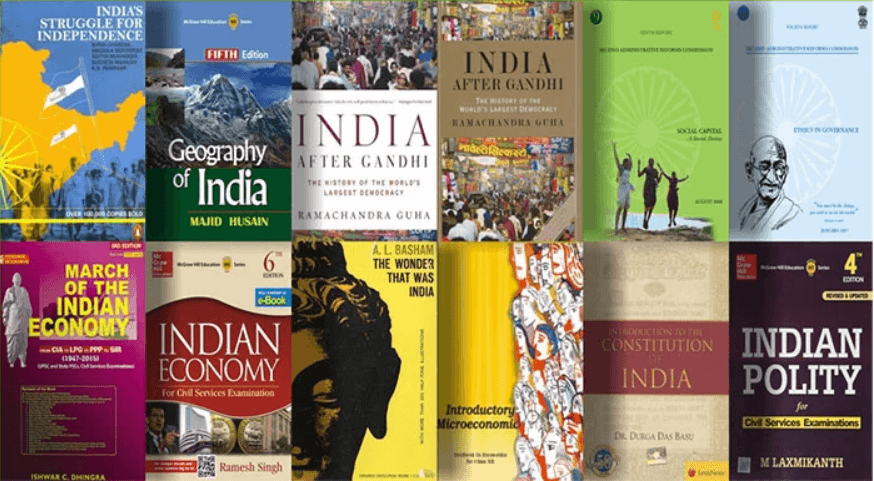
India’s Struggle for Independence
- Authors: Bipan Chandra, Mridula Mukherjee, Aditya Mukherjee, K.N. Panikkar and Sucheta Mahajan.
- Publisher: Penguin Random House India.
- Edition: Check the current available edition.
- Exam relevance: Mainly Mains GS Paper I; also useful for understanding the freedom movement for Prelims.
- Priority: Recommended.
This book provides a broader analytical understanding of the freedom struggle, including the nature of the national movement, its different phases, major leaders, organisations and ideological developments. It is particularly useful for descriptive answers in the Main examination.
2.2 Indian Art and Culture
Courseware on Indian Art and Culture
- Author: Nitin Singhania
- Publisher: McGraw Hill
- Edition: 6th Edition (2026 edition; published November 2025).
- ISBN-13: 9789364448796
- Exam relevance: Prelims GS Paper I and Mains GS Paper I.
- Priority: Recommended.
This book covers visual arts, architecture, sculpture, paintings, music, dance, theatre, literature, religions, festivals, heritage sites and other aspects of Indian culture. It is a useful consolidated reference for the art and culture portion of the syllabus.
Candidates should also refer to NCERT’s An Introduction to Indian Art and relevant official publications for selected topics.
2.3 Indian Polity and Constitution
Courseware on Indian Polity
- Author: M. Laxmikanth
- Publisher: McGraw Hill
- Edition: 8th Edition (2025).
- ISBN-13: 9789364447676
- Exam relevance: Prelims GS Paper I and Mains GS Paper II.
- Priority: Essential.
This is a core reference for Indian Polity and the Constitution. It covers the historical background of the Constitution, its salient features, Fundamental Rights, Directive Principles of State Policy, Parliament, President, Prime Minister, Council of Ministers, Judiciary, federalism, local government, constitutional bodies and statutory bodies.
Candidates should study this book systematically and revise important constitutional provisions, articles, amendments, institutions and their functions. Current constitutional and legal developments should be studied separately.
2.4 Indian Economy
Indian Economy is relevant to both Prelims and Mains. Candidates should understand basic economic concepts before studying topics such as national income, inflation, banking, monetary policy, fiscal policy, taxation, external trade, poverty, unemployment, agriculture and economic reforms.
Courseware on Indian Economy
- Author: Nitin Singhania
- Publisher: McGraw Hill
- Edition: 7th Edition (2026).
- ISBN-13: 9789364449724
- Exam relevance: Prelims GS Paper I and Mains GS Paper III.
- Priority: Recommended.
This book covers important concepts and developments in the Indian economy, including national income, growth and development, money supply, banking, poverty, inequality, unemployment, inflation, taxation and public finance.
Courseware on Indian Economy
- Author: Ramesh Singh
- Publisher: McGraw Hill
- Edition: 18th Edition (2026).
- ISBN-13: 9789364446570
- Exam relevance: Prelims GS Paper I and Mains GS Paper III.
- Priority: Alternative reference.
This is another established reference for Indian Economy. Candidates may choose either Nitin Singhania or Ramesh Singh as their principal textbook. Reading both books completely is generally unnecessary. Economic Survey, Union Budget and current economic developments should be used as supplements.
2.5 Geography
Geography preparation requires an understanding of physical geography, Indian geography, human geography, resources, agriculture, industries, population and geographical phenomena. NCERT textbooks should form the foundation of preparation.
Certificate Physical and Human Geography
- Author: Goh Cheng Leong
- Publisher: Oxford University Press (OUP India).
- Edition: Second Edition.
- ISBN-13: 9789354975660
- Publication date: 26 December 2023.
- Exam relevance: Prelims GS Paper I and selected topics in Mains GS Paper I.
- Priority: Recommended.
This book is useful for physical geography, landforms, climate, weather, vegetation and geographical processes. It should be read along with NCERT Geography textbooks and an atlas.
Other important geography resources:
- NCERT Geography textbooks for Classes VI to XII, selected according to the syllabus.
- School Atlas – Oxford or another standard atlas with clear physical, political and thematic maps.
- Indian Geography textbooks and official maps for Indian physical and economic geography.
For Mains, candidates should practise map-based questions, diagrams and the application of geographical concepts to current issues.
2.6 Environment and Ecology
Environment and Ecology has become an important area in the Preliminary Examination and is also relevant to Mains GS Paper III. Preparation should cover ecosystems, biodiversity, conservation, climate change, pollution, environmental laws, international conventions and institutions.
Environment
- Author / Institution: Shankar IAS Academy.
- Publisher: Shankar IAS Academy.
- Edition: Verify the latest available edition directly with the publisher before purchase.
- ISBN: Check the ISBN printed on the current edition.
- Exam relevance: Prelims GS Paper I and Mains GS Paper III.
- Priority: Recommended.
This is a commonly used subject-specific resource for environment and ecology. It covers ecological concepts, biodiversity, protected areas, environmental pollution, climate change, international environmental agreements and conservation-related topics.
Static preparation should be supplemented with current reports, government notifications, environmental conventions and developments relating to national parks, wildlife sanctuaries and threatened species.
2.7 General Science and Science & Technology
There is no need for most candidates to purchase several advanced science textbooks for the General Studies papers. Basic NCERT Science textbooks and current developments are generally more useful for this part of the examination.
Recommended resources:
- NCERT Science textbooks, particularly Classes VI to X, for fundamental concepts.
- Selected NCERT Biology, Physics and Chemistry chapters where relevant to the syllabus and previous-year questions.
- Government science and technology publications and current affairs material for space technology, biotechnology, artificial intelligence, defence technology, nanotechnology and other emerging areas.
2.8 Current Affairs
Current affairs are relevant to both Prelims and Mains. Candidates should follow important national and international developments and understand their connection with the static syllabus.
Recommended resources:
- A reputed national newspaper for regular reading and analysis.
- Yojana magazine for development, governance and social-sector issues.
- Kurukshetra magazine for rural development, agriculture and related issues.
- Economic Survey and Union Budget of the Government of India.
- Government ministry websites, reports, notifications and press releases.
- Relevant international organisation reports, where connected with the syllabus.
Rather than collecting several monthly current affairs magazines, candidates should select a limited number of sources and revise them regularly.
2.9 CSAT – General Studies Paper II
The Civil Services Preliminary Examination includes a qualifying General Studies Paper II, commonly known as CSAT. It tests comprehension, interpersonal skills, logical reasoning, analytical ability, decision-making, general mental ability, basic numeracy and data interpretation.
Recommended resources:
- Previous-year CSAT question papers published by UPSC.
- One standard CSAT practice manual covering comprehension, reasoning, numeracy and data interpretation.
- Basic mathematics textbooks for school-level arithmetic and related concepts, wherever necessary.
Candidates should not ignore CSAT merely because it is qualifying in nature. Regular timed practice using previous-year papers is important, particularly for candidates who are not comfortable with mathematics or logical reasoning.
3. Best Books for UPSC Main Examination
The Main Examination consists of descriptive papers, including Essay, four General Studies papers, two Optional Subject papers and qualifying language papers. The General Studies papers require conceptual understanding, analytical ability, examples, relevant facts and the ability to present balanced answers within the prescribed word limit.
The following resources are arranged paper-wise according to the General Studies syllabus.
3.1 GS Paper I – Indian Heritage and Culture, History and Geography of the World and Society
GS Paper I covers Indian culture, modern Indian history, the freedom struggle, post-independence consolidation, world history, Indian society and geography.
Recommended books and resources:
- Indian Art and Culture – Nitin Singhania
Publisher: McGraw Hill. Sixth Edition (2026 edition). ISBN-13: 9789364448796. Useful for Indian heritage and culture. - Comprehensive Modern Indian History – Brijesh Singh
Publisher: S Chand Publishing. Useful for modern Indian history and the national movement. Verify the latest revised edition before purchase. - India’s Struggle for Independence – Bipan Chandra and others
Publisher: Penguin Random House India. Useful for analytical understanding of the national movement. - History of Medieval India – Satish Chandra
Publisher: Orient Blackswan. A supplementary reference for selected historical themes. - Mastering Modern World History – Norman Lowe
Publisher: Bloomsbury. ISBN-13: 9789356402980. Useful for world history topics such as the Industrial Revolution, imperialism, world wars, political ideologies and major global developments. Check the current edition information with the publisher. - Certificate Physical and Human Geography – Goh Cheng Leong
Publisher: Oxford University Press. Second Edition. ISBN-13: 9789354975660. Useful for physical geography concepts. - NCERT Sociology textbooks – Classes XI and XII
Publisher: NCERT. Useful for Indian society, social institutions, social change, diversity and related themes.
For Indian society, candidates should also use current examples, government reports, census-related information, committee recommendations and relevant social-sector schemes. Books alone cannot provide all the contemporary examples needed for good Mains answers.
3.2 GS Paper II – Governance, Constitution, Polity, Social Justice and International Relations
GS Paper II covers the Constitution, political system, Parliament, Judiciary, federalism, constitutional and statutory bodies, governance, transparency, accountability, social justice and international relations.
Recommended books and resources:
- Courseware on Indian Polity – M. Laxmikanth
Publisher: McGraw Hill. Eighth Edition (2025). ISBN-13: 9789364447676. A core reference for the Constitution and Indian political system. - Governance – M. Laxmikanth
Publisher: McGraw Hill. Check the latest available edition and ISBN in the publisher’s catalogue. Useful for governance, transparency, accountability, citizen-centric administration and related topics. - Second Administrative Reforms Commission Reports
Publisher: Government of India. Important reports include those dealing with ethics in governance, local governance, citizen-centric administration, e-governance, public order and related administrative reforms. - India’s foreign policy and international relations resources
Use Ministry of External Affairs publications, official bilateral and multilateral statements, and selected current affairs analysis. International Relations is a dynamic subject and should not be prepared only from an old static book.
For this paper, candidates should connect constitutional provisions and institutional functions with contemporary issues. Important Supreme Court judgments, constitutional amendments, government policies and international developments should be revised regularly.
3.3 GS Paper III – Technology, Economic Development, Biodiversity, Environment, Security and Disaster Management
GS Paper III covers the Indian economy, agriculture, infrastructure, science and technology, environment, biodiversity, disaster management and internal security.
Recommended books and resources:
- Courseware on Indian Economy – Nitin Singhania
Publisher: McGraw Hill. Seventh Edition (2026). ISBN-13: 9789364449724. A reference for economic concepts and the Indian economy. - Courseware on Indian Economy – Ramesh Singh
Publisher: McGraw Hill. Eighteenth Edition (2026). ISBN-13: 9789364446570. An alternative reference for Indian Economy. Candidates may choose one principal textbook. - Environment – Shankar IAS Academy
Publisher: Shankar IAS Academy. Verify the latest available edition. Useful for environment, ecology and biodiversity. - Economic Survey
Publisher: Ministry of Finance, Government of India. Important for economic developments, data, policy issues and analytical examples. - Union Budget
Publisher: Ministry of Finance, Government of India. Useful for government expenditure, taxation, fiscal policy and sectoral priorities. - Disaster management publications
Publisher: National Disaster Management Authority (NDMA) and relevant government agencies. Use official guidelines and reports for disaster preparedness, mitigation and response. - Internal security resources
Use official Ministry of Home Affairs publications, government reports and relevant reference material covering border management, terrorism, cyber security, organised crime and security challenges.
For internal security, disaster management, agriculture and science and technology, candidates should avoid relying entirely on a single book. The syllabus is broad, and official reports, current developments, case studies and examples are important.
3.4 GS Paper IV – Ethics, Integrity and Aptitude
GS Paper IV tests understanding of ethics, human values, attitude, aptitude, emotional intelligence, public service values, probity in governance and ethical issues in public administration. It also includes case studies.
The Lexicon for Ethics, Integrity and Aptitude
- Author / editorial credit: Niraj Kumar and Chronicle Editorial Team.
- Publisher: Chronicle Books / Chronicle Publications.
- Edition: Revised Edition 2026 (12th revised edition, as stated by the publisher).
- Exam relevance: Mains GS Paper IV.
- Priority: Recommended.
This book covers ethical concepts, values, attitude, emotional intelligence, contributions of moral thinkers, ethics in public administration, probity in governance and case studies. It can be used as a structured reference for the Ethics paper.
Ethics, Integrity and Aptitude
- Authors: G. Subba Rao and P.N. Roy Chowdhury.
- Publisher: CL Educate Limited.
- Edition: 9th Edition (2026).
- ISBN-13: 9789369147311
- Exam relevance: Mains GS Paper IV.
- Priority: Alternative / supplementary.
This book provides coverage of ethics and human interface, human values, attitude, aptitude, emotional intelligence, ethical theories, public service values, accountability, transparency and case studies.
Candidates do not need to study every ethics book available. Select one principal reference and supplement it with examples, case studies, constitutional values, important quotations and regular answer-writing practice.
4. Recommended NCERT Books for UPSC Preparation
NCERT textbooks are useful for building conceptual foundations across History, Geography, Political Science, Economics, Sociology and Science. Candidates should not necessarily read every chapter of every NCERT textbook. The selection should be based on the syllabus and previous-year questions.
| Subject | Classes | Purpose |
|---|---|---|
| History | VI to XII | Ancient, medieval, modern and world history; historical themes and developments. |
| Geography | VI to XII | Physical geography, Indian geography, resources, climate and human geography. |
| Political Science | IX to XII | Constitution, political institutions, democracy, governance and international relations. |
| Economics | IX to XII | Basic economic concepts, development, Indian economy and macroeconomic foundations. |
| Sociology | XI and XII | Indian society, social institutions, social change and social issues. |
| Science | VI to X | Fundamental concepts in Physics, Chemistry and Biology. |
| Fine Arts | XI | Indian art, architecture, sculpture and painting. |
Official NCERT textbook resources: Candidates can access NCERT textbooks through the official NCERT and ePathshala portals. These portals provide textbooks in different subjects and languages.
5. Previous-Year Question Papers and Practice Books
Previous-year question papers are among the most important resources for both Prelims and Mains. They help candidates understand the examination pattern, the nature of questions, the depth of the syllabus and the way topics are tested.
Rather than solving questions only at the end of preparation, candidates should use previous-year questions while studying each subject.
For Prelims
- Practise previous-year General Studies Paper I questions topic-wise and year-wise.
- Analyse why each option is correct or incorrect.
- Maintain a record of recurring themes and important concepts.
- Practise CSAT papers under timed conditions.
- Use mock tests to assess preparation, but do not substitute them for standard books and previous-year questions.
For Mains
- Study previous-year questions paper-wise and syllabus-wise.
- Practise writing answers within the prescribed word limit.
- Develop the ability to introduce, analyse and conclude an answer effectively.
- Use relevant constitutional provisions, government data, reports, examples and case studies.
- Review answers for relevance, structure, clarity and factual accuracy.
Official UPSC question papers: Previous-year question papers for Civil Services Preliminary and Main examinations can be accessed from the UPSC website.
6. Important Government Publications and Free Resources
In addition to standard textbooks, candidates should use selected government publications. These provide authoritative information, official data, policy details and examples that can improve the quality of Mains answers.
| Publication / Resource | Issuing authority | Relevance |
|---|---|---|
| Economic Survey | Ministry of Finance | Economy, development, agriculture, infrastructure and social-sector issues. |
| Union Budget | Ministry of Finance | Public finance, taxation, expenditure and government priorities. |
| India Year Book | Publications Division, Government of India | Government programmes, institutions, sectors and national developments. |
| Yojana | Publications Division | Development, governance, social justice and public policy. |
| Kurukshetra | Publications Division | Rural development, agriculture, rural economy and related issues. |
| Administrative Reforms Commission Reports | Government of India | Governance, ethics, public administration and institutional reforms. |
| NDMA Guidelines | National Disaster Management Authority | Disaster preparedness, mitigation, response and recovery. |
| Ministry of External Affairs publications | Ministry of External Affairs | Foreign policy, international relations and India’s external engagements. |
Some useful official portals are listed below:
7. Minimum Booklist for UPSC Beginners
Beginners often become confused by the large number of books recommended across websites, coaching institutes and discussion forums. It is not necessary to purchase every book mentioned in this article. Candidates should start with a small set of standard resources and expand their reading only when required by the syllabus.
The following is a practical starting booklist for General Studies:
| Subject | Suggested starting resource |
|---|---|
| Ancient Indian History | Relevant NCERT textbooks and R.S. Sharma’s Ancient India. |
| Medieval Indian History | Relevant NCERT textbooks; selected chapters from Satish Chandra. |
| Modern Indian History | Comprehensive Modern Indian History – Brijesh Singh |
| Art and Culture | NCERT An Introduction to Indian Art and Nitin Singhania. |
| Indian Polity | Indian Polity – M. Laxmikanth. |
| Economy | One standard Indian Economy textbook, along with basic NCERT concepts. |
| Geography | NCERT Geography textbooks, G.C. Leong and an atlas. |
| Environment | Environment – Shankar IAS Academy. |
| Science and Technology | NCERT Science textbooks and current affairs. |
| Ethics | One standard GS Paper IV reference book and regular case-study practice. |
| CSAT | One practice manual and official previous-year question papers. |
This list is intended as a starting point. Candidates should refer to the detailed subject-wise sections above for additional resources and Mains-specific preparation.
8. How to Use the Recommended Books Effectively
Having the right books is only one part of preparation. Candidates should develop a systematic reading, note-making and revision strategy.
8.1 Read the syllabus before starting a book
Keep the official syllabus available while studying. Identify which chapters and topics are relevant to the examination. This prevents unnecessary reading and helps maintain focus.
8.2 Use previous-year questions to guide your preparation
Analyse previous-year questions before and after completing a topic. This helps identify important concepts, recurring areas and the expected depth of understanding.
8.3 Avoid collecting multiple books on the same subject
Choose one principal reference for each major subject. Use additional books only when they provide a different perspective or cover a specific topic that is missing from the primary source.
8.4 Make concise and useful notes
Notes should help in revision. Avoid rewriting entire chapters. Record important concepts, constitutional articles, historical developments, data, examples, diagrams and facts that are difficult to remember.
8.5 Revise regularly
Revision is essential for retaining factual information and conceptual understanding. Plan multiple revisions of standard books instead of continuously adding new sources.
8.6 Prepare separately for Prelims and Mains
Some books are useful for both stages, but the method of preparation differs. Prelims requires factual accuracy, conceptual clarity and objective-question practice. Mains requires analysis, balanced arguments, examples, structured answers and the ability to apply knowledge to contemporary issues.
8.7 Supplement static books with current affairs
Books provide foundational knowledge, but subjects such as Economy, Environment, Governance, Science and Technology and International Relations require regular updates. Use official publications and reliable current affairs sources to supplement static preparation.
9. Books for the UPSC Optional Subject
The Optional Subject in the Main Examination requires a separate and detailed booklist. The choice of books depends on the optional subject selected by the candidate and the prescribed syllabus.
Some popular optional subjects include:
- History
- Geography
- Political Science and International Relations
- Public Administration
- Sociology
- Anthropology
- Philosophy
- Psychology
- Economics
- Mathematics
- Law
- Commerce and Accountancy
Candidates should select books that correspond closely to the official optional-subject syllabus. Standard university textbooks, prescribed readings, subject-specific reference books and previous-year questions are useful. A general General Studies booklist cannot replace a dedicated optional-subject preparation plan.
10. Frequently Asked Questions (FAQs)
1. Which is the most important book for UPSC preparation?
There is no single book that covers the entire Civil Services Examination syllabus. However, M. Laxmikanth’s Indian Polity is an important standard reference for Indian Polity. Other subjects require their own textbooks, NCERT resources and current affairs material.
2. Are NCERT books sufficient for UPSC preparation?
NCERT books are important for building foundational knowledge, particularly in History, Geography, Economics, Political Science, Sociology and Science. However, NCERTs alone are generally not sufficient for the entire examination. Candidates should supplement them with standard reference books, previous-year questions and current affairs.
3. How many books should a candidate read for UPSC?
There is no fixed number of books. Candidates should focus on a limited number of reliable resources for each subject and revise them thoroughly. Reading several books covering the same topics can result in unnecessary duplication.
4. Should the same books be used for Prelims and Mains?
Some standard books, such as Indian Polity, Economy, History and Geography references, are useful for both stages. However, Mains preparation requires additional analytical reading, answer-writing practice, examples, reports and case studies.
5. Which books are useful for UPSC Mains GS Paper IV?
Books such as The Lexicon for Ethics, Integrity and Aptitude by Niraj Kumar and Ethics, Integrity and Aptitude by G. Subba Rao and P.N. Roy Chowdhury are useful references. Candidates should also practise case studies and use real-life examples to develop their analytical and ethical reasoning.
6. Is it necessary to purchase the latest edition of every UPSC book?
Not always. For subjects where the fundamental content remains largely unchanged, an older edition may still be useful. However, candidates should prefer updated editions when the book includes revised facts, new chapters, recent examination questions or changes in laws and policies. Current affairs should be updated separately.
7. Where can candidates download free NCERT books?
NCERT textbooks can be accessed through the official NCERT textbook portal and ePathshala. Candidates should use official sources rather than unauthorised copies.
8. Where can candidates find official UPSC previous-year question papers?
UPSC provides previous-year question papers on its official website under the Examinations section. Candidates can download General Studies, CSAT, Essay and Optional Subject papers from the official question-paper portal.
Conclusion
A well-planned booklist can make Civil Services Examination preparation more organised and effective. Candidates should begin with NCERT textbooks, select standard reference books for each subject, study the official syllabus and regularly practise previous-year questions.
For Prelims, the emphasis should be on conceptual clarity, factual accuracy, revision and objective-question practice. For Mains, candidates should focus on analytical understanding, structured answer writing, examples, government reports and contemporary developments.
Ultimately, success does not depend on the number of books purchased or collected. It depends on selecting appropriate resources, understanding them thoroughly, revising consistently and applying the knowledge effectively in the examination.