The UPSC Civil Services Examination (CSE) is one of the most sought-after competitive examinations in India, attracting candidates from diverse academic and professional backgrounds. However, candidates must fulfil certain eligibility conditions prescribed by the Union Public Service Commission (UPSC) before applying for the examination. These conditions include nationality, educational qualification, minimum and maximum age limits, number of attempts and physical and medical standards for specific services.
This article on the UPSC Exam Eligibility Criteria provide detailed information about who can apply for the examination and the conditions candidates must satisfy at different stages of the selection process. Understanding these requirements is essential before submitting an application, particularly for candidates seeking age relaxation or reservation benefits under different categories.
UPSC Exam Eligibility Criteria: Age Limit, Educational Qualification, Nationality and Number of Attempts
The Union Public Service Commission (UPSC) conducts the Civil Services Examination (CSE) every year to recruit candidates for various prestigious services of the Government of India, including the Indian Administrative Service (IAS), Indian Foreign Service (IFS), Indian Police Service (IPS) and other Central Civil Services.
To appear in the UPSC Civil Services Examination, candidates must fulfil certain eligibility conditions prescribed by the Commission. These conditions relate to nationality, educational qualifications, age limit, number of attempts and physical and medical standards. The eligibility requirements also vary in certain respects depending on the candidate’s category and the service for which they are applying.
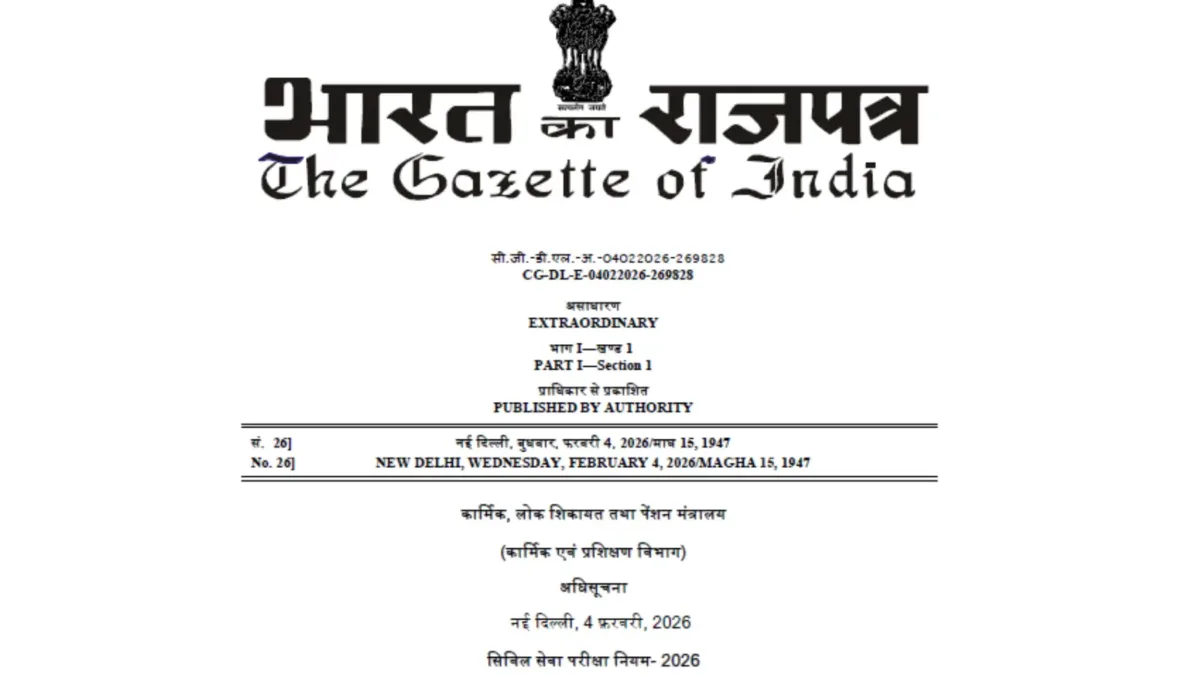
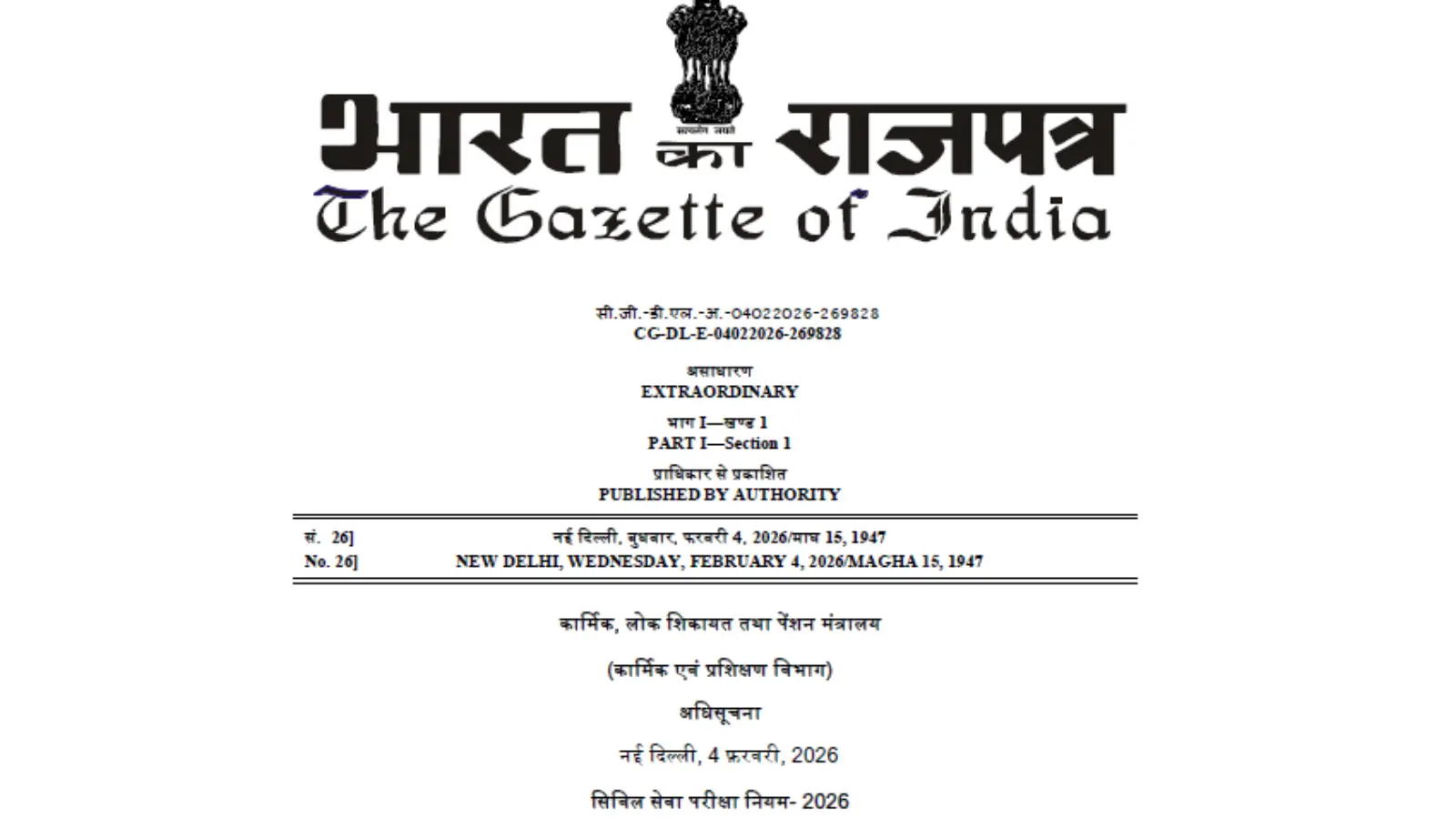
The UPSC Eligibility Criteria are governed by the Civil Services Examination Rules, 2026, notified by the Department of Personnel and Training (DoPT), Government of India. Candidates should carefully understand these requirements before submitting their application.
UPSC Eligibility Criteria 2026: Overview
The major eligibility requirements for the UPSC Civil Services Examination 2026 are summarised below.
| Eligibility Criteria | Requirements |
|---|---|
| Nationality | Indian citizenship or other specified nationality categories, depending on the service |
| Minimum Educational Qualification | Graduate degree from a recognised university or an equivalent qualification |
| Minimum Age | 21 years |
| Maximum Age (General/EWS) | 32 years |
| Maximum Age (OBC) | 35 years |
| Maximum Age (SC/ST) | 37 years |
| Maximum Attempts (General/EWS) | 6 |
| Maximum Attempts (OBC) | 9 |
| Maximum Attempts (SC/ST) | Unlimited, subject to age limit |
| Maximum Attempts (PwBD) | 9 for General/EWS/OBC and unlimited for SC/ST |
| Physical Standards | Applicable service-specific physical and medical standards |
| Exam Conducting Authority | Union Public Service Commission |
Note: The above conditions are based on the Civil Services Examination Rules, 2026. Candidates must also satisfy the specific requirements applicable to their category and the service for which they are being considered.
1. Nationality Criteria for UPSC Civil Services Examination
The nationality requirements for the Civil Services Examination depend on the service to which a candidate seeks appointment.
A. Nationality for IAS, IPS and Indian Foreign Service
To be eligible for appointment to the Indian Administrative Service (IAS), Indian Police Service (IPS) and Indian Foreign Service (IFS), a candidate must be a citizen of India.
B. Nationality for Other Civil Services
For services other than IAS, IPS and IFS, a candidate must satisfy any one of the following nationality conditions:
- A citizen of India.
- A subject of Nepal.
- A subject of Bhutan.
- A Tibetan refugee who came to India before 1 January 1962 with the intention of permanently settling in India.
- A person of Indian origin who has migrated from Pakistan, Burma (Myanmar), Sri Lanka, or specified East African countries, including Kenya, Uganda, the United Republic of Tanzania, Zambia, Malawi, Zaire, Ethiopia and Vietnam, with the intention of permanently settling in India.
Important: Candidates belonging to the categories mentioned in points 2 to 5 must possess a certificate of eligibility issued by the Government of India. Such candidates may be admitted to the examination, but an offer of appointment can be made only after the required eligibility certificate has been issued.
2. Educational Qualification for UPSC Civil Services Examination
The minimum educational qualification required to appear in the UPSC Civil Services Examination is a bachelor’s degree from a recognised university or an equivalent qualification.
According to the Civil Services Examination Rules, 2026, a candidate must possess a degree from any of the following institutions:
- A university incorporated by an Act of the Central or State Legislature in India.
- An educational institution established by an Act of Parliament.
- An institution declared to be a deemed university under Section 3 of the University Grants Commission Act, 1956.
- A qualification recognised by the Government of India as equivalent to the above degrees.
There is no restriction on the academic stream or subject of graduation. Candidates from Arts, Humanities, Science, Commerce, Engineering, Medical Sciences, Law and other disciplines can apply for the Civil Services Examination, provided they fulfil the prescribed educational requirements.
Is graduation compulsory for UPSC?
Yes. A bachelor’s degree or an equivalent qualification is compulsory for the Civil Services Examination. Candidates who have completed their graduation from a recognised university are eligible to apply, irrespective of their subject or discipline.
Can final-year graduation students apply for UPSC?
Yes. Candidates who have appeared for or intend to appear in the qualifying degree examination are permitted to apply for the Civil Services Preliminary Examination, subject to the conditions prescribed in the examination rules.
However, candidates who qualify for the Preliminary Examination must submit proof of passing the required degree examination along with their application for admission to the Civil Services Main Examination, within the prescribed deadline.
Thus, final-year graduation students can appear in the Preliminary Examination, but they must fulfil the educational qualification requirement at the stage prescribed by UPSC for admission to the Main Examination.
Can engineering graduates apply for UPSC?
Yes. Candidates holding a bachelor’s degree in engineering, including B.Tech and B.E., from a recognised institution are eligible to appear in the Civil Services Examination.
Can medical graduates apply for UPSC?
Yes. Candidates holding recognised medical qualifications such as MBBS are eligible. Candidates who have completed the final professional MBBS examination but have not completed their internship may also apply, subject to the specific documentary requirements and conditions prescribed in the examination rules.
Is there any minimum percentage required in graduation?
No. UPSC does not prescribe a minimum percentage of marks in graduation for the Civil Services Examination. Candidates need to possess the required degree or equivalent qualification from a recognised institution.
3. UPSC Age Limit 2026
Age is one of the most important eligibility conditions for the Civil Services Examination. The minimum and maximum age limits are prescribed in the official examination rules, with certain relaxations available for reserved categories.
For the Civil Services Examination 2026, a candidate must have attained the age of 21 years and must not have attained the age of 32 years on 1 August 2026.
The category-wise age limits are given below:
| Category | Minimum Age | Maximum Age |
|---|---|---|
| General | 21 years | 32 years |
| EWS | 21 years | 32 years |
| OBC | 21 years | 35 years |
| SC | 21 years | 37 years |
| ST | 21 years | 37 years |
| PwBD (General/EWS) | 21 years | 42 years |
| PwBD (OBC) | 21 years | 45 years |
| PwBD (SC/ST) | 21 years | 47 years |
Age relaxation for reserved categories
The upper age limit is relaxed for certain categories as follows:
- OBC: Three years of relaxation for candidates eligible for OBC reservation.
- SC/ST: Five years of relaxation.
- Persons with Benchmark Disabilities: Up to ten years of relaxation.
- Eligible ex-servicemen and certain defence personnel: Relaxation as prescribed in the examination rules.
The applicable relaxations may be cumulative in specified cases, subject to the conditions in the official rules.
For detailed information, candidates can refer to our separate article on UPSC Age Limit 2026, which explains the category-wise age limits, date-of-birth criteria and different relaxation provisions.
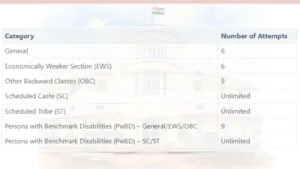
4. Number of Attempts in UPSC Civil Services Examination
UPSC has prescribed a maximum number of attempts for candidates appearing in the Civil Services Examination. The number of attempts varies according to the candidate’s category.
The category-wise permissible number of attempts is as follows:
| Category | Maximum Number of Attempts |
|---|---|
| General | 6 |
| EWS | 6 |
| OBC | 9 |
| SC | Unlimited |
| ST | Unlimited |
| PwBD (General/EWS) | 9 |
| PwBD (OBC) | 9 |
| PwBD (SC/ST) | Unlimited |
The unlimited attempts available to SC/ST candidates are subject to the applicable upper age limit. Similarly, PwBD candidates belonging to the SC/ST categories are permitted unlimited attempts, subject to other eligibility conditions.
When is an attempt counted in UPSC?
An attempt is counted when a candidate actually appears in at least one paper of the Civil Services Preliminary Examination.
The following points are important:
- Merely submitting the application form does not count as an attempt.
- Appearing in at least one paper of the Preliminary Examination counts as one attempt.
- If a candidate appears in the Preliminary Examination but is subsequently disqualified, the attempt is still counted.
- If a candidate applies for the examination but does not appear in either Preliminary Examination paper, it is not counted as an attempt.
Candidates should carefully keep track of the attempts already used, as the responsibility for maintaining this record rests primarily with them.
5. Physical and Medical Standards for UPSC
Candidates appearing in the Civil Services Examination must satisfy the prescribed medical and physical standards applicable to the services for which they are being considered.
Medical fitness is particularly important for services such as the Indian Police Service (IPS), where specific physical and medical standards are prescribed.
The medical examination is conducted in accordance with the provisions of the Civil Services Examination Rules and the relevant service requirements.
Physical standards for IPS
Candidates seeking appointment to the Indian Police Service must fulfil the prescribed physical and medical standards. These may include requirements relating to height, chest measurement, eyesight and general medical fitness, as applicable to the candidate.
The physical standards for male and female candidates may differ. Candidates should refer to the relevant medical examination provisions and official service-specific requirements rather than relying on general eligibility tables.
Are physical standards compulsory for IAS?
The physical standards applicable to the IPS are different from the general medical fitness requirements for other civil services. Candidates seeking appointment to the IAS must satisfy the prescribed medical fitness requirements, but they are not subject to the same IPS-specific physical measurements.
6. Eligibility of Final-Year Students and Candidates Awaiting Results
UPSC provides an opportunity for candidates who are in the final year of their qualifying degree course to apply for the Preliminary Examination.
Such candidates must satisfy the following conditions:
- They must have appeared for or intend to appear in the qualifying degree examination.
- They must qualify in the Civil Services Preliminary Examination to proceed to the Main Examination.
- They must produce documentary proof of passing the qualifying degree examination within the prescribed deadline for the Main Examination application.
If a candidate fails to provide the required proof of educational qualification within the prescribed period, the candidature may be cancelled.
7. Can Government Employees Apply for UPSC?
Yes. Government employees, including employees of Central and State Governments, are not automatically barred from appearing in the Civil Services Examination.
However, candidates who are already employed in government service must comply with the applicable rules regarding intimation, permission and submission of undertakings, wherever required.
Government servants should carefully examine the relevant provisions of the Civil Services Examination Rules and the instructions issued by their respective departments before applying.
8. Category-wise Eligibility and Reservation Benefits
UPSC provides reservation and certain eligibility relaxations to candidates belonging to specified categories in accordance with the Government of India’s reservation policy.
The major categories and their associated eligibility benefits are summarised below:
| Category | Age Relaxation | Maximum Attempts |
|---|---|---|
| General | No relaxation | 6 |
| EWS | No relaxation | 6 |
| OBC (eligible Non-Creamy Layer) | 3 years | 9 |
| SC | 5 years | Unlimited |
| ST | 5 years | Unlimited |
| PwBD (General/EWS) | 10 years | 9 |
| PwBD (OBC) | 13 years cumulatively | 9 |
| PwBD (SC/ST) | 15 years cumulatively | Unlimited |
Important conditions for claiming reservation
- OBC candidates must fulfil the Central Government’s eligibility requirements for reservation and must not belong to the creamy layer.
- SC/ST candidates must possess the prescribed valid caste certificate.
- EWS candidates must possess a valid Income and Asset Certificate in the prescribed format.
- PwBD candidates must satisfy the prescribed benchmark disability requirements and provide the necessary certificates.
Candidates should ensure that their category certificates are valid and issued by the competent authority in the prescribed format. Incorrect or unsupported category claims may lead to the cancellation of candidature or loss of reservation benefits.
9. Important Documents Required for UPSC Application
While filling out the Civil Services Examination application, candidates should keep their personal, educational and category-related information ready.
The documents and information generally required during the application and subsequent examination stages include:
- Matriculation or Secondary School Certificate as proof of date of birth.
- Graduation degree or provisional degree certificate, wherever applicable.
- Valid photo identity document, as prescribed in the application instructions.
- Recent photograph and signature in the prescribed format.
- SC/ST/OBC/EWS certificate, wherever applicable.
- PwBD certificate, wherever applicable.
- Discharge or service-related certificates for candidates claiming eligible ex-servicemen or defence-related concessions.
- Other certificates or documents required under the examination rules.
Not every document needs to be uploaded at the initial application stage. Candidates should follow the specific instructions issued by UPSC for the Preliminary Examination application, Main Examination application and subsequent verification stages.
10. Important Points to Remember About UPSC Eligibility
Before applying for the Civil Services Examination, candidates should remember the following important points:
- A bachelor’s degree or equivalent qualification from a recognised institution is compulsory.
- The minimum age is 21 years.
- The upper age limit for General and EWS candidates is 32 years.
- Eligible OBC candidates receive three years of upper-age relaxation.
- SC and ST candidates receive five years of upper-age relaxation.
- General and EWS candidates are permitted six attempts.
- OBC candidates are permitted nine attempts.
- SC and ST candidates are permitted unlimited attempts, subject to the upper age limit.
- Final-year graduation students may apply for the Preliminary Examination, subject to the prescribed conditions.
- Indian citizenship is compulsory for appointment to IAS, IPS and Indian Foreign Service.
- Candidates must fulfil the relevant medical and physical standards for their respective services.
- The official examination notification and rules are the final authority on eligibility.
Frequently Asked Questions (FAQs) on UPSC Eligibility Criteria
1. What is the minimum qualification required for UPSC?
A bachelor’s degree from a recognised university or an equivalent qualification is the minimum educational qualification required for the Civil Services Examination. Candidates from any academic stream can apply.
2. Can a 12th-pass candidate apply for UPSC?
No. A candidate must possess a bachelor’s degree or an equivalent qualification to be eligible for the Civil Services Examination. However, students pursuing graduation may apply for the Preliminary Examination in their final year, subject to the prescribed conditions.
3. Can final-year graduation students appear for UPSC Prelims?
Yes. Candidates who have appeared for or intend to appear in their qualifying degree examination may apply for the Preliminary Examination. However, they must submit proof of passing the qualifying examination within the prescribed deadline for admission to the Main Examination.
4. Is there any minimum percentage required in graduation for UPSC?
No. UPSC does not prescribe a minimum percentage of marks in graduation. A candidate must simply possess the required recognised degree or equivalent qualification.
5. Can an engineering student apply for UPSC?
Yes. Candidates holding a recognised engineering degree, such as B.Tech or B.E., are eligible to apply for the Civil Services Examination.
6. Can a candidate from a private university apply for UPSC?
Yes, provided the university or institution is legally recognised and the degree satisfies the educational qualification requirements prescribed in the Civil Services Examination Rules.
7. Can a foreign citizen apply for the IAS examination?
No. Only Indian citizens are eligible for appointment to the Indian Administrative Service (IAS), Indian Police Service (IPS) and Indian Foreign Service (IFS). Certain other nationality categories are permitted for specified services under the examination rules.
8. Is UPSC eligibility different for male and female candidates?
The general educational qualification, minimum age, maximum age and number of attempts are not different on the basis of gender. However, service-specific medical and physical standards may differ.
9. Can married women apply for UPSC?
Yes. Married and unmarried women are equally eligible to apply for the Civil Services Examination, subject to the prescribed eligibility conditions.
10. Can government employees appear in the UPSC Civil Services Examination?
Yes. Government employees can apply, subject to the applicable service rules, intimation and other requirements prescribed by their department and the examination authorities.
11. Is there any restriction on the graduation subject for UPSC?
No. Candidates from Arts, Science, Commerce, Engineering, Medical Sciences, Law and other academic disciplines can apply. UPSC does not prescribe a particular graduation subject.
12. What is the maximum age limit for UPSC?
The maximum age limit for General and EWS candidates is 32 years. Eligible OBC candidates can apply up to 35 years, while SC and ST candidates can apply up to 37 years, subject to the prescribed date of age calculation and other eligibility requirements.
13. How many attempts are allowed in UPSC?
General and EWS candidates are allowed six attempts, OBC candidates are allowed nine attempts, and SC/ST candidates are allowed unlimited attempts, subject to the prescribed upper age limit. Eligible PwBD candidates receive the attempt relaxations specified in the examination rules.
14. Is an attempt counted if a candidate does not appear in UPSC Prelims?
No. An attempt is counted only when a candidate actually appears in at least one paper of the Civil Services Preliminary Examination. Merely submitting an application does not count as an attempt.
Conclusion
The UPSC Civil Services Examination has clearly defined eligibility requirements relating to nationality, educational qualification, age, number of attempts and medical fitness. A candidate must possess a recognised bachelor’s degree or equivalent qualification, satisfy the prescribed age criteria and remain within the permitted number of attempts.
Although certain relaxations are available to candidates belonging to OBC, SC, ST, PwBD and other eligible categories, these benefits are subject to specific conditions laid down by the Government of India.
Before submitting an application, candidates should carefully examine the official Civil Services Examination notification and verify that they fulfil all the eligibility conditions. Meeting the eligibility requirements is the first step towards appearing in the Civil Services Examination and pursuing a career in India’s civil services.
Official Sources and References
- Union Public Service Commission (UPSC) – Official Website
- UPSC – Active Examination Notifications
- Civil Services Examination Rules, 2026 – Gazette of India
- UPSC – Examination Information and FAQs
- UPSC – FAQs on SC/ST/OBC/EWS/PwBD Categories
- Department of Personnel and Training (DoPT), Government of India