The Union Public Service Commission (UPSC) conducts the Civil Services Examination (CSE) to recruit candidates for the Indian Administrative Service (IAS), Indian Foreign Service (IFS), Indian Police Service (IPS) and several other civil services. The examination is conducted through a multi-stage selection process designed to assess a candidate’s knowledge, understanding, analytical ability, written communication and overall suitability for public service.
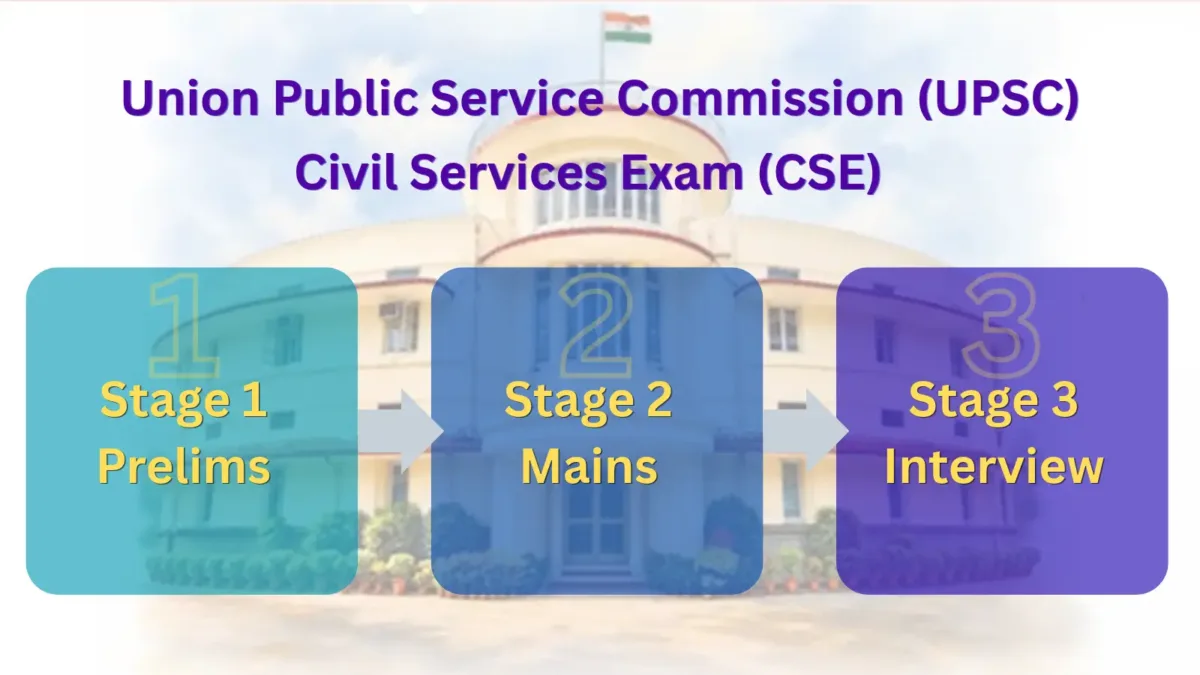
The UPSC Civil Services Examination consists of three stages: Preliminary Examination, Main Examination and Interview (Personality Test). Each stage has a different purpose and examination format. Candidates preparing for CSE should understand the complete examination pattern, including the number of papers, marks, duration, qualifying requirements and the role of each stage.
This article explains the pattern on the basis of the latest published examination scheme. Candidates should also check the official CSE notification when it is released, as the rules applicable to that examination will be final.
UPSC Exam Pattern Overview
The Civil Services Examination is conducted in two successive examinations: the Preliminary Examination and the Main Examination. The Main Examination consists of a written examination followed by an Interview or Personality Test. For convenience, these are commonly described as three stages of the UPSC selection process.
| Stage | Examination | Nature |
|---|---|---|
| Stage 1 | Preliminary Examination | Objective type (Multiple Choice Questions) |
| Stage 2 | Main Examination | Descriptive written examination |
| Stage 3 | Interview / Personality Test | Personality assessment |
- The Preliminary Examination is a screening test. Its marks are not included in the final merit list.
- Candidates who qualify in Prelims are eligible to appear in the Main Examination, subject to the prescribed conditions.
- The final ranking is determined by the marks obtained in the Main Examination written papers that count for merit and the Interview/Personality Test.
UPSC Prelims Exam Pattern
The Preliminary Examination is the first stage of the Civil Services Examination. It consists of two compulsory objective-type papers, both carrying 200 marks. Each paper has a duration of two hours.
| Paper | Subject | Marks | Duration |
|---|---|---|---|
| Paper I | General Studies | 200 | 2 hours |
| Paper II | General Studies Paper II (CSAT) | 200 | 2 hours |
| Total | 400 | 4 hours |
- Both papers are objective in nature and contain multiple-choice questions.
- The question papers are set in Hindi and English.
- Candidates must appear in both papers.
- General Studies Paper II, commonly known as CSAT, is qualifying in nature, while the marks obtained in General Studies Paper I are used to determine the Preliminary Examination cut-off, provided the candidate secures the required qualifying marks in CSAT.
UPSC Prelims Paper I: General Studies
General Studies Paper I carries 200 marks and is an important paper for determining whether a candidate qualifies for the Main Examination. The paper tests a candidate’s understanding of subjects such as history, geography, polity, economy, environment, science and current affairs.
The broad syllabus of General Studies Paper I includes:
- Current events of national and international importance.
- History of India and the Indian National Movement.
- Indian and World Geography, including physical, social and economic geography.
- Indian Polity and Governance, including the Constitution, political system, Panchayati Raj, public policy and rights issues.
- Economic and Social Development, including sustainable development, poverty, inclusion, demographics and social sector initiatives.
- General issues relating to environmental ecology, biodiversity and climate change.
- General Science.
UPSC Prelims Paper II: CSAT
General Studies Paper II, popularly called the Civil Services Aptitude Test (CSAT), carries 200 marks. It is a qualifying paper, and candidates must secure at least 33% marks to qualify in this paper.
Since the paper carries 200 marks, the minimum qualifying score is 66 marks. Candidates who score below this minimum are not considered qualified in the Preliminary Examination, even if they obtain a high score in General Studies Paper I.
The broad areas covered in CSAT include:
- Comprehension.
- Interpersonal skills, including communication skills.
- Logical reasoning and analytical ability.
- Decision-making and problem-solving.
- General mental ability.
- Basic numeracy (numbers and their relations, orders of magnitude, etc.) up to Class X level.
- Data interpretation, including charts, graphs, tables and data sufficiency, up to Class X level.
Negative Marking in UPSC Prelims
There is negative marking for incorrect answers in both Preliminary Examination papers. For every wrong answer, one-third (1/3) of the marks assigned to that question is deducted.
For example, if a question carries two marks, an incorrect answer will result in a deduction of approximately 0.67 marks. If a candidate marks more than one answer for a question, it is treated as an incorrect answer, even if one of the marked options is correct.
There is no negative marking for a question that is left unanswered. Therefore, candidates should avoid marking multiple options and should carefully consider whether to attempt questions where they are uncertain.
Is UPSC Prelims Marks Counted in the Final Merit List?
No. Marks obtained in the Preliminary Examination are not counted for preparing the final merit list. The Preliminary Examination is conducted only to shortlist candidates for the Main Examination.
To qualify for the Main Examination, a candidate must secure at least the prescribed qualifying marks in CSAT and the required cut-off marks in General Studies Paper I. The cut-off in General Studies Paper I is determined by UPSC according to the examination rules and the performance of candidates.
UPSC Mains Exam Pattern
Candidates who qualify in the Preliminary Examination are eligible to appear in the Civil Services (Main) Examination. Unlike Prelims, the Main Examination is descriptive in nature. Candidates are required to write answers in a structured manner, demonstrating their understanding, analytical ability and capacity to express ideas clearly.
The Main Examination consists of nine conventional essay-type papers. Each paper carries 250 or 300 marks, depending on its nature, and has a duration of three hours. Two papers are qualifying in nature, while the marks obtained in the remaining seven papers are counted for merit.
UPSC Mains: Paper-wise Marks and Duration
| Paper | Subject | Marks | Nature |
|---|---|---|---|
| Paper A | One Indian Language (from the Eighth Schedule) | 300 | Qualifying |
| Paper B | English | 300 | Qualifying |
| Paper I | Essay | 250 | Counted for Merit |
| Paper II | General Studies I | 250 | Counted for Merit |
| Paper III | General Studies II | 250 | Counted for Merit |
| Paper IV | General Studies III | 250 | Counted for Merit |
| Paper V | General Studies IV | 250 | Counted for Merit |
| Paper VI | Optional Subject – Paper I | 250 | Counted for Merit |
| Paper VII | Optional Subject – Paper II | 250 | Counted for Merit |
| Total | 2,250 |
Although the total marks of all nine written papers amount to 2,250, the two language papers are qualifying in nature. Therefore, only seven papers, carrying a total of 1,750 marks, are counted for determining a candidate’s merit in the written examination.
Qualifying Papers in UPSC Mains
The first two papers of the Main Examination are qualifying papers. These are:
- Paper A – Indian Language: Candidates must choose one language from the languages included in the Eighth Schedule to the Constitution of India, subject to the applicable rules.
- Paper B – English: This paper tests the candidate’s ability to understand and use English effectively.
Each paper carries 300 marks. Candidates are required to secure at least 25% marks in each qualifying paper, which means a minimum of 75 marks out of 300 in each paper.
The marks obtained in these two papers are not added to the merit total. However, qualifying in both papers is essential for the evaluation of the remaining papers, subject to the rules applicable to the examination.
The rules provide certain exemptions from Paper A for eligible candidates from specified North-Eastern states. Candidates should check the relevant examination notification for the exact exemption conditions.
UPSC Mains Essay Paper
The Essay paper carries 250 marks. Candidates are generally required to write essays on topics selected from different themes. The paper tests the ability to organise ideas, develop arguments, maintain clarity and present a balanced understanding of a subject.
A good essay requires more than factual knowledge. Candidates are expected to present their thoughts in a coherent manner, support arguments with relevant examples and maintain a logical flow throughout the essay.
UPSC Mains General Studies Papers
There are four General Studies papers in the Main Examination. Each paper carries 250 marks, making a total of 1,000 marks. These papers cover a wide range of subjects and issues relevant to governance, society, the economy, international relations, ethics and public administration.
General Studies Paper I – Indian Heritage and Culture, History and Geography of the World and Society
This paper covers Indian culture, art forms, literature and architecture; modern Indian history; the freedom struggle; post-independence consolidation; world history; Indian society; social issues; and geography of the world and India.
General Studies Paper II – Governance, Constitution, Polity, Social Justice and International Relations
This paper includes the Indian Constitution, Parliament, State Legislatures, executive and judiciary, constitutional and statutory bodies, government policies, welfare schemes, social justice, governance, transparency, accountability and India’s relations with other countries.
General Studies Paper III – Technology, Economic Development, Biodiversity, Environment, Security and Disaster Management
This paper covers the Indian economy, inclusive growth, budgeting, agriculture, food processing, infrastructure, science and technology, environmental conservation, biodiversity, climate change, internal security and disaster management.
General Studies Paper IV – Ethics, Integrity and Aptitude
This paper deals with ethics and human values, attitude, aptitude, emotional intelligence, contributions of moral thinkers, public service values, probity in governance and ethical issues in public administration. It also includes case studies to assess a candidate’s ability to handle ethical and administrative situations.
UPSC Mains Optional Subject Papers
Candidates must select one optional subject from the list prescribed by UPSC. The optional subject has two papers, each carrying 250 marks. Together, these papers contribute 500 marks to the written merit total.
The optional subject gives candidates an opportunity to demonstrate their knowledge and understanding of a particular discipline. The list includes subjects from humanities, sciences, engineering, agriculture, medicine and literature in specified languages.
Some of the optional subjects available include:
- Agriculture
- Anthropology
- Geography
- History
- Political Science and International Relations
- Public Administration
- Sociology
- Philosophy
- Economics
- Psychology
- Mathematics
- Law
- Commerce and Accountancy
- Medical Science
- Management
- Literature of languages included in the UPSC list
This is only a selection of subjects. Candidates should refer to the official notification for the complete list of optional subjects and their detailed syllabi.
Duration and Medium of UPSC Mains Papers
Each of the nine written papers in the Main Examination has a duration of three hours. The papers are conventional, descriptive or essay-type papers rather than objective multiple-choice tests.
Candidates may write the Main Examination in English or in an eligible language permitted under the examination rules. The rules also prescribe the conditions for choosing the medium of the examination and the language of the Interview/Personality Test. Candidates should carefully read the relevant instructions before selecting their medium.
UPSC Interview Pattern
Candidates who obtain the minimum qualifying marks in the written part of the Main Examination, as determined by UPSC, are called for the Interview or Personality Test. The Interview carries 275 marks.
The purpose of the Interview is not simply to test a candidate’s factual knowledge. It is intended to assess the candidate’s personal suitability for a career in public service. The Board evaluates qualities such as intellectual ability, critical thinking, clarity of expression, balance of judgement, leadership, social awareness, integrity and interest in current affairs.
The Interview is generally based on the candidate’s Detailed Application Form (DAF), educational background, interests, work experience, home state, current national and international developments and other relevant matters.
| Particular | Marks |
|---|---|
| Interview / Personality Test | 275 |
| Minimum qualifying marks | No minimum qualifying marks prescribed |
There is no separately prescribed minimum qualifying mark for the Interview. The marks awarded by the Interview Board are added to the marks obtained in the seven merit-based written papers.
UPSC CSE Final Merit List: Total Marks
The final merit list is prepared by combining the marks obtained in the seven merit-based papers of the Main Examination and the Interview/Personality Test.
| Component | Marks Counted for Merit |
|---|---|
| Essay | 250 |
| General Studies I | 250 |
| General Studies II | 250 |
| General Studies III | 250 |
| General Studies IV | 250 |
| Optional Subject Paper I | 250 |
| Optional Subject Paper II | 250 |
| Total Written Merit Marks | 1,750 |
| Interview / Personality Test | 275 |
| Grand Total | 2,025 |
Thus, the maximum marks considered for the final ranking in the Civil Services Examination are 2,025. The two qualifying language papers in the Main Examination and the marks obtained in the Preliminary Examination are not included in this total.
UPSC Exam Pattern: Important Points to Remember
- The Civil Services Examination has three stages: Preliminary Examination, Main Examination and Interview/Personality Test.
- The Preliminary Examination consists of two objective-type papers carrying 200 marks each.
- CSAT is qualifying in nature, with a minimum requirement of 33% marks.
- Negative marking applies to incorrect answers in both Preliminary Examination papers.
- Preliminary Examination marks are not counted in the final merit list.
- The Main Examination consists of nine descriptive papers, each of three hours’ duration.
- Two Main Examination papers – Indian Language and English – are qualifying in nature.
- The seven merit-based Main Examination papers carry a total of 1,750 marks.
- Candidates have to choose one optional subject, which has two papers of 250 marks each.
- The Interview/Personality Test carries 275 marks.
- The final merit list is based on a total of 2,025 marks.
Frequently Asked Questions (FAQs) on UPSC Exam Pattern
1. What is the exam pattern of UPSC CSE?
The UPSC Civil Services Examination consists of three stages: Prelims, Mains and Interview. Prelims is an objective screening examination, Mains is a descriptive written examination consisting of nine papers, and the final stage is the Interview or Personality Test.
2. How many papers are there in UPSC Prelims?
There are two compulsory papers in UPSC Prelims: General Studies Paper I and General Studies Paper II (CSAT). Each paper carries 200 marks and has a duration of two hours.
3. Is CSAT qualifying in UPSC Prelims?
Yes. CSAT is a qualifying paper. Candidates must secure at least 33% marks, or 66 marks out of 200, to qualify in this paper.
4. Is there negative marking in UPSC Prelims?
Yes. One-third of the marks assigned to a question is deducted for every incorrect answer. There is no negative marking for questions left unanswered.
5. How many papers are there in UPSC Mains?
There are nine papers in the UPSC Main Examination. These include two qualifying language papers, one Essay paper, four General Studies papers and two papers of one optional subject.
6. How many marks are counted in UPSC Mains for the final merit list?
Seven papers carrying a total of 1,750 marks are counted for merit. The two qualifying language papers, carrying 300 marks each, are not included in the merit total.
7. How many marks are required to qualify in the UPSC Mains language papers?
Candidates must secure at least 25% marks in each qualifying language paper. Since each paper carries 300 marks, the minimum qualifying score is 75 marks in each paper.
8. How many marks does the UPSC Interview carry?
The UPSC Interview or Personality Test carries 275 marks. These marks are added to the 1,750 marks obtained in the merit-based written papers of the Main Examination.
9. What is the total marks of the UPSC Civil Services Examination?
The total marks considered for the final merit list are 2,025, comprising 1,750 marks from the Main Examination written papers and 275 marks from the Interview/Personality Test.
10. Are UPSC Prelims marks included in the final merit list?
No. Prelims is only a screening examination. Its marks are not added to the final merit total. The final ranking is based on the Main Examination merit papers and the Interview/Personality Test.
11. Is the UPSC Mains examination objective or descriptive?
The UPSC Main Examination is descriptive in nature. Candidates are required to write conventional essay-type answers in the prescribed papers.
12. Has the UPSC CSE 2027 exam pattern been officially announced?
The final examination pattern for CSE 2027 will be governed by the official notification and examination rules issued for that year. Until those documents are published, candidates can use the latest published Civil Services Examination scheme as the reference for preparation. Any change announced by UPSC in the 2027 notification will take precedence.
Official Sources
The examination structure and rules described in this article are based on official UPSC and Government of India documents. Candidates preparing for CSE should check the latest notification and rules when published.
- UPSC Examination Division – Official information and FAQs on the Civil Services Examination
- UPSC – Civil Services (Preliminary) Examination, 2026: Official examination notice and documents
- UPSC – Civil Services Examination 2024: Official Examination Notice, including the scheme and syllabus
- UPSC – Official Examination Calendar
Note for CSE candidates: The paper structure, marks and qualifying requirements presented here follow the latest published examination scheme available for reference. Always read the official CSE notification and accompanying rules before applying, as the Commission’s year-specific documents will prevail over this general guide.