The Union Public Service Commission (UPSC) conducts the Civil Services Preliminary Examination as the first stage of the Civil Services Examination (CSE). It is an objective-type examination designed to screen candidates for admission to the Civil Services Main Examination.
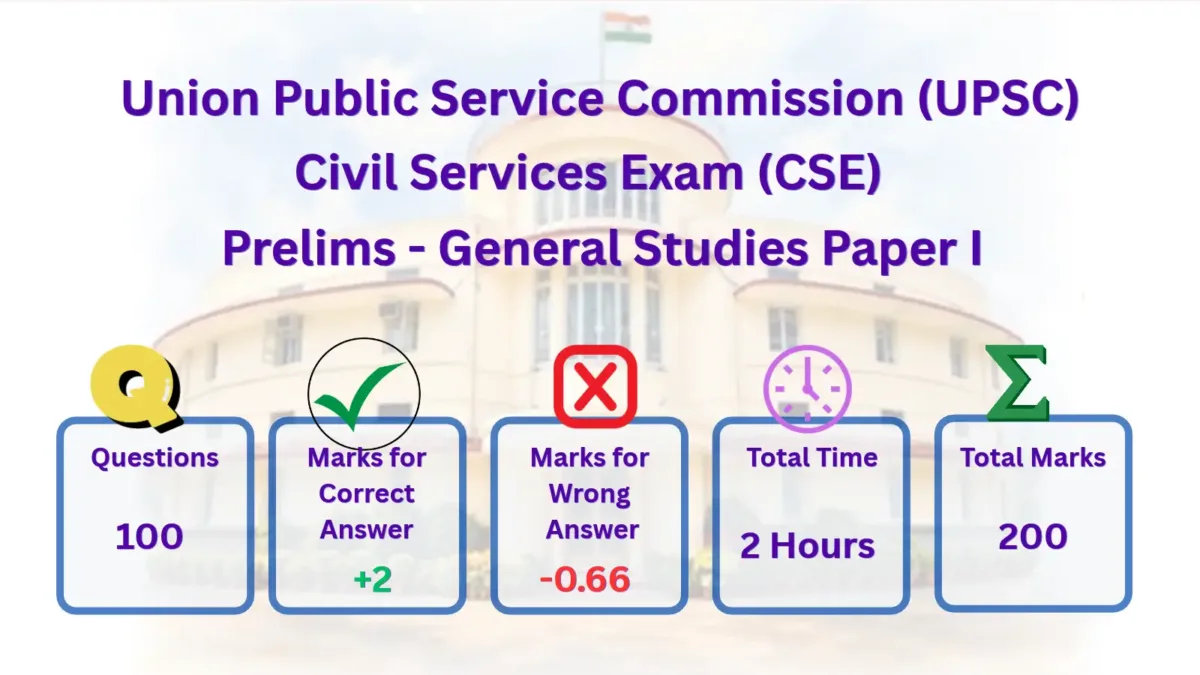
The UPSC Prelims examination consists of two compulsory papers: General Studies Paper I and General Studies Paper II, commonly known as CSAT. Each paper carries 200 marks and has a duration of two hours. While marks obtained in General Studies Paper I determine the Preliminary Examination cut-off, CSAT is qualifying in nature. Candidates must secure at least 33% marks in CSAT to qualify for the Main Examination.
This article explains the UPSC Prelims exam pattern, including the two papers, marks distribution, examination duration, negative marking, qualifying criteria and syllabus.
UPSC Prelims Exam Pattern: Overview
| Particulars | Details |
|---|---|
| Conducting authority | Union Public Service Commission (UPSC) |
| Examination | Civil Services (Preliminary) Examination |
| Stage | First stage of the Civil Services Examination |
| Nature of examination | Objective type (Multiple Choice Questions) |
| Number of papers | Two compulsory papers |
| Paper I | General Studies |
| Paper II | General Studies Paper II (CSAT) |
| Maximum marks | 200 marks for each paper; 400 marks in total |
| Duration | Two hours for each paper |
| CSAT qualifying marks | 33% (66 out of 200 marks) |
| Negative marking | One-third of the marks assigned to a question for an incorrect answer |
| Question paper language | Hindi and English |
| Purpose | Screening candidates for the Civil Services Main Examination |
| Contribution to final merit | Prelims marks are not counted in the final merit list |
The above examination scheme is based on the Civil Services Examination Rules, 2026. Candidates should also read the relevant year’s UPSC notification and examination instructions for any specific directions.
UPSC Prelims: Two Compulsory Papers
The Preliminary Examination comprises two objective-type papers. Both papers are compulsory, and candidates must appear in both to be considered for evaluation.
1. General Studies Paper I
General Studies Paper I is the main merit-determining paper of the Preliminary Examination. It covers subjects such as history, geography, Indian polity, economy, environment, science and current affairs.
| Particulars | Details |
|---|---|
| Paper | General Studies Paper I |
| Maximum marks | 200 |
| Duration | Two hours |
| Question type | Objective type (MCQs) |
| Nature | Marks counted for determining the Prelims cut-off |
| Negative marking | Applicable |
The marks obtained in General Studies Paper I are used to determine whether a candidate meets the cut-off for qualifying for the Main Examination, subject to the qualifying requirement in CSAT.
General Studies Paper I syllabus
According to the official UPSC syllabus, General Studies Paper I covers the following areas:
- Current events of national and international importance: Important developments, government policies, international relations, national issues and other significant current affairs.
- History of India and the Indian National Movement: Ancient, medieval and modern Indian history, with particular emphasis on the Indian freedom struggle.
- Indian and World Geography: Physical, social and economic geography of India and the world.
- Indian Polity and Governance: Constitution, political system, Panchayati Raj, public policy and rights issues.
- Economic and Social Development: Sustainable development, poverty, inclusion, demographics and social sector initiatives.
- Environmental Ecology, Biodiversity and Climate Change: General issues relating to environmental ecology, biodiversity and climate change that do not require subject specialisation.
- General Science: Basic scientific concepts and developments across different areas of science.
For a detailed topic-wise explanation, refer to our UPSC Prelims Syllabus guide.
2. General Studies Paper II (CSAT)
General Studies Paper II is popularly known as the Civil Services Aptitude Test (CSAT). It assesses a candidate’s comprehension, reasoning, analytical ability, decision-making skills and basic numerical ability.
Unlike General Studies Paper I, CSAT is a qualifying paper. Candidates must obtain at least 33% marks to qualify in this paper. Marks obtained in CSAT are not added to the marks used for determining the Preliminary Examination merit cut-off.
| Particulars | Details |
|---|---|
| Paper | General Studies Paper II (CSAT) |
| Maximum marks | 200 |
| Duration | Two hours |
| Question type | Objective type (MCQs) |
| Nature | Qualifying |
| Minimum qualifying marks | 33% (66 marks out of 200) |
| Negative marking | Applicable |
CSAT syllabus
The official syllabus for General Studies Paper II includes the following areas:
- Comprehension: Understanding passages and interpreting the information provided.
- Interpersonal skills: Including communication skills.
- Logical reasoning and analytical ability: Applying logic, identifying relationships and analysing information.
- Decision-making and problem-solving: Assessing situations and selecting appropriate solutions.
- General mental ability: Questions testing general reasoning and mental aptitude.
- Basic numeracy: Numbers and their relations, orders of magnitude and other basic numerical concepts at the Class X level.
- Data interpretation: Charts, graphs, tables and data sufficiency at the Class X level.
For a detailed list of topics and preparation resources, refer to our UPSC Prelims Syllabus article.
UPSC Prelims Marks Distribution
Each of the two Preliminary Examination papers carries 200 marks. Therefore, the combined maximum marks for the two papers are 400.
| Paper | Maximum marks | Qualifying requirement | Role in Prelims merit |
|---|---|---|---|
| General Studies Paper I | 200 | Cut-off fixed by UPSC | Counted |
| General Studies Paper II (CSAT) | 200 | Minimum 33% | Not counted |
| Total | 400 | Both papers must be cleared as applicable | Only Paper I determines the merit cut-off |
Although the two papers together carry 400 marks, candidates should not calculate their Prelims merit by adding their scores in both papers. Only General Studies Paper I marks are considered for the Preliminary Examination cut-off, provided the candidate also secures the qualifying marks in CSAT.
UPSC Prelims Exam Duration
Both General Studies Paper I and General Studies Paper II are conducted for a duration of two hours each.
| Paper | Duration |
|---|---|
| General Studies Paper I | 2 hours |
| General Studies Paper II (CSAT) | 2 hours |
| Total examination time | 4 hours |
The two papers are generally conducted in separate sessions on the same examination day. Candidates should check their e-admit card and the official examination instructions for the reporting time and session timings applicable to that year’s examination.
Negative Marking in UPSC Prelims
UPSC follows a negative-marking system in both General Studies Paper I and General Studies Paper II. For every incorrect answer, one-third of the marks assigned to that question is deducted.
The negative-marking rules are as follows:
- For every incorrect answer, one-third of the marks assigned to that question is deducted.
- If a candidate marks more than one answer for a question, it is treated as an incorrect answer, even if one of the marked answers is correct.
- If a candidate leaves a question unanswered, no marks are deducted for that question.
- The same negative-marking principle applies to both Preliminary Examination papers.
Example of negative marking
Suppose a question carries two marks. If a candidate answers it incorrectly, one-third of two marks, or approximately 0.67 marks, will be deducted.
If the candidate leaves the same question unanswered, there is no negative marking.
Formula:
Penalty for an incorrect answer = One-third × Marks assigned to the question.
Candidates should read the instructions printed on the question paper and answer sheet carefully before attempting the examination.
Is CSAT Qualifying in UPSC Prelims?
Yes. General Studies Paper II (CSAT) is qualifying in nature. A candidate must obtain at least 33% marks in this paper to qualify for the Main Examination.
Since CSAT carries 200 marks, the minimum qualifying score is:
33% of 200 = 66 marks.
Obtaining 66 marks or more in CSAT does not, by itself, qualify a candidate for the Main Examination. The candidate must also secure the required cut-off marks in General Studies Paper I.
How Is the UPSC Prelims Cut-off Calculated?
The Preliminary Examination cut-off is determined on the basis of marks obtained in General Studies Paper I. General Studies Paper II is qualifying in nature and its marks are not included in the calculation of the Prelims merit cut-off.
To qualify for the Main Examination, a candidate must satisfy both of the following conditions:
- Obtain at least 33% marks in General Studies Paper II (CSAT).
- Obtain the minimum qualifying marks in General Studies Paper I as determined by UPSC.
The cut-off in General Studies Paper I is not fixed permanently. It may vary from one examination year to another depending on factors such as the difficulty of the question paper, the number of vacancies, the number of candidates and the overall performance of candidates.
UPSC also publishes category-wise cut-off marks. Candidates should refer to the official cut-off notice for the relevant examination year rather than relying on unofficial estimates.
Are UPSC Prelims Marks Counted in the Final Merit List?
No. The Civil Services Preliminary Examination is a screening test. Marks obtained in Prelims are not counted towards the final merit list or final ranking.
Its purpose is to shortlist candidates for the Civil Services Main Examination. The final merit is determined on the basis of marks obtained in the Main Examination and the Personality Test, in accordance with the applicable examination rules.
Therefore, a candidate’s Prelims score is important for qualifying for Mains, but it does not directly contribute to the final selection marks.
Is It Compulsory to Appear in Both Prelims Papers?
Yes. Both General Studies Paper I and General Studies Paper II are compulsory. According to the Civil Services Examination Rules, candidates must appear in both papers for evaluation. A candidate who does not appear in either of the two papers will be disqualified from the Preliminary Examination.
Simply appearing for one paper is not sufficient to qualify for the next stage.
Language of UPSC Prelims Question Papers
The UPSC Preliminary Examination question papers are set in both Hindi and English. Candidates should read the instructions and the question paper carefully, particularly where a translation or interpretation of a term is important.
The official examination notice and the instructions provided with the question paper should be followed in case of any doubt.
Recent Development: Provisional Answer Key from UPSC Prelims 2026
UPSC introduced an important transparency-related change from the Civil Services Preliminary Examination 2026 onwards. Under the earlier practice, the official answer key was generally released after completion of the entire Civil Services Examination process. Under the revised procedure, UPSC will release a provisional answer key after the Preliminary Examination.
Candidates can submit representations concerning discrepancies in the question paper and provisional answer key through the Commission’s Question Paper Representation Portal (QPRep).
The final answer key and marks of the Preliminary Examination will continue to be released only after declaration of the final result of the examination. This change improves the transparency of the examination process but does not alter the two-paper structure, marks distribution or qualifying requirements of Prelims.
Difference Between UPSC Prelims and Mains
The Preliminary Examination and Main Examination serve different purposes and have different formats.
| Particulars | Preliminary Examination | Main Examination |
|---|---|---|
| Nature | Objective type | Descriptive (conventional) type |
| Purpose | Screening candidates for Mains | Assess knowledge, understanding and written expression |
| Number of papers | 2 | 9 |
| Marks | 200 per paper | Two qualifying papers and seven merit-counting papers |
| Duration | 2 hours per paper | 3 hours per paper |
| Optional subject | No optional subject | One optional subject with two papers |
| Negative marking | Applicable | Not applicable in the same objective-test manner |
| Contribution to final merit | Not counted | Counted along with the Personality Test |
For complete details about the written examination, refer to our UPSC Mains Exam Pattern guide. You can also read the overall UPSC Exam Pattern to understand all three stages of the selection process.
Frequently Asked Questions (FAQs)
1. How many papers are there in UPSC Prelims?
There are two compulsory papers in UPSC Prelims: General Studies Paper I and General Studies Paper II (CSAT). Both papers are objective type and carry 200 marks each.
2. What is the total marks of UPSC Prelims?
Each paper carries 200 marks. Therefore, the combined maximum marks of the two papers are 400. However, only General Studies Paper I marks are counted for determining the Prelims cut-off.
3. What is the duration of each UPSC Prelims paper?
Each paper has a duration of two hours. The total examination time is four hours, excluding any break between the two sessions.
4. Is CSAT qualifying in UPSC Prelims?
Yes. CSAT is qualifying in nature. Candidates must secure at least 33% marks, equivalent to 66 out of 200 marks, in General Studies Paper II.
5. Are marks obtained in CSAT counted for the Prelims cut-off?
No. CSAT marks are not added to the marks used for determining the Prelims cut-off. A candidate must only meet the minimum qualifying requirement of 33% in CSAT.
6. Is there negative marking in both UPSC Prelims papers?
Yes. For every incorrect answer, one-third of the marks assigned to that question is deducted. No marks are deducted for an unanswered question.
7. What happens if a candidate does not appear in CSAT?
Both Preliminary Examination papers are compulsory. A candidate who does not appear in either paper will be disqualified from the Preliminary Examination.
8. Are UPSC Prelims marks counted in the final selection?
No. Prelims is only a screening examination. Its marks are not included in the final merit calculation.
9. Is the UPSC Prelims question paper available in Hindi?
Yes. The question papers are set in both Hindi and English, as provided in the Civil Services Examination Rules.
10. When will UPSC release the official Prelims answer key?
From the Civil Services Preliminary Examination 2026 onwards, UPSC has introduced the release of a provisional answer key after the Preliminary Examination. The final answer key and marks are released after the declaration of the final result.
Official Sources and References
The information in this article is based primarily on the official Civil Services Examination Rules and UPSC guidance. Candidates should always refer to the notification applicable to their examination year.
- Government of India Gazette – Civil Services Examination Rules, 2026 (4 February 2026)
- UPSC – Civil Services (Preliminary) Examination, 2026
- UPSC – Examination-related Frequently Asked Questions
- Press Information Bureau – Change of UPSC Exam Pattern (2 January 2019)
- Press Information Bureau – Civil Services Examination: CSAT qualifying paper (13 May 2015)
- Press Information Bureau – Transparency in UPSC Examinations (23 March 2026)
Conclusion
The UPSC Civil Services Preliminary Examination consists of two compulsory objective-type papers, each carrying 200 marks and having a duration of two hours. General Studies Paper I determines the Prelims cut-off, while General Studies Paper II (CSAT) is qualifying with a minimum requirement of 33% marks.
Candidates should understand the examination structure, syllabus, marking scheme and qualifying conditions before beginning their preparation. They should also remember that Prelims is a screening stage and its marks are not counted in the final merit list. For the latest examination-specific instructions, the official UPSC notification and examination rules should always be treated as the final authority.