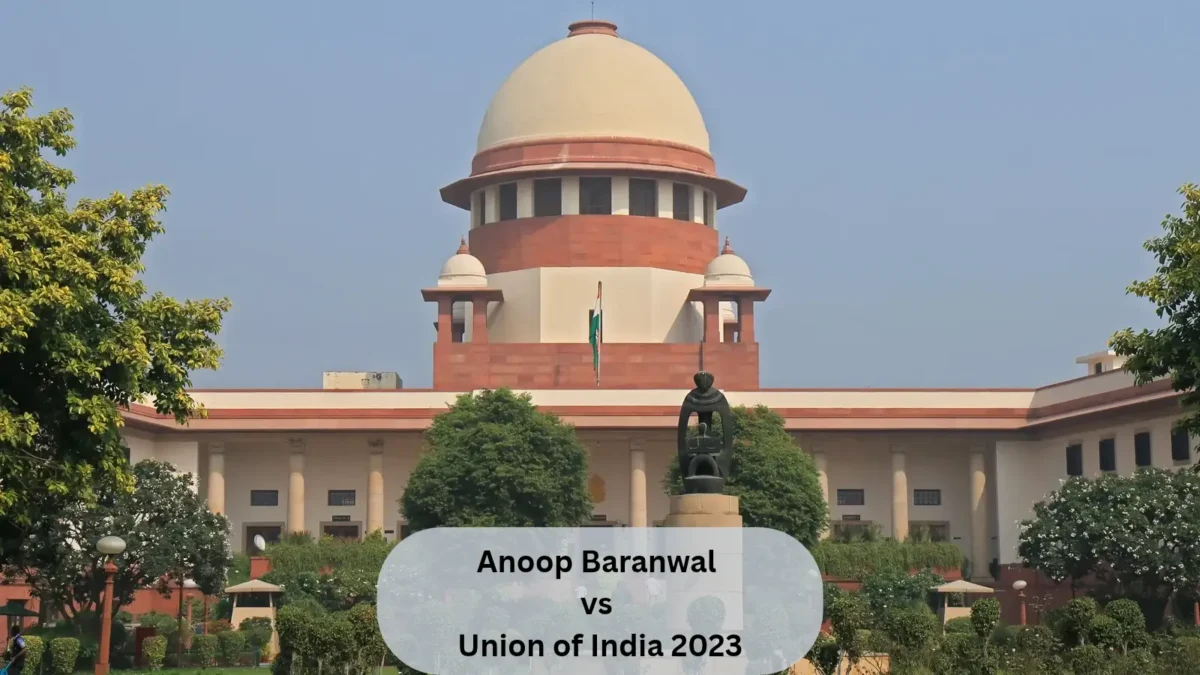
Anoop Baranwal vs Union of India (2023) is one of the most important Supreme Court judgments for understanding the appointment of the Chief Election Commissioner (CEC) and Election Commissioners (ECs), the independence of the Election Commission of India (ECI), and the constitutional meaning of Article 324.
The Constitution gives the President the power to appoint the Chief Election Commissioner and other Election Commissioners, subject to any law made by Parliament. For several decades, however, Parliament had not enacted a comprehensive law laying down the appointment procedure. This led to a constitutional question: who should advise the President in appointing the members of the Election Commission?
In its landmark judgment delivered on 2 March 2023, a five-judge Constitution Bench of the Supreme Court directed that, until Parliament made a law on the subject, appointments to the posts of CEC and Election Commissioners would be made on the advice of a committee consisting of the Prime Minister, the Leader of the Opposition in the Lok Sabha, and the Chief Justice of India.
The judgment became especially significant because Parliament subsequently enacted the Chief Election Commissioner and Other Election Commissioners (Appointment, Conditions of Service and Term of Office) Act, 2023, which replaced the Chief Justice of India with a Union Cabinet Minister nominated by the Prime Minister in the selection committee.
As a result, the Anoop Baranwal judgment remains central to the contemporary debate over the independence of India’s Election Commission.
Why Is Anoop Baranwal Case in the News?
The judgment has returned to the national debate because of continuing litigation over the 2023 law governing the appointment of the CEC and Election Commissioners.
In September 2026, a two-judge Supreme Court Bench delivered differing views on whether petitions challenging the constitutional validity of the 2023 law should be referred to a larger Constitution Bench. The matter was consequently placed before the Chief Justice of India for appropriate administrative action. One of the judges emphasised that it is not sufficient for the Election Commission to be independent; it must also appear to be independent.
On 7 October 2026, Chief Justice Surya Kant agreed to examine an application seeking recall of the September split order. Therefore, the broader constitutional debate surrounding the appointment of Election Commissioners remains a live issue.
UPSC takeaway: The 2023 Anoop Baranwal judgment and the subsequent 2023 CEC appointment law should be studied together, but they should not be treated as the same legal development.
Anoop Baranwal Case: Basic Details
| Particular | Details |
|---|---|
| Case | Anoop Baranwal v. Union of India |
| Writ Petition | W.P. (Civil) No. 104 of 2015 and connected matters |
| Date of judgment | 2 March 2023 |
| Court | Supreme Court of India |
| Bench | Five-judge Constitution Bench |
| Key constitutional provision | Article 324 |
| Chief Justice heading the Bench | Justice K. M. Joseph |
| Five-judge Constitution Bench | (1) Justice K. M. Joseph; (2) Justice Ajay Rastogi (3) Justice Aniruddha Bose; (4) Justice Hrishikesh Roy; and (5) Justice C.T. Ravikumar |
| Central issue | Appointment of CEC and Election Commissioners |
| Key interim constitutional mechanism | PM + Leader of Opposition + CJI committee |
The official judgment records that the petitions concerned the true effect of Article 324 and, particularly, Article 324(2), which provides for appointment of the CEC and other Election Commissioners by the President, subject to any law made by Parliament.
Also see: Anoop Baranwal v Union of India by Supreme Court Observer and Anoop Baranwal v Union of India Judgement in IndianKanoon.org
What Does Article 324 Say?
Article 324 is the constitutional foundation of the Election Commission of India.
It provides for the superintendence, direction and control of elections to:
- Parliament;
- State Legislatures;
- the office of President; and
- the office of Vice-President.
Article 324(2) provides that the Election Commission shall consist of the Chief Election Commissioner and such number of other Election Commissioners, if any, as the President may from time to time fix.
It further provides that the appointment of the CEC and other Election Commissioners shall, subject to the provisions of any law made by Parliament, be made by the President.
This phrase—“subject to the provisions of any law made in that behalf by Parliament”—became central to the Anoop Baranwal litigation.
Background of the Case
For many years, the appointment of the CEC and Election Commissioners was made by the executive government with the President formally making the appointments.
Although Article 324 contemplated the possibility of Parliament making a law regulating appointments, Parliament had not enacted such a comprehensive law prescribing a selection mechanism.
This raised concerns about whether the executive branch had too much influence over the appointment of an institution responsible for conducting elections to the very government that participated in those elections.
The petitioners argued that the independence of the Election Commission was essential to maintaining free and fair elections and that the appointment mechanism should therefore include an element of institutional independence.
The Main Constitutional Issue
The central question before the Supreme Court was not simply who appoints the Election Commissioners.
The deeper constitutional question was:
How can the independence of the Election Commission be protected when the Constitution requires the President to appoint the CEC and ECs, but Parliament has not enacted a law prescribing the appointment process?
This question required the Court to examine Article 324 in the wider constitutional context of democracy, free and fair elections and institutional independence.
What Did the Supreme Court Decide?
The Constitution Bench held that, until Parliament made a law on the subject, the President should appoint the CEC and Election Commissioners on the advice of a committee consisting of:
- Prime Minister of India
- Leader of the Opposition in the Lok Sabha
- Chief Justice of India
If there was no recognised Leader of the Opposition, the Court provided for the leader of the largest opposition party in the Lok Sabha having the largest numerical strength.
The Supreme Court expressly stated that this arrangement would operate until Parliament enacted legislation governing the appointment process.
Why Did the Supreme Court Bring in a Selection Committee?
The Court’s reasoning was closely connected with the principle of free and fair elections.
An election is not considered genuinely free merely because citizens are permitted to vote. The institution responsible for administering elections must also possess sufficient independence and public credibility.
The Court therefore considered the independence of the Election Commission an important constitutional value.
Including the Chief Justice of India and the Leader of the Opposition was intended to introduce a degree of institutional and political balance into the appointment process.
The Selection Committee Under Anoop Baranwal
| Member | Role |
|---|---|
| Prime Minister | Head of the Union government |
| Leader of the Opposition in Lok Sabha | Representation of the opposition |
| Chief Justice of India | Judicial representation |
This arrangement was often compared with a collegium-type mechanism because it moved the selection process away from exclusive executive control.
However, it is important for UPSC aspirants to remember that the Supreme Court did not permanently amend Article 324. It prescribed the mechanism as an interim arrangement until Parliament enacted a law.
Why Is the Judgment Important?
The significance of the judgment extends beyond the appointment of Election Commissioners.
It raises a fundamental question about how constitutional institutions can remain independent when their members are appointed by the political executive.
The Election Commission conducts elections involving the ruling party, opposition parties and individual candidates. Its decisions can affect the political fortunes of governments and parties.
Therefore, the credibility of the appointment process can directly influence public confidence in elections.
Election Commission Independence
The concept of independence of the Election Commission has several dimensions.
- Independence of appointment
- Security of tenure
- Protection against arbitrary removal
- Financial and administrative autonomy
- Ability to enforce electoral rules impartially
- Institutional credibility
The Anoop Baranwal judgment primarily brought the appointment dimension of institutional independence into sharp focus.
The Court also appealed to the Union Government and Parliament to consider measures such as a permanent secretariat for the Election Commission and charging its expenditure to the Consolidated Fund of India to strengthen institutional independence.
Anoop Baranwal Judgment and the 2023 CEC Act
One of the most important developments after the judgment was the enactment of the Chief Election Commissioner and Other Election Commissioners (Appointment, Conditions of Service and Term of Office) Act, 2023.
The Act established a statutory framework for appointment of the CEC and Election Commissioners.
However, the composition of the selection committee under the Act differs significantly from the mechanism prescribed by the Supreme Court in Anoop Baranwal.
Supreme Court Committee vs 2023 Act
| Anoop Baranwal Judgment, 2023 | CEC and Other ECs Act, 2023 |
|---|---|
| Prime Minister | Prime Minister |
| Leader of Opposition in Lok Sabha | Leader of Opposition in Lok Sabha |
| Chief Justice of India | Union Cabinet Minister nominated by the Prime Minister |
Thus, the CJI was replaced by a Union Cabinet Minister nominated by the Prime Minister.
This means that the government has two members on the three-member selection committee, while the opposition has one member.
This change is at the heart of the continuing debate about whether the 2023 law adequately protects the institutional independence of the Election Commission. The Supreme Court has been examining constitutional challenges to this statutory framework.
Why Is the 2023 Act Controversial?
Critics argue that replacing the Chief Justice of India with a Union Cabinet Minister increases executive influence over appointments.
Their argument is based on institutional independence: if the Union government has two members on a three-member selection committee, it may have greater influence over the final choice.
The government, on the other hand, has defended Parliament’s authority to legislate on the appointment process under Article 324(2).
This creates an important constitutional tension between two principles:
- Parliamentary law-making power under Article 324(2); and
- the need to preserve the independence and credibility of the Election Commission.
2026 Supreme Court Developments: What UPSC Aspirants Should Know
The controversy did not end with the enactment of the 2023 Act.
In 2026, petitions challenging the constitutional validity of the appointment law came before the Supreme Court. The dispute concerns, among other things, whether the composition of the selection committee undermines the independence of the Election Commission.
On 23 September 2026, Justices Dipankar Datta and Satish Chandra Sharma delivered differing views on whether the challenge should be referred to a larger Constitution Bench. The disagreement resulted in the matter being placed before the Chief Justice for further action.
Justice Datta stressed that the Election Commission must not merely be independent in fact but should also appear to be independent.
On 7 October 2026, the Chief Justice agreed to examine an application seeking recall of the September split order. Consequently, the legal challenge to the 2023 appointment framework remains an evolving issue.
Important: For UPSC answers, do not write that the Supreme Court has struck down the 2023 Act. As of October 2026, the constitutional challenge remains under judicial consideration.
Anoop Baranwal and Separation of Powers
The case is also significant from the perspective of separation of powers.
The Constitution assigns different responsibilities to Parliament, the executive and the judiciary. Article 324 itself contemplates that Parliament may make a law concerning the appointment of Election Commissioners.
The Supreme Court’s 2023 decision therefore did not permanently take away Parliament’s legislative role. Instead, it provided an interim mechanism in the absence of parliamentary legislation.
Once Parliament enacted the 2023 law, the legal landscape changed and the question shifted toward the constitutional validity of that legislation.
Judicial Activism or Constitutional Necessity?
The judgment has generated debate over the appropriate limits of judicial intervention.
One view is that the Court was justified in filling a constitutional vacuum because the independence of the Election Commission is essential to free and fair elections.
The other view is that Article 324(2) expressly contemplated legislation by Parliament and that the judiciary should be cautious about prescribing an appointment mechanism where the Constitution has left room for legislative action.
This makes the case particularly useful for UPSC Mains because it allows candidates to present both sides of a constitutional debate rather than treating the judgment as a simple judicial victory or defeat.
Key Constitutional Provisions Related to the Case
| Article | Subject | Relevance |
|---|---|---|
| Article 324 | Election Commission | Core provision in Anoop Baranwal |
| Article 325 | One general electoral roll | Non-discrimination in electoral rolls |
| Article 326 | Adult suffrage | Basis of voting rights for Lok Sabha and State Assemblies |
| Article 327 | Parliament’s power | Power to make election-related laws |
| Article 328 | State Legislature’s power | Election-related legislative power within constitutional limits |
| Article 329 | Bar to interference by courts | Concerns electoral matters and election petitions |
Anoop Baranwal Judgment: Key Points for UPSC Prelims
- The judgment was delivered on 2 March 2023.
- It was delivered by a five-judge Constitution Bench.
- The case concerned Article 324, particularly Article 324(2).
- The Court prescribed an interim appointment mechanism for CEC and ECs.
- The interim committee consisted of the Prime Minister, Leader of the Opposition in Lok Sabha and Chief Justice of India.
- The arrangement was to operate until Parliament made a law.
- Parliament subsequently enacted the CEC and Other ECs Act, 2023.
- The 2023 Act replaced the CJI with a Union Cabinet Minister nominated by the Prime Minister.
- The present controversy concerns the constitutional validity of the statutory appointment mechanism, not the simple continuation of the 2023 judgment’s interim arrangement.
Anoop Baranwal vs Union of India: Prelims Comparison
| Point | Anoop Baranwal | 2023 CEC Act |
|---|---|---|
| Nature | Supreme Court judgment | Parliamentary legislation |
| Year | 2023 | 2023 |
| Selection committee | PM + LoP + CJI | PM + LoP + Union Cabinet Minister nominated by PM |
| CJI included? | Yes | No |
| Purpose | Interim mechanism pending parliamentary law | Statutory appointment framework |
Important Supreme Court Cases Related to the Election Commission
The Anoop Baranwal judgment should be studied alongside other important cases dealing with the powers and functioning of the Election Commission.
| Case | Year | Key significance |
|---|---|---|
| Mohinder Singh Gill v. Chief Election Commissioner | 1978 | Important interpretation of Election Commission powers under Article 324 |
| A.C. Jose v. Sivan Pillai | 1984 | Examines the relationship between statutory law and Article 324 powers |
| T. N. Seshan v. Union of India | 1995 | Upheld the multi-member Election Commission |
| Anoop Baranwal v. Union of India | 2023 | Interim appointment mechanism for CEC and ECs |
Significance for Electoral Reforms in India
The larger significance of the Anoop Baranwal judgment lies in its treatment of electoral institutions as an important part of constitutional democracy.
Free and fair elections require more than periodic voting. They require an election management institution that is capable of acting impartially, enforcing electoral rules and maintaining public confidence.
The debate over appointments therefore forms part of a much larger discussion involving:
- Independence of the Election Commission
- Security of tenure of Election Commissioners
- Financial autonomy of the ECI
- Administrative autonomy
- Transparency in appointments
- Political neutrality
- Enforcement of the Model Code of Conduct
- Electoral expenditure
- Use of money and muscle power
What Does the Judgment Mean for the Independence of ECI?
The judgment does not mean that the Election Commission became completely independent from the executive or Parliament.
Rather, it recognised that the method of appointing constitutional functionaries can affect the perceived and actual independence of the institution they lead.
This is why the appointment process has become an important component of the broader debate over electoral reforms.
Critical Analysis: Strengths of the Judgment
- It addressed a long-standing legislative vacuum concerning the appointment process.
- It emphasised the importance of institutional independence.
- It introduced judicial representation into the interim selection mechanism.
- It strengthened the debate over transparent appointment of Election Commissioners.
- It connected electoral administration with the constitutional principle of free and fair elections.
Critical Analysis: Limitations and Concerns
- The mechanism prescribed by the Court was expressly temporary.
- Parliament retained the constitutional authority to enact a law on appointments.
- The judgment raised questions about the extent to which courts should prescribe institutional structures not expressly specified in the Constitution.
- The subsequent 2023 legislation demonstrates that the constitutional debate over appointment procedures remains unresolved.
UPSC Mains: Model Answer Framework
Question: “The independence of the Election Commission is essential for ensuring free and fair elections.” Discuss in the light of the Anoop Baranwal judgment.
Introduction: Mention Article 324 and the constitutional role of the Election Commission.
Body:
- Explain the absence of a parliamentary law governing appointments before 2023.
- Explain the Supreme Court’s interim mechanism in Anoop Baranwal.
- Discuss the role of the PM, LoP and CJI.
- Explain the subsequent CEC and Other ECs Act, 2023.
- Discuss concerns regarding executive influence.
- Balance this with Parliament’s power under Article 324(2).
- Mention the continuing judicial debate over the 2023 Act.
Conclusion: Suggest that electoral credibility requires not merely formal independence but transparent appointments, institutional autonomy and accountability.
MCQs on Anoop Baranwal Case
Question 1
With reference to Anoop Baranwal v. Union of India (2023), consider the following statements:
- The judgment dealt primarily with the appointment of the Chief Election Commissioner and Election Commissioners.
- The Supreme Court relied upon Article 324 of the Constitution.
- The judgment permanently amended Article 324.
Which of the statements given above is/are correct?
- 1 only
- 1 and 2 only
- 2 and 3 only
- 1, 2 and 3
Answer: B. 1 and 2 only
Question 2
Under the mechanism prescribed by the Supreme Court in Anoop Baranwal, the selection committee consisted of:
- Prime Minister, Home Minister and Chief Justice of India
- Prime Minister, Leader of Opposition and Chief Justice of India
- President, Prime Minister and Chief Justice of India
- Prime Minister, Speaker of Lok Sabha and Chief Justice of India
Answer: B. Prime Minister, Leader of Opposition and Chief Justice of India
Question 3
The Supreme Court’s mechanism in Anoop Baranwal was to remain in force:
- Permanently
- For five years
- Until Parliament enacted a law on the subject
- Until the next general election
Answer: C. Until Parliament enacted a law on the subject
Question 4
Which constitutional provision was at the centre of the Anoop Baranwal judgment?
- Article 280
- Article 312
- Article 324
- Article 356
Answer: C. Article 324
Question 5
Under the 2023 CEC and Other ECs Act, which member replaced the Chief Justice of India in the Selection Committee?
- Attorney General of India
- Union Law Minister
- A Union Cabinet Minister nominated by the Prime Minister
- Vice-President of India
Answer: C. A Union Cabinet Minister nominated by the Prime Minister
Question 6
Which one of the following best describes the present significance of the Anoop Baranwal judgment?
- It abolished the Election Commission.
- It permanently transferred appointment powers from the President to the Supreme Court.
- It highlighted the relationship between the appointment process and the independence of the Election Commission.
- It introduced proportional representation for Lok Sabha elections.
Answer: C. It highlighted the relationship between the appointment process and the independence of the Election Commission.
Question 7
Consider the following pairs:
| Case | Subject |
|---|---|
| Mohinder Singh Gill case | Powers of Election Commission |
| T. N. Seshan case | Multi-member Election Commission |
| Anoop Baranwal case | Appointment of CEC and Election Commissioners |
Which of the pairs given above are correctly matched?
- 1 and 2 only
- 2 and 3 only
- 1 and 3 only
- 1, 2 and 3
Answer: D. 1, 2 and 3
Frequently Asked Questions
What is the Anoop Baranwal case?
Anoop Baranwal v. Union of India is a 2023 Supreme Court Constitution Bench judgment concerning the appointment of the Chief Election Commissioner and Election Commissioners and the institutional independence of the Election Commission.
What was the Supreme Court’s ruling in Anoop Baranwal?
The Court directed that, until Parliament enacted a law, appointments to the posts of CEC and Election Commissioners should be made on the advice of a committee consisting of the Prime Minister, Leader of the Opposition in the Lok Sabha and Chief Justice of India.
Did the Anoop Baranwal judgment permanently change the Constitution?
No. The mechanism prescribed by the Court was expressly applicable until Parliament made a law governing the appointments.
What changed after the Anoop Baranwal judgment?
Parliament enacted the Chief Election Commissioner and Other Election Commissioners (Appointment, Conditions of Service and Term of Office) Act, 2023, creating a statutory appointment framework.
Who replaced the CJI under the 2023 CEC appointment law?
The 2023 Act provides for a Union Cabinet Minister nominated by the Prime Minister in place of the Chief Justice of India.
Why is the Anoop Baranwal case important for UPSC?
The judgment connects several important UPSC themes: Article 324, constitutional bodies, separation of powers, judicial review, electoral reforms, institutional independence and free and fair elections.
Conclusion
Anoop Baranwal v. Union of India (2023) represents an important moment in the constitutional evolution of India’s electoral institutions. Its central contribution was to connect the appointment of Election Commissioners with the broader constitutional requirement of free and fair elections.
The judgment also illustrates the dynamic relationship between the judiciary and Parliament. The Supreme Court provided an interim mechanism because Parliament had not enacted a law governing appointments; Parliament subsequently exercised its legislative power by enacting the 2023 CEC and Other ECs Act.
The resulting controversy demonstrates that the debate is not simply about who appoints the Election Commissioners. At its core, it concerns how India can maintain an Election Commission that is independent, impartial, transparent and trusted by all political stakeholders.
For UPSC aspirants, the most important chain to remember is:
Article 324 → absence of parliamentary appointment law → Anoop Baranwal judgment (2023) → PM + LoP + CJI committee → CEC and Other ECs Act, 2023 → replacement of CJI by Union Cabinet Minister → continuing debate over ECI independence.