The Chief Election Commissioner of India is the head of the Election Commission of India (ECI), a constitutional body entrusted with the superintendence, direction and control of elections in India.
The office of the Chief Election Commissioner of India (CEC of India) is important for the functioning of India’s parliamentary democracy because the Election Commission is responsible for conducting elections to the Lok Sabha, Rajya Sabha, State Legislative Assemblies, and the offices of the President and Vice-President.
The constitutional foundation of the Election Commission is found primarily in Article 324 of the Constitution of India. The appointment, tenure, service conditions and other aspects relating to the CEC and Election Commissioners are now governed by the Chief Election Commissioner and Other Election Commissioners (Appointment, Conditions of Service and Term of Office) Act, 2023.
For UPSC aspirants, the CEC is an important topic under Indian Polity, Constitutional Bodies, Election Reforms, Separation of Powers and Democratic Governance.
Who is the Chief Election Commissioner of India?
The Chief Election Commissioner of India (CEC) is the head and chairperson of the Election Commission of India.
Article 324 of the Constitution provides for an Election Commission consisting of:
- the Chief Election Commissioner; and
- such number of other Election Commissioners as the President may determine from time to time.
When other Election Commissioners are appointed, the Chief Election Commissioner of India acts as the Chairman of the Election Commission of India.
The Election Commission is an independent constitutional authority, rather than a department of the Union Government.
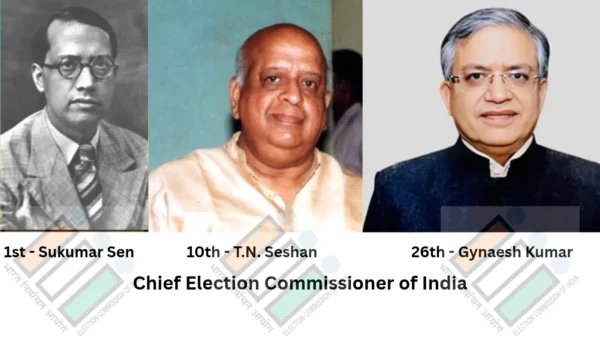
As of October 2026, Gyanesh Kumar is the 26th Chief Election Commissioner of India.
See List of Chief Election Commissioners of India.
Constitutional Basis of the Chief Election Commissioner of India
The principal constitutional provision relating to the CEC is Article 324.
Article 324
Article 324 vests the following powers in the Election Commission:
Superintendence, direction and control of the preparation of electoral rolls and the conduct of elections.
These elections include elections to:
- Lok Sabha
- Rajya Sabha
- State Legislative Assemblies
- State Legislative Councils
- President of India
- Vice-President of India
Article 324(2) provides that the Election Commission shall consist of the CEC and such number of other Election Commissioners as the President may determine.
It also provides that the appointment of the CEC and other Election Commissioners shall be made by the President, subject to any law made by Parliament.
Article 324(5) provides special constitutional protection to the CEC against removal from office.
Why is Article 324 Important?
Article 324 is important because it establishes the constitutional status and institutional independence of the Election Commission.
The Constitution does not merely create an election-related administrative agency. It creates a constitutional body with wide powers relating to the electoral process.
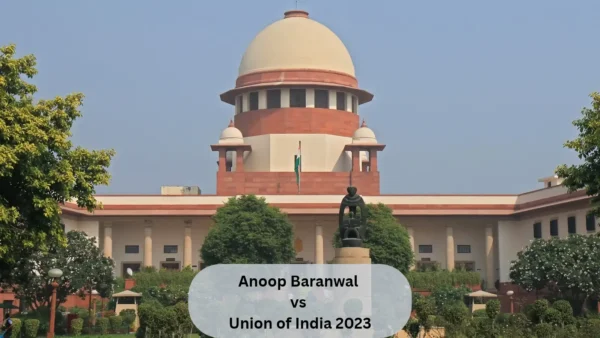
The Supreme Court has emphasized the importance of an independent Election Commission in maintaining free and fair elections. In Anoop Baranwal v. Union of India (2023), the Court examined the appointment mechanism for the CEC and Election Commissioners and emphasized the constitutional importance of insulating the Election Commission from executive influence.
Appointment of the Chief Election Commissioner of India
Constitutional Position
Article 324(2) states that the President appoints the CEC and other Election Commissioners, subject to parliamentary law.
Thus, constitutionally:
President → appoints CEC and Election Commissioners
However, the Constitution originally did not prescribe a detailed selection procedure.
Parliament subsequently enacted legislation dealing with the appointment and service conditions of the Election Commissioners.
Chief Election Commissioner and Other Election Commissioners Act, 2023
The major change came with the Chief Election Commissioner and Other Election Commissioners (Appointment, Conditions of Service and Term of Office) Act, 2023.
The Act was enacted on 28 December 2023 and came into force on 2 January 2024.
It replaced the earlier Election Commission (Conditions of Service of Election Commissioners and Transaction of Business) Act, 1991.
The 2023 Act regulates:
- appointment;
- qualifications;
- search committee;
- selection committee;
- tenure;
- salary and service conditions;
- resignation;
- removal; and
- transaction of business of the Election Commission.
How is the CEC Appointed under the 2023 Act?
The process involves three stages.
1. Search Committee
A Search Committee headed by the Union Minister of Law and Justice prepares a panel of suitable persons for consideration.
2. Selection Committee
The Selection Committee recommends persons for appointment as CEC and Election Commissioners.
| Member | Position |
|---|---|
| Prime Minister | Chairperson |
| Union Cabinet Minister nominated by the Prime Minister | Member |
| Leader of Opposition in Lok Sabha | Member |
If no Leader of Opposition is recognized, the leader of the single largest opposition party in the Lok Sabha is treated as the Leader of Opposition for this purpose.
3. Appointment by President
The President formally appoints the Chief Election Commissioner and other Election Commissioners on the recommendation of the Selection Committee.
Thus, the current statutory mechanism can be remembered as:
Search Committee → Selection Committee → President → Appointment
CEC Appointment: Supreme Court’s 2023 Judgment vs 2023 Act
This is an important area for UPSC.
In Anoop Baranwal vs Union of India 2023, the Supreme Court directed that, until Parliament enacted a law, appointments should be made on the recommendation of a committee consisting of:
- Prime Minister;
- Leader of Opposition in Lok Sabha; and
- Chief Justice of India.
The Court’s arrangement was intended to operate until Parliament made a law regulating appointments.
Parliament subsequently enacted the 2023 Act.
The Act replaced the Chief Justice of India in the Selection Committee with a Union Cabinet Minister nominated by the Prime Minister.
| Mechanism | Selection Committee |
|---|---|
| Supreme Court framework, 2023 | Prime Minister + Leader of Opposition + Chief Justice of India |
| 2023 Act | Prime Minister + Leader of Opposition + Union Cabinet Minister nominated by Prime Minister |
This difference has generated an important constitutional debate concerning the independence of the Election Commission.
Qualifications for CEC and Election Commissioners
The 2023 Act lays down eligibility requirements.
A person considered for appointment should:
- be a person of integrity;
- have knowledge and experience in the management and conduct of elections; and
- hold or have held a post equivalent to the Secretary to the Government of India.
The statutory framework therefore emphasizes senior administrative experience and experience connected with election management.
Tenure of the Chief Election Commissioner of India
Under the 2023 Act, the CEC and other Election Commissioners hold office for:
Six years OR until the age of 65 years, whichever is earlier.
They are not eligible for reappointment.
Important UPSC Fact
If an Election Commissioner is subsequently appointed as the CEC, the aggregate period served as Election Commissioner and CEC cannot exceed six years.
Example
Suppose a person serves as an Election Commissioner for four years and is then appointed CEC.
He or she can serve as CEC for a maximum of another two years, subject to the age limit of 65 years.
Removal of the Chief Election Commissioner
The removal of the CEC is one of the most important constitutional protections given to the office.
Under Article 324(5), the CEC cannot be removed from office except:
- in the same manner; and
- on the same grounds
as a Judge of the Supreme Court.
This means the CEC has a high degree of security of tenure.
Grounds for Removal of the CEC
The grounds are:
- Proved misbehaviour; or
- Incapacity.
These are the same grounds applicable to the removal of a Supreme Court Judge.
Procedure for Removal of CEC
The removal procedure can be understood in the following steps:
Step 1: Motion in Parliament
A motion for removal is initiated in either House of Parliament.
Step 2: Special Majority
The motion must be passed by:
- a majority of the total membership of that House; and
- a majority of not less than two-thirds of the members present and voting.
Step 3: Both Houses
The required motion must be passed by both Houses of Parliament.
Step 4: President’s Order
After Parliament adopts the address, the President issues the order removing the CEC.
Therefore:
Proved misbehaviour/incapacity → Parliamentary address → Special majority in both Houses → President’s removal order
The Judges (Inquiry) Act, 1968 provides the statutory framework concerning investigation and proof of misbehaviour or incapacity in relation to judges and the parliamentary address procedure.
Can the President Remove the CEC Directly?
No.
The President cannot arbitrarily remove the CEC.
The President’s removal power is subject to the constitutional procedure applicable to a Supreme Court Judge.
This protection is intended to safeguard the independence of the Election Commission.
Removal of Election Commissioners
There is an important distinction between the CEC and other Election Commissioners.
CEC
The CEC enjoys constitutional protection and can be removed only in the manner and on the grounds applicable to a Supreme Court Judge.
Other Election Commissioners
An Election Commissioner cannot be removed from office except on the recommendation of the CEC.
This distinction is specifically recognized in Article 324(5).
UPSC Trap
Do not write:
“CEC and all Election Commissioners have identical removal procedures.”
They do not.
The Constitution provides stronger removal protection directly to the CEC.
Resignation of CEC
The CEC can resign from office by submitting a written resignation to the President of India.
The 2023 Act also provides for resignation of Election Commissioners.
Salary and Service Conditions of CEC
The 2023 Act provides that the salary, allowances and other conditions of service of the CEC and other Election Commissioners are equivalent to those of the Cabinet Secretary.
The Constitution also protects the CEC against variation of conditions of service to his or her disadvantage after appointment.
Powers and Functions of the Chief Election Commissioner
The CEC heads the Election Commission, which has extensive constitutional and statutory responsibilities.
1. Conduct of Elections
The Election Commission conducts elections to:
- Parliament;
- State Legislatures;
- President; and
- Vice-President.
2. Preparation and Revision of Electoral Rolls
The Election Commission supervises the preparation and revision of electoral rolls.
The Representation of the People Act, 1950 provides the statutory framework concerning electoral rolls and related matters.
3. Election Schedules
The Election Commission announces election schedules and coordinates the electoral process.
4. Recognition of Political Parties
The Election Commission recognizes political parties and determines their status under the applicable legal framework.
5. Allocation of Election Symbols
The Commission regulates the allotment and reservation of election symbols under the applicable law and the Election Symbols (Reservation and Allotment) Order, 1968.
6. Model Code of Conduct
The Election Commission enforces the Model Code of Conduct (MCC) during elections.
The MCC is not itself a comprehensive statute enacted by Parliament. It is primarily a set of guidelines evolved through political consensus and enforced through the Commission’s constitutional and statutory powers.
7. Advising on Disqualification
The Election Commission has an important constitutional role in matters concerning the disqualification of members of Parliament and State Legislatures.
For example:
- Article 103 deals with disqualification of Members of Parliament.
- Article 192 deals with disqualification of members of State Legislatures.
The President or Governor, as applicable, acts according to the opinion of the Election Commission in such matters.
Constitutional Articles Related to the Election Commission
| Article | Subject |
|---|---|
| Article 324 | Election Commission: superintendence, direction and control of elections |
| Article 325 | No exclusion from electoral roll on grounds of religion, race, caste or sex |
| Article 326 | Elections to Lok Sabha and State Assemblies based on adult suffrage |
| Article 327 | Parliament’s power to make laws regarding elections |
| Article 328 | State Legislature’s power to make laws regarding State elections |
| Article 329 | Bar to interference by courts in electoral matters, subject to constitutional provisions |
| Article 103 | Decision on disqualification of MPs |
| Article 192 | Decision on disqualification of State legislators |
Article 324 vs Article 327
This distinction is particularly important for UPSC.
Article 324 gives constitutional powers to the Election Commission.
Article 327 gives Parliament power to make laws relating to elections.
These provisions operate together.
The Supreme Court’s decisions concerning electoral-roll revision have emphasized that statutory law regulates elections, while Parliament’s legislation does not extinguish the constitutional functions vested in the Election Commission.
Important Acts Related to the Chief Election Commissioner and Election Commission
1. Chief Election Commissioner and Other Election Commissioners Act, 2023
This is the most important current legislation specifically dealing with the CEC and Election Commissioners.
It deals with:
- appointment;
- qualifications;
- Search Committee;
- Selection Committee;
- tenure;
- salary;
- service conditions;
- resignation;
- removal; and
- transaction of business.
It replaced the 1991 Act.
2. Representation of the People Act, 1950
The Representation of the People Act, 1950 primarily deals with:
- allocation of seats;
- delimitation-related matters;
- electoral rolls;
- qualifications of voters; and
- related electoral matters.
It defines the Election Commission as the Commission appointed by the President under Article 324.
3. Representation of the People Act, 1951
The Representation of the People Act, 1951 deals primarily with:
- conduct of elections;
- qualifications and disqualifications for membership;
- corrupt practices;
- electoral offences;
- election disputes; and
- other matters connected with elections.
4. Presidential and Vice-Presidential Elections Act, 1952
This Act regulates matters relating to elections to the offices of:
- President of India; and
- Vice-President of India.
The Election Commission conducts these elections under the constitutional framework and relevant statutory provisions.
5. Judges (Inquiry) Act, 1968
This Act becomes relevant because Article 324(5) provides that the CEC can be removed in the same manner and on the same grounds as a Supreme Court Judge.
The Act regulates the procedure relating to investigation and proof of misbehaviour or incapacity of judges and the parliamentary address procedure.
Election Commission: Constitutional Body or Statutory Body?
The Election Commission of India is a constitutional body.
It derives its existence from Article 324 of the Constitution.
However, its functioning is supplemented by several statutes, including:
- Representation of the People Act, 1950;
- Representation of the People Act, 1951;
- Presidential and Vice-Presidential Elections Act, 1952; and
- Chief Election Commissioner and Other Election Commissioners Act, 2023.
UPSC Prelims Point
Do not confuse:
Election Commission of India → Constitutional body
with
State Election Commission → Constitutional body under Article 243K
Both are constitutional bodies, but they deal with different elections.
CEC vs Election Commissioner
| Basis | Chief Election Commissioner | Other Election Commissioner |
|---|---|---|
| Constitutional basis | Article 324 | Article 324 |
| Appointment | President under statutory framework | President under statutory framework |
| Position | Chairman of Commission | Member |
| Tenure | 6 years or 65 years, whichever is earlier | 6 years or 65 years, whichever is earlier |
| Reappointment | Not eligible | Not eligible |
| Removal | Like Supreme Court Judge | On recommendation of CEC |
| Resignation | To President | To President |
| Role | Heads the Commission | Participates in Commission’s decisions |
Independence of the Election Commission
The independence of the Election Commission is essential because elections determine the composition of representative institutions.
Several safeguards exist.
Constitutional Safeguards
- Constitutional status under Article 324
- Security of tenure of the CEC
- Removal procedure comparable to a Supreme Court Judge
- Protection against disadvantageous alteration of CEC service conditions
Institutional Safeguards
- Multi-member Commission
- Majority-based decision-making
- Statutory framework governing appointment and service conditions
- Constitutional powers over the electoral process
However, debates continue concerning the appointment mechanism, financial and administrative autonomy, and removal protection of Election Commissioners.
Why is the Appointment of CEC Controversial?
The central constitutional debate concerns whether the appointment mechanism provides sufficient institutional independence from the executive.
The Anoop Baranwal judgment of 2023 emphasized the need for an independent appointment mechanism until Parliament enacted a law.
The subsequent 2023 Act established a Selection Committee comprising:
- Prime Minister;
- Union Cabinet Minister nominated by the Prime Minister; and
- Leader of Opposition in Lok Sabha.
Critics have argued that the composition gives the government side a numerical majority in the Selection Committee.
The government, on the other hand, has defended the statutory framework as Parliament’s exercise of its constitutional authority under Article 324(2).
This makes the issue particularly relevant to UPSC questions on:
- constitutional bodies;
- checks and balances;
- institutional independence;
- separation of powers;
- judicial review; and
- electoral reforms.
CEC and the Principle of Free and Fair Elections
Although the phrase “free and fair elections” is not contained in Article 324 as a standalone phrase, it is central to India’s constitutional democracy.
The Election Commission’s powers are intended to ensure that elections are conducted in accordance with constitutional and statutory requirements.
The Supreme Court has repeatedly emphasized the importance of an independent electoral process.
The CEC therefore occupies a critical position between:
Constitutional democracy → Electoral process → Representative government
Important Supreme Court Judgments Related to the Election Commission
1. Mohinder Singh Gill v. Chief Election Commissioner (1978)
An important judgment concerning the broad powers of the Election Commission under Article 324.
The case is frequently cited in discussions concerning the Commission’s plenary powers where legislation does not specifically provide for a situation.
2. A.C. Jose v. Sivan Pillai (1984)
The judgment is important for understanding the limits of the Election Commission’s powers under Article 324.
The Commission cannot use Article 324 to override valid legislation.
3. T.N. Seshan v. Union of India (1995)
The Supreme Court examined the status of the CEC vis-à-vis other Election Commissioners.
The Court upheld the constitutional framework of a multi-member Election Commission and clarified the relationship between the CEC and other Election Commissioners.
4. Anoop Baranwal v. Union of India (2023)
One of the most important recent judgments concerning the appointment of the CEC and Election Commissioners.
The Supreme Court directed that, until Parliament enacted a law, appointments should be recommended by a committee comprising:
Prime Minister + Leader of Opposition + Chief Justice of India.
Parliament subsequently enacted the 2023 law, establishing a different Selection Committee.
CEC and UPSC: Prelims Facts to Remember
- The Election Commission of India is a constitutional body.
- Its primary constitutional foundation is Article 324.
- The CEC is appointed by the President of India.
- The current statutory appointment mechanism is governed by the 2023 Act.
- The CEC has a tenure of six years or until 65 years of age, whichever is earlier.
- The CEC cannot be reappointed.
- The CEC can be removed in the same manner and on the same grounds as a Supreme Court Judge.
- An Election Commissioner can be removed by the President on the recommendation of the CEC.
- Article 325 deals with non-discrimination in electoral rolls.
- Article 326 deals with adult suffrage.
- Article 327 deals with Parliament’s power concerning elections.
- Article 328 deals with State Legislature’s power concerning elections.
- Article 329 deals with the bar on court interference in electoral matters, subject to constitutional provisions.
CEC: Prelims Comparison
| Provision/Institution | Key Point |
|---|---|
| Article 324 | Election Commission of India |
| Article 243K | State Election Commission |
| Article 103 | Disqualification of MPs |
| Article 192 | Disqualification of State legislators |
| Article 326 | Adult suffrage |
| Article 327 | Parliament’s electoral law-making power |
| Article 328 | State Legislature’s electoral law-making power |
| Article 329 | Bar on court interference in elections |
| Representation of the People Act, 1950 | Electoral rolls and related matters |
| Representation of the People Act, 1951 | Conduct of elections and election disputes |
| CEC Act, 2023 | Appointment, tenure, service conditions and business of the Commission |
Frequently Asked Questions
Who appoints the Chief Election Commissioner of India?
The President of India appoints the CEC under Article 324, subject to the statutory framework established by Parliament. Under the 2023 Act, the appointment is made on the recommendation of the Selection Committee.
What is the tenure of the Chief Election Commissioner?
The CEC holds office for six years or until attaining 65 years of age, whichever is earlier.
Can the CEC be reappointed?
No. Under the 2023 Act, the CEC and other Election Commissioners are not eligible for reappointment.
How can the CEC be removed?
The CEC can be removed only in the same manner and on the same grounds as a Judge of the Supreme Court. The grounds are proved misbehaviour or incapacity.
Who removes the CEC?
The President issues the removal order, but only after the constitutionally prescribed parliamentary process has been completed.
Can an Election Commissioner be removed in the same way as the CEC?
No. An Election Commissioner can be removed by the President only on the recommendation of the CEC.
Which Article deals with the Election Commission?
Article 324.
Is the Election Commission a constitutional body?
Yes. The Election Commission of India is a constitutional body established under Article 324.
Conclusion
The Chief Election Commissioner of India occupies a central position in India’s constitutional democracy. Article 324 provides the constitutional foundation for the Election Commission, while parliamentary legislation supplies the detailed legal framework governing elections and the service conditions of the CEC and Election Commissioners.
The Chief Election Commissioner and Other Election Commissioners Act, 2023 represents a major development because it establishes a statutory framework for appointment, tenure, service conditions and functioning of the Election Commission.
For UPSC aspirants, the CEC should therefore be studied not merely as a current-affairs topic but as part of the larger themes of constitutional bodies, electoral reforms, institutional independence, judicial review and democratic governance.
The most important chain to remember is:
Article 324 → Election Commission → CEC → Appointment under 2023 Act → Six-year/65-year tenure → Special removal protection → Free and fair elections