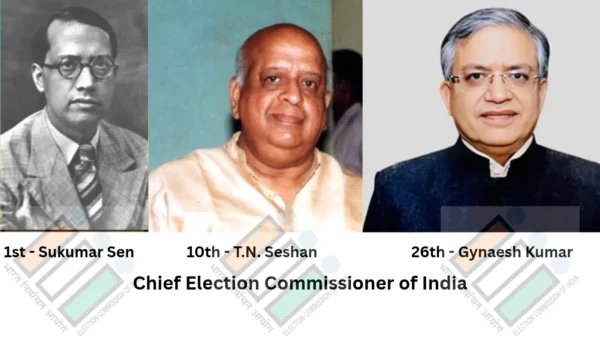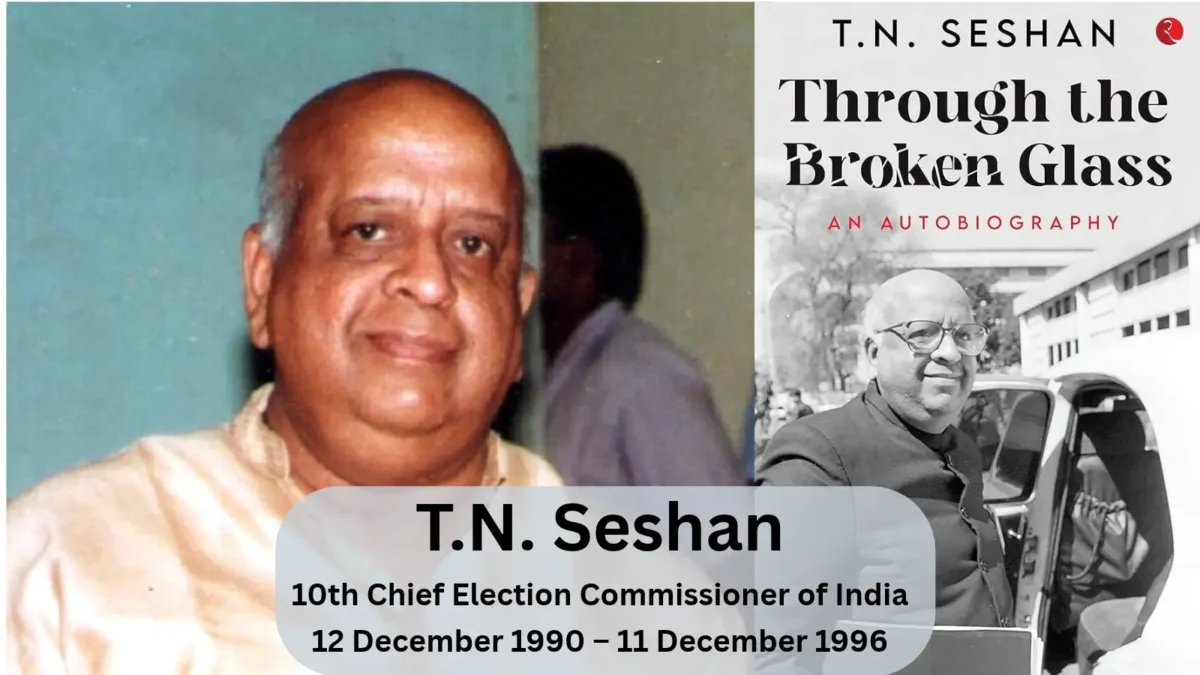
T.N. Seshan was the tenth Chief Election Commissioner of India and one of the most influential figures in the history of the Election Commission of India.
Serving from 12 December 1990 to 11 December 1996, Seshan transformed the public perception of the Election Commission. His tenure is associated with strict enforcement of electoral rules, greater attention to the Model Code of Conduct, action against electoral malpractices, voter identity cards, election expenditure monitoring and a more assertive interpretation of the Commission’s constitutional responsibilities.
For UPSC aspirants, T.N. Seshan is particularly important because his tenure illustrates the relationship between constitutional powers, institutional independence, electoral reforms and judicial review.
See List of Chief Election Commissioners of India.
Who Was T.N. Seshan?
Thirunellai Narayana Iyer Seshan, popularly known as T.N. Seshan, was a distinguished Indian civil servant who later became the Chief Election Commissioner.
Before becoming CEC, Seshan held several senior administrative positions and eventually served as Cabinet Secretary of India.
He was appointed Chief Election Commissioner on 12 December 1990.
| Particular | Details |
|---|---|
| Name | T. N. Seshan |
| Office | Chief Election Commissioner of India |
| Position in CEC chronology | 10th CEC |
| Tenure | 12 December 1990 – 11 December 1996 |
| Previous position | Cabinet Secretary of India |
| Major significance | Strengthening enforcement of electoral rules |
The official Election Commission records confirm Seshan’s tenure from 12 December 1990 to 11 December 1996.
Why Is T.N. Seshan Considered a Transformative CEC?
Before Seshan, the Election Commission was already a constitutional body with significant powers under Article 324. However, Seshan’s tenure is remembered for the unusually assertive manner in which those powers and existing electoral rules were enforced.
He sought to ensure that elections were not merely formally conducted but were conducted according to rules designed to protect the integrity of the electoral process.
The Election Commission’s own historical account describes Seshan as asserting the authority and autonomy of the Commission, rigorously implementing the Model Code of Conduct and acting against electoral malpractices.
T. N. Seshan and the Model Code of Conduct
One of the most important aspects of Seshan’s tenure was the rigorous enforcement of the Model Code of Conduct (MCC).
The Model Code of Conduct is a set of norms governing the behaviour of political parties and candidates during elections. It evolved through political consensus rather than being a conventional statute enacted by Parliament.
The Election Commission explains that the MCC comes into operation from the announcement of the election schedule and remains applicable until the election process is completed. It seeks to regulate campaign conduct, meetings, processions, election-day behaviour and the use of official machinery.
Seshan’s contribution was particularly important because he treated violations of electoral norms as matters requiring active enforcement rather than merely advisory compliance.
Electoral Malpractices and Seshan
Seshan became known for taking a strict position against electoral malpractice.
Issues that received greater attention during his tenure included:
- Bribery and inducement of voters
- Distribution of liquor during elections
- Use of money power
- Muscle power and intimidation
- Booth capturing
- Misuse of official machinery
- Violation of campaign rules
- Excessive election expenditure
- Use of religion and other divisive appeals in campaigning
His approach changed the political understanding of the Election Commission. Political parties increasingly recognised that violations could attract serious administrative consequences.
Introduction of Electors Photo Identity Cards
Another important development associated with Seshan was the introduction of Electors Photo Identity Cards (EPICs).
The objective was to improve voter identification and reduce the possibility of impersonation and fraudulent voting.
The Election Commission’s historical publication records that Seshan strongly supported the introduction of photo identity cards and that EPICs were introduced in poll-bound States in 1993.
The project faced political and administrative resistance, but it became an important component of India’s electoral administration.
Seshan and Election Expenditure
Seshan also emphasised compliance with limits and rules relating to election expenditure.
Election expenditure is important because excessive spending can create an unequal electoral environment in which candidates with greater financial resources enjoy an unfair advantage.
By placing greater emphasis on expenditure monitoring, the Election Commission sought to make elections more competitive and reduce the influence of money power.
Seshan and Electoral Observers
Seshan’s tenure also witnessed a greater role for election observers.
Observers provided an additional mechanism through which the Election Commission could monitor electoral processes on the ground and obtain independent assessments of developments during elections.
The ECI’s historical account notes that the role of observers expanded during Seshan’s tenure and subsequently received statutory backing in 1996 through Section 20B of the Representation of the People Act, 1951.
The 1993 Expansion of the Election Commission
One of the most important constitutional developments during Seshan’s tenure was the transformation of the Election Commission into a multi-member body.
On 1 October 1993, two additional Election Commissioners were appointed. They were:
- M. S. Gill
- G. V. G. Krishnamurty
This was significant because the Election Commission had originally functioned as a single-member body headed by the CEC.
The ECI records that two additional Commissioners had first been appointed in October 1989, but that arrangement was short-lived. Two additional Commissioners were appointed again on 1 October 1993, after which the multi-member structure continued.
T. N. Seshan vs Union of India: The 1995 Supreme Court Case
The expansion of the Election Commission led to a major constitutional dispute between Seshan and the Union Government.
Seshan challenged the appointment of the two additional Election Commissioners. The dispute ultimately reached the Supreme Court in T. N. Seshan, Chief Election Commissioner of India v. Union of India.
The Supreme Court upheld the constitutional validity of a multi-member Election Commission.
The Court’s reasoning was significant for understanding Article 324. The constitutional provision does not necessarily require the Election Commission to consist only of the CEC. It contemplates a Chief Election Commissioner and such number of other Election Commissioners as the President may determine, subject to the constitutional framework.
The judgment also established an important principle: the CEC is the Chairman of a multi-member Commission, but this does not mean that the CEC possesses unilateral decision-making authority.
In a multi-member Commission, decisions are taken according to the prescribed decision-making mechanism, with the members having an equal say.
Why the Seshan Case Matters for UPSC
The case is important because it illustrates the distinction between:
- Security of tenure and decision-making power
- Chairmanship and unilateral authority
- Institutional independence and unlimited power
- Constitutional discretion and judicial review
It is therefore useful in UPSC answers dealing with constitutional bodies and checks and balances.
Seshan and Article 324
Article 324 is central to understanding Seshan’s tenure.
Article 324 vests the Election Commission with the superintendence, direction and control of elections to Parliament, State Legislatures and the offices of President and Vice-President.
Seshan interpreted these constitutional responsibilities assertively and attempted to use the Commission’s constitutional authority to ensure free and fair elections.
However, his tenure also demonstrated that Article 324 does not give the Election Commission unlimited authority over every aspect of government administration. The constitutional powers of the Commission must operate within the broader constitutional structure and applicable laws.
Was Seshan Responsible for Creating the Model Code of Conduct?
No. This is an important UPSC distinction.
The Model Code of Conduct existed before Seshan. It had evolved through political consensus.
Seshan’s major contribution was not creating the MCC from scratch, but enforcing it much more rigorously and giving it greater practical importance during elections.
This distinction is important because an objective UPSC question may attempt to confuse the origin of the MCC with its rigorous enforcement during Seshan’s tenure.
Was Seshan Responsible for Introducing Voter ID Cards?
Seshan played a major role in the introduction and implementation of Electors Photo Identity Cards. The ECI’s historical material specifically records his strong advocacy of EPICs and their introduction in poll-bound States in 1993.
Therefore, for UPSC purposes, Seshan can be strongly associated with the expansion of photo voter identification, while avoiding the simplistic claim that every aspect of today’s voter-ID system was personally created by him.
T.N. Seshan’s Autobiography: Through the Broken Glass
T. N. Seshan also left behind an important first-hand account of his life and career in his autobiography, Through the Broken Glass: An Autobiography. The book was published posthumously by Rupa Publications in 2023. It provides Seshan’s own account of his career in the Indian Administrative Service, his experiences as a senior civil servant, and, most importantly, his controversial and transformative tenure as Chief Election Commissioner of India.
The autobiography offers valuable insights into Seshan’s determination to strengthen the Election Commission and enforce electoral rules. It discusses the challenges he faced while attempting to curb electoral malpractice, enforce the Model Code of Conduct, regulate election expenditure and strengthen the credibility of the electoral process. The book is particularly significant because it presents these events from Seshan’s own perspective rather than solely through the accounts of political parties, journalists or government officials. The book’s publisher describes it as an account of Seshan’s struggle to bring about a new era of electoral reforms in India.
For students of Indian Polity and UPSC aspirants, Through the Broken Glass is useful as a supplementary source for understanding the personality, administrative philosophy and approach of one of India’s most influential Chief Election Commissioners. It should, however, be read as an autobiographical primary account, alongside constitutional provisions, Supreme Court judgments, Election Commission publications and independent historical scholarship.
Book: Through the Broken Glass: An Autobiography
Author: T. N. Seshan
Publisher: Rupa Publications
Publication: 2023
Subject: Autobiography, Indian administration and electoral reforms
Seshan’s Legacy
Seshan’s greatest legacy was institutional rather than merely procedural.
He demonstrated that the effectiveness of a constitutional institution depends not only on the powers written in the Constitution but also on the willingness and capacity of its office-holders to exercise those powers.
His tenure strengthened public awareness of the Election Commission and changed expectations regarding electoral administration.
The ECI has itself described Seshan’s tenure as a period in which he asserted the authority and autonomy of the Commission, rigorously implemented the Model Code and acted against electoral malpractice.
Limitations and Criticism of the Seshan Model
A balanced UPSC answer should not portray Seshan simply as an individual who possessed unlimited powers.
His confrontational style generated conflicts with governments, political parties and other constitutional authorities. The 1993 expansion of the Commission and the subsequent litigation demonstrated the constitutional limits of the authority of an individual CEC.
The Supreme Court’s 1995 judgment reinforced the principle that the Election Commission, when constituted as a multi-member body, functions collectively rather than as an institution dominated by the CEC alone.
Thus, Seshan’s legacy has two dimensions:
- Positive: stronger enforcement, greater institutional visibility and enhanced credibility of electoral administration.
- Constitutional lesson: institutional independence does not mean unlimited or unilateral power.
T.N. Seshan and the Evolution of the Election Commission
| Before Seshan’s era | Seshan’s tenure | Long-term significance |
|---|---|---|
| ECI had constitutional powers | More assertive exercise of those powers | Greater public visibility of ECI |
| MCC existed | Stricter enforcement | MCC became central to election administration |
| Electoral malpractice remained a major concern | Greater enforcement against violations | Stronger emphasis on electoral integrity |
| Voter identification mechanisms were evolving | EPIC implementation expanded | Photo voter identification became important |
| Election observers existed | Greater emphasis on observers | Observer role received statutory backing |
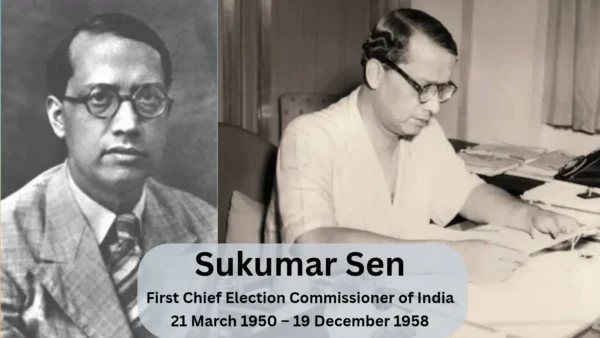
Sukumar Sen and T.N. Seshan: Two Landmark CECs
| Feature | Sukumar Sen | T. N. Seshan |
|---|---|---|
| CEC number | 1st | 10th |
| Tenure | 1950-1958 | 1990-1996 |
| Historical context | Early years of the Republic | Era of increasingly complex electoral politics |
| Main contribution | Institution-building | Enforcement and electoral reform |
| Major association | First general elections | MCC enforcement, EPIC and electoral discipline |
| UPSC theme | Democratic institution-building | Constitutional powers and electoral reforms |
UPSC Prelims Facts: T.N. Seshan
- T. N. Seshan was the 10th Chief Election Commissioner of India.
- He served from 12 December 1990 to 11 December 1996.
- He had previously served as Cabinet Secretary.
- His tenure is strongly associated with rigorous enforcement of the Model Code of Conduct.
- His tenure saw major efforts toward implementation of Electors Photo Identity Cards.
- His tenure witnessed the transformation of the Election Commission into a continuous three-member Commission in 1993.
- The Supreme Court upheld the multi-member structure in the T. N. Seshan case, 1995.
- The CEC is Chairman of a multi-member Election Commission, but does not possess unilateral decision-making power.
UPSC Mains: How to Use T. N. Seshan in Answers
T. N. Seshan can be used as an example in answers on:
- Independence of constitutional bodies
- Electoral reforms in India
- Free and fair elections
- Role of the Election Commission
- Article 324
- Model Code of Conduct
- Money and muscle power in elections
- Institutional autonomy
- Checks and balances
- Judicial review of constitutional bodies
MCQs on T. N. Seshan
Question 1
T. N. Seshan served as the Chief Election Commissioner of India during:
- 1985-1990
- 1990-1996
- 1991-1997
- 1992-1998
Answer: B. 1990-1996
Question 2
T. N. Seshan was which numbered Chief Election Commissioner of India?
- 8th
- 9th
- 10th
- 11th
Answer: C. 10th
Question 3
Which of the following is most closely associated with T. N. Seshan’s tenure?
- Abolition of the Election Commission
- Strict enforcement of electoral norms
- Introduction of proportional representation for Lok Sabha elections
- Abolition of the Model Code of Conduct
Answer: B. Strict enforcement of electoral norms
Question 4
Consider the following statements:
- The Model Code of Conduct was created entirely by T. N. Seshan.
- Seshan is associated with rigorous enforcement of the Model Code of Conduct.
- His tenure saw major efforts toward implementation of photo identity cards for voters.
Which of the statements given above is/are correct?
- 1 only
- 2 only
- 2 and 3 only
- 1, 2 and 3
Answer: C. 2 and 3 only
Question 5
Who were appointed as the two additional Election Commissioners in 1993 during T. N. Seshan’s tenure?
- M. S. Gill and G. V. G. Krishnamurty
- V. S. Sampath and H. S. Brahma
- A. K. Joti and O. P. Rawat
- R. K. Trivedi and S. L. Shakdhar
Answer: A. M. S. Gill and G. V. G. Krishnamurty
Question 6
The Supreme Court judgment in T. N. Seshan v. Union of India is important because it:
- Abolished the Election Commission
- Rejected the concept of a multi-member Election Commission
- Upheld the multi-member structure of the Election Commission
- Removed Article 324 from the Constitution
Answer: C. Upheld the multi-member structure of the Election Commission
Question 7
Which constitutional provision is most directly relevant to the powers of the Election Commission discussed during the Seshan era?
- Article 280
- Article 315
- Article 324
- Article 338
Answer: C. Article 324
Conclusion
T. N. Seshan occupies a unique position in the history of India’s electoral democracy. He did not create the Election Commission, nor did he create every electoral rule associated with his tenure. His historical importance lies in the assertive enforcement of the constitutional and legal framework governing elections.
His tenure brought issues such as electoral malpractice, money power, voter identification, election expenditure and the Model Code of Conduct into much sharper public focus.
At the same time, the constitutional conflict surrounding the expansion of the Election Commission demonstrated an equally important principle: the Election Commission is an institution, not simply the office of the CEC.
For UPSC aspirants, T. N. Seshan is therefore an excellent case study of how institutional autonomy, constitutional power, electoral reform and judicial review interact in India’s democratic system.