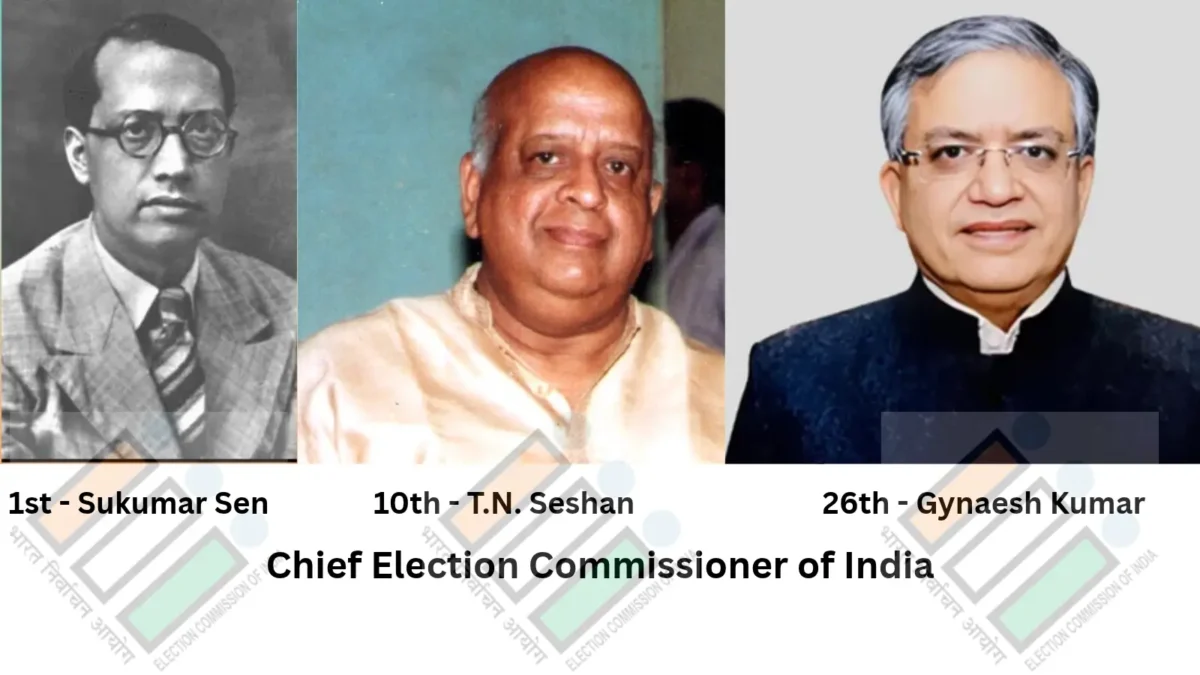
The Chief Election Commissioner (CEC) is the head of the Election Commission of India. Since the establishment of the Election Commission on 25 January 1950, several Chief Election Commissioners have headed the institution and overseen India’s electoral process.
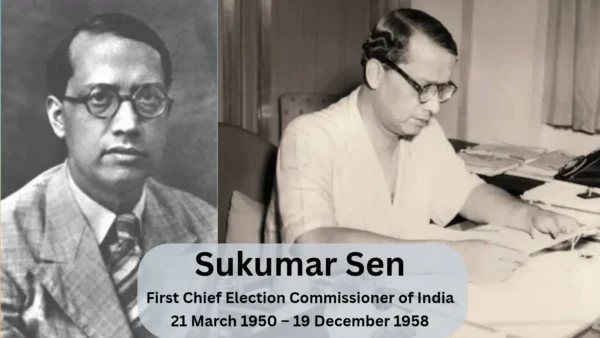
Sukumar Sen was the first Chief Election Commissioner of India. He served from 21 March 1950 to 19 December 1958 and supervised India’s first two general elections held in 1951–52 and 1957.
List of Chief Election Commissioners of India
| S. No. | Chief Election Commissioner | Tenure |
|---|---|---|
| 1 | Sukumar Sen | 21 March 1950 – 19 December 1958 |
| 2 | K. V. K. Sundaram | 20 December 1958 – 30 September 1967 |
| 3 | S. P. Sen Verma | 1 October 1967 – 30 September 1972 |
| 4 | Dr. Nagendra Singh | 1 October 1972 – 6 February 1973 |
| 5 | T. Swaminathan | 7 February 1973 – 17 June 1977 |
| 6 | S. L. Shakdhar | 18 June 1977 – 17 June 1982 |
| 7 | R. K. Trivedi | 18 June 1982 – 31 December 1985 |
| 8 | R. V. S. Peri Sastri | 1 January 1986 – 25 November 1990 |
| 9 | V. S. Ramadevi | 26 November 1990 – 11 December 1990 |
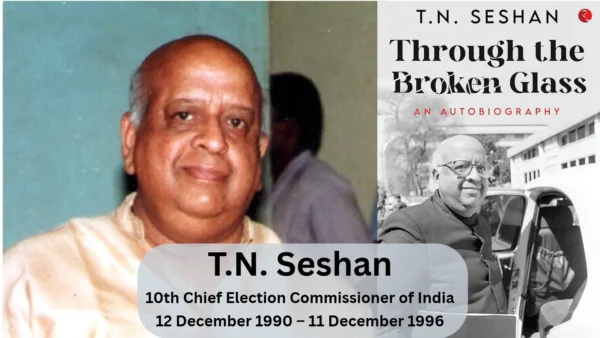
| 10 | T. N. Seshan | 12 December 1990 – 11 December 1996 |
| 11 | Dr. M. S. Gill | 12 December 1996 – 13 June 2001 |
| 12 | J. M. Lyngdoh | 14 June 2001 – 7 February 2004 |
| 13 | T. S. Krishna Murthy | 8 February 2004 – 15 May 2005 |
| 14 | B. B. Tandon | 16 May 2005 – 29 June 2006 |
| 15 | N. Gopalaswami | 30 June 2006 – 20 April 2009 |
| 16 | Navin B. Chawla | 21 April 2009 – 29 July 2010 |
| 17 | Dr. S. Y. Quraishi | 30 July 2010 – 10 June 2012 |
| 18 | V. S. Sampath | 11 June 2012 – 15 January 2015 |
| 19 | H. S. Brahma | 16 January 2015 – 18 April 2015 |
| 20 | Dr. Nasim Zaidi | 19 April 2015 – 5 July 2017 |
| 21 | A. K. Joti | 6 July 2017 – 22 January 2018 |
| 22 | O. P. Rawat | 23 January 2018 – 1 December 2018 |
| 23 | Sunil Arora | 2 December 2018 – 12 April 2021 |
| 24 | Sushil Chandra | 13 April 2021 – 14 May 2022 |
| 25 | Rajiv Kumar | 15 May 2022 – 18 February 2025 |
| 26 | Gyanesh Kumar | 19 February 2025 – Present |
Who Was the First Chief Election Commissioner of India?
Sukumar Sen was the first Chief Election Commissioner of India.
He assumed office on 21 March 1950 and served until 19 December 1958. He supervised India’s first general election held in 1951–52 and the second general election held in 1957.
Sukumar Sen was therefore the CEC during the formative years of India’s electoral democracy.
Who is the Current Chief Election Commissioner of India?
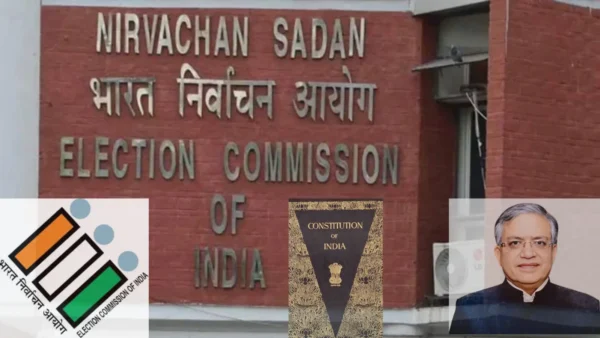
Gyanesh Kumar is the 26th Chief Election Commissioner of India. He assumed charge on 19 February 2025.
He succeeded Rajiv Kumar, who served as the 25th Chief Election Commissioner from 15 May 2022 to 18 February 2025.
When Did the Election Commission Become a Three-Member Body?
This is an important topic for UPSC Prelims because the Election Commission was not always a multi-member body.
Originally a Single-Member Commission
When the Election Commission of India was established on 25 January 1950, it consisted only of the Chief Election Commissioner.
For several decades, the Election Commission functioned as a single-member body headed by the CEC.
First Appointment of Two Additional Election Commissioners: 1989
For the first time, two additional Election Commissioners were appointed on 16 October 1989.
The two Election Commissioners were:
- V. S. Seigell
- S. S. Dhanoa
This created a three-member Election Commission consisting of the CEC and two Election Commissioners.
However, this arrangement was short-lived. The additional commissioners’ tenure ended in early January 1990, and the Commission reverted to a single-member structure.
Multi-Member Election Commission Since 1 October 1993
Two additional Election Commissioners were appointed again on 1 October 1993.
Since then, the Election Commission has functioned as a multi-member body.
The present structure consists of:
- One Chief Election Commissioner
- Two Election Commissioners
Thus, for UPSC purposes, remember the distinction:
| Period | Structure of Election Commission |
|---|---|
| 1950 – 15 October 1989 | Single-member Commission headed by CEC |
| 16 October 1989 – early January 1990 | CEC + two Election Commissioners |
| 1990 – 30 September 1993 | Single-member Commission |
| From 1 October 1993 | Multi-member Commission; CEC + two Election Commissioners |
UPSC Shortcut: The Election Commission was originally a single-member body. A three-member structure was briefly introduced in 1989 and has been in continuous operation since 1 October 1993.
How Does a Multi-Member Election Commission Take Decisions?
When the Election Commission consists of the CEC and other Election Commissioners, all Election Commissioners have equal say in decision-making.
Decisions are taken by majority where there is a difference of opinion.
Therefore, the CEC does not possess an absolute veto over the decisions of the other Election Commissioners merely because he or she is the Chairman of the Commission.
This principle is particularly important for understanding the functioning of a multi-member Election Commission.
Important UPSC Facts About Chief Election Commissioners
- First CEC: Sukumar Sen
- First CEC to serve after the Constitution came into force: Sukumar Sen
- First CEC’s tenure: 21 March 1950 – 19 December 1958
- Current CEC: Gyanesh Kumar
- Current CEC’s number: 26th CEC
- Election Commission established: 25 January 1950
- First two additional Election Commissioners appointed: 16 October 1989
- First brief three-member phase: 1989–1990
- Present continuous multi-member structure: From 1 October 1993
- Constitutional provision: Article 324
MCQs on Chief Election Commissioner and Election Commission
Question 1
Who was the first Chief Election Commissioner of India?
- T. N. Seshan
- Sukumar Sen
- K. V. K. Sundaram
- R. V. S. Peri Sastri
Answer: B. Sukumar Sen
Explanation: Sukumar Sen was the first Chief Election Commissioner of India. He served from 21 March 1950 to 19 December 1958.
Question 2
Consider the following statements about the Election Commission of India:
- It was established on 25 January 1950.
- It was originally a multi-member body consisting of the CEC and two Election Commissioners.
- Article 324 provides the constitutional basis for the Election Commission.
Which of the statements given above is/are correct?
- 1 and 2 only
- 1 and 3 only
- 2 and 3 only
- 1, 2 and 3
Answer: B. 1 and 3 only
Explanation: The Election Commission was originally a single-member body headed by the CEC. Two additional Election Commissioners were first appointed only in 1989.
Question 3
Two additional Election Commissioners were first appointed in India in:
- 1950
- 1977
- 1989
- 1993
Answer: C. 1989
Explanation: Two additional Election Commissioners were appointed for the first time on 16 October 1989.
Question 4
Since when has the present continuous multi-member Election Commission been in operation?
- 16 October 1989
- 1 January 1990
- 1 October 1993
- 25 January 1950
Answer: C. 1 October 1993
Explanation: Although two additional Election Commissioners were first appointed in 1989, that arrangement was short-lived. Two additional Election Commissioners were appointed again on 1 October 1993, and the multi-member structure has continued since then.
Question 5
Who among the following was the Chief Election Commissioner of India when the Election Commission first became a three-member body in 1989?
- R. V. S. Peri Sastri
- T. N. Seshan
- S. L. Shakdhar
- V. S. Ramadevi
Answer: A. R. V. S. Peri Sastri
Explanation: R. V. S. Peri Sastri was CEC from 1 January 1986 to 25 November 1990. The first two additional Election Commissioners were appointed during his tenure in October 1989.
Question 6
Which of the following correctly describes the Election Commission of India?
- It has always been a three-member body.
- It was originally a single-member body.
- It became a three-member body permanently in 1989.
- It became a three-member body only after the 2023 Act.
Answer: B. It was originally a single-member body.
Explanation: The Election Commission originally consisted only of the Chief Election Commissioner. The first two additional Election Commissioners were appointed in 1989, and the present continuous multi-member arrangement began in 1993.
Question 7
Consider the following pairs:
| Chief Election Commissioner | Position in the sequence |
|---|---|
| Sukumar Sen | 1st |
| T. N. Seshan | 10th |
| Rajiv Kumar | 25th |
| Gyanesh Kumar | 26th |
How many of the above pairs are correctly matched?
- Only one
- Only two
- Only three
- All four
Answer: D. All four
Question 8
Which Article of the Constitution provides the constitutional basis for the Election Commission of India?
- Article 280
- Article 324
- Article 326
- Article 329
Answer: B. Article 324
Explanation: Article 324 vests the superintendence, direction and control of the preparation of electoral rolls and the conduct of elections in the Election Commission.
Question 9
Consider the following statements:
- The CEC is the Chairman of the Election Commission.
- All Election Commissioners have equal say in the decision-making of the Commission.
- The CEC has an absolute veto over the decisions of other Election Commissioners.
Which of the statements given above is/are correct?
- 1 only
- 1 and 2 only
- 2 and 3 only
- 1, 2 and 3
Answer: B. 1 and 2 only
Explanation: The CEC is the Chairman of the Commission, but all Election Commissioners have equal say in decision-making. Where there is a difference of opinion, decisions are taken by majority.
Question 10
Which of the following Chief Election Commissioners served for the longest period among the following?
- Sukumar Sen
- K. V. K. Sundaram
- T. N. Seshan
- R. V. S. Peri Sastri
Answer: B. K. V. K. Sundaram
Explanation: K. V. K. Sundaram served from 20 December 1958 to 30 September 1967, a tenure of nearly nine years.
Question 11
Who was the Chief Election Commissioner immediately before Gyanesh Kumar?
- Sushil Chandra
- Sunil Arora
- Rajiv Kumar
- O. P. Rawat
Answer: C. Rajiv Kumar
Question 12
Which of the following statements regarding the multi-member Election Commission is correct?
- It was created for the first time in 1993.
- It was first introduced in 1989 and has been continuously operational since 1993.
- It was introduced by the Representation of the People Act, 1951.
- It was created by the 2023 CEC Act.
Answer: B. It was first introduced in 1989 and has been continuously operational since 1993.
UPSC Prelims Quick Revision
| Question | Answer |
|---|---|
| Who was India’s first CEC? | Sukumar Sen |
| When was ECI established? | 25 January 1950 |
| Constitutional basis of ECI? | Article 324 |
| When were two additional ECs first appointed? | 16 October 1989 |
| Who were the first two additional ECs? | V. S. Seigell and S. S. Dhanoa |
| When did the continuous multi-member system begin? | 1 October 1993 |
| Who is the 25th CEC? | Rajiv Kumar |
| Who is the 26th CEC? | Gyanesh Kumar |
| Present structure of ECI? | CEC + two Election Commissioners |
| Do all ECs have equal voting power? | Yes |
Important Takeaway for UPSC Aspirants
Remember the following chronology:
1950 → Single-member Election Commission
1989 → First appointment of two additional Election Commissioners
1990 → Multi-member experiment temporarily ends
1 October 1993 → Two additional Election Commissioners appointed again
1993 onwards → Continuous multi-member Election Commission
2025 → Gyanesh Kumar becomes the 26th Chief Election Commissioner