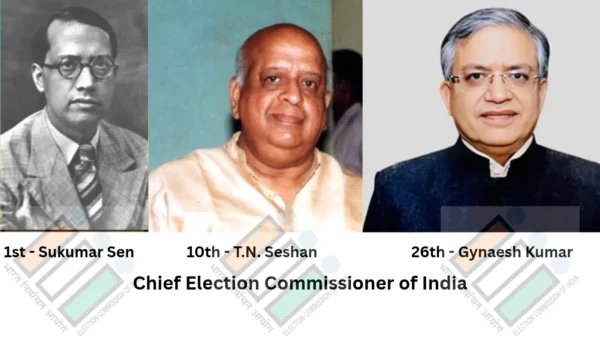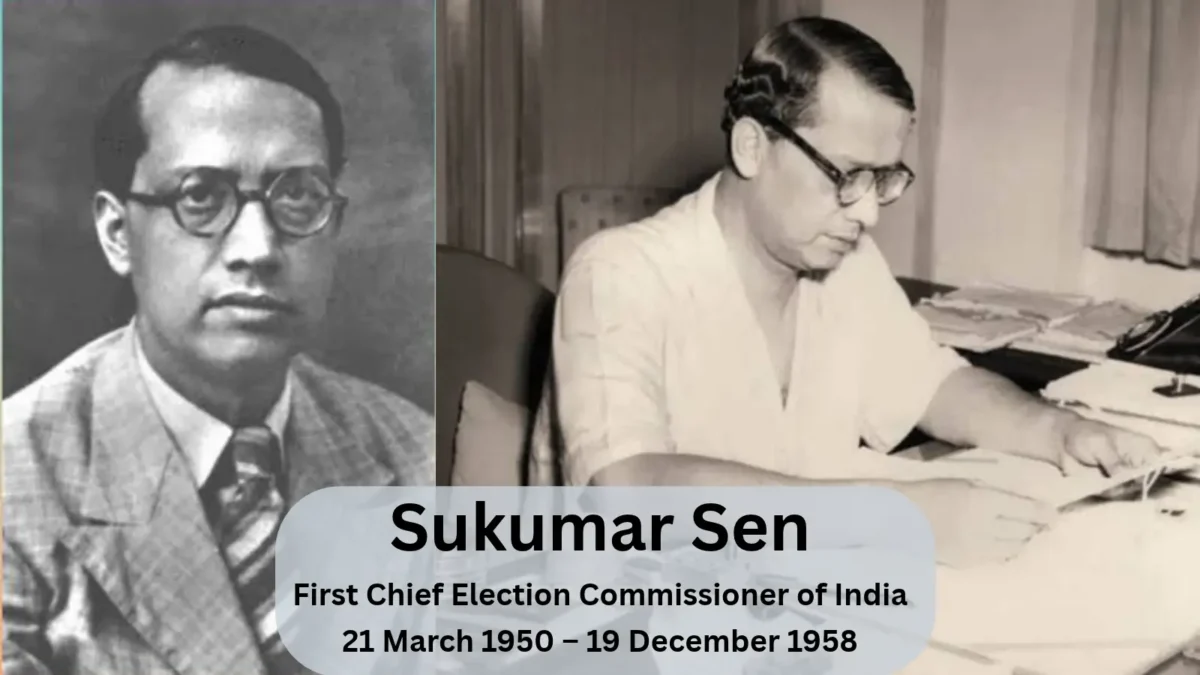
Sukumar Sen was the first Chief Election Commissioner of India and one of the most important figures in the early history of Indian democracy. Appointed on 21 March 1950, shortly after the Constitution came into force, Sen was entrusted with the enormous task of establishing an electoral system for a newly independent country.
His greatest achievement was the successful conduct of India’s first general elections in 1951-52. These elections were unprecedented in scale and complexity. India had adopted universal adult franchise despite widespread illiteracy, poverty, limited administrative infrastructure and enormous geographical diversity.
Sukumar Sen therefore occupies a foundational place in India’s electoral history. While later Chief Election Commissioners such as T. N. Seshan became famous for enforcing the authority of the Election Commission, Sen’s contribution was to build the institutional foundations on which India’s electoral democracy could operate.
See List of Chief Election Commissioners of India.
Who Was Sukumar Sen?
Sukumar Sen was an Indian civil servant who became the country’s first Chief Election Commissioner after the Constitution established the Election Commission of India as an independent constitutional authority.
The Election Commission was established on 25 January 1950. Originally, it was a single-member constitutional body headed by the Chief Election Commissioner. Sen became the first person to occupy this office.
The official records of the Election Commission of India list his tenure as:
| Particular | Details |
|---|---|
| Name | Sukumar Sen |
| Position | First Chief Election Commissioner of India |
| Tenure | 21 March 1950 – 19 December 1958 |
| Major contribution | Conduct of India’s first general elections |
| Election | First General Elections, 1951-52 |
Appointment as India’s First Chief Election Commissioner
The Constitution of India created the Election Commission under Article 324. The provision entrusted the Commission with the superintendence, direction and control of elections to Parliament, State Legislatures, and the offices of President and Vice-President.
In the early years of the Republic, the institutional structure of the Election Commission was very different from the present arrangement. The Commission originally consisted only of the Chief Election Commissioner.
Sukumar Sen was therefore not simply the first person to hold the office. He was also the first person responsible for converting a constitutional provision into a functioning nationwide electoral institution.
The First General Elections of 1951-52
The most important chapter in Sukumar Sen’s career was the organisation and conduct of India’s first general elections.
India’s Constitution had adopted universal adult franchise. This meant that the electoral system had to be prepared for an enormous number of citizens, many of whom had never participated in an election before.
The Election Commission had to solve several practical problems before voting could take place. These included:
- Preparation of electoral rolls
- Identification and registration of eligible voters
- Creation of electoral constituencies
- Design of polling arrangements
- Recruitment and training of election personnel
- Production and distribution of ballot papers
- Establishment of polling stations
- Development of procedures for counting votes
- Electoral arrangements in remote and difficult geographical areas
The first general elections were conducted during 1951-52. According to Election Commission historical material, elections were conducted for 489 seats in the House of the People and around 3,283 seats in State Assemblies. The elections used the First-Past-the-Post (FPTP) system.
These elections became a landmark in the history of Indian democracy and demonstrated that universal adult franchise could be operationalised on a massive scale in a newly independent and socially diverse country.
Challenges Faced by Sukumar Sen
The task before Sen was much more difficult than conducting an ordinary election. India had just emerged from colonial rule and Partition. Administrative resources were limited and the electoral system itself had to be constructed almost from scratch.
1. Widespread Illiteracy
One of the major challenges was the high level of illiteracy among the population. The electoral system had to be designed in a way that ordinary citizens could understand.
The Commission therefore adopted methods that made identification of candidates and voting possible even for people who could not read or write.
2. Enormous Geographical Diversity
India’s geographical conditions created another major challenge. Elections had to be organised across mountains, forests, villages, deserts, islands and remote settlements.
The electoral machinery had to reach citizens across an enormous territory despite limited transportation and communication infrastructure.
3. Creation of Electoral Rolls
Before citizens could vote, the Election Commission had to prepare electoral rolls on an unprecedented scale.
This required identifying eligible voters and establishing electoral constituencies throughout the country.
4. Lack of Previous Experience
India had no experience of conducting a democratic election on this scale under universal adult franchise.
Sen therefore had to establish procedures, administrative practices and institutional conventions that later became part of India’s electoral system.
Sukumar Sen and the Institutionalisation of the Election Commission
Sen’s contribution should not be measured only by the number of elections conducted during his tenure. His larger contribution was institutional.
He helped establish the principle that elections should be administered by a constitutional authority rather than being treated simply as an extension of ordinary government administration.
The Election Commission was given responsibility for the conduct of elections, while the political executive did not directly conduct the electoral process.
This separation became an important element of India’s democratic system.
Why Were the 1951-52 Elections Historically Important?
The first general elections demonstrated several important features of India’s constitutional democracy:
- Universal adult franchise: Ordinary citizens were given the right to participate in the democratic process.
- Constitutional election administration: Elections were administered through an independent constitutional institution.
- Peaceful transfer of political legitimacy: Political authority was to be derived from elections rather than force or hereditary succession.
- Administrative feasibility of democracy: The elections demonstrated that parliamentary democracy could function across a vast and diverse country.
Sukumar Sen’s Tenure as CEC
Sukumar Sen served as Chief Election Commissioner from 21 March 1950 to 19 December 1958.
His tenure therefore covered not only the first general elections but also the subsequent consolidation of India’s electoral machinery.
The first general election was followed by the second general election in 1957. By this stage, the electoral administration had acquired greater experience and institutional maturity.
Sukumar Sen and the Making of Indian Democracy
Sukumar Sen’s significance lies in the fact that he worked at a foundational moment in Indian constitutional history.
The Constitution provided the framework, but institutions required people capable of implementing that framework. Sen was one of the earliest constitutional functionaries to translate the principles of the Constitution into a functioning nationwide democratic process.
His achievement was particularly significant because India rejected the argument that widespread poverty, illiteracy or social diversity made democracy impractical.
The successful elections of 1951-52 provided an early demonstration that constitutional democracy could take root in India.
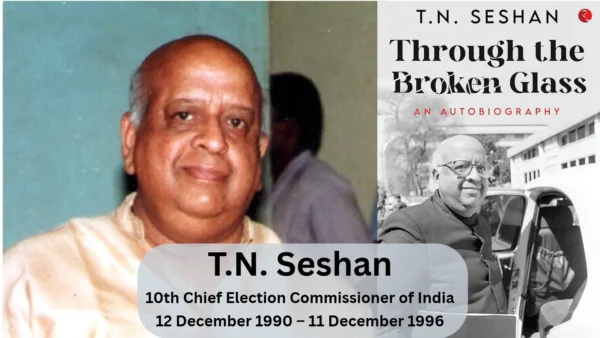
Sukumar Sen vs T. N. Seshan: Different Kinds of Contributions
| Sukumar Sen | T. N. Seshan |
|---|---|
| First CEC of India | 10th CEC of India |
| Served 1950-1958 | Served 1990-1996 |
| Built the foundations of electoral administration | Assertively enforced electoral rules |
| Conducted the first general elections | Strengthened enforcement of electoral norms |
| Associated with institution-building | Associated with electoral reform and enforcement |
UPSC Significance of Sukumar Sen
Sukumar Sen is relevant to both UPSC Prelims and Mains.
For UPSC Prelims
- Sukumar Sen was the first Chief Election Commissioner of India.
- He became CEC in 1950.
- He conducted India’s first general elections in 1951-52.
- The Election Commission was established on 25 January 1950.
- Article 324 deals with the Election Commission of India.
- The first general elections were conducted using the First-Past-the-Post system.
For UPSC Mains
Sukumar Sen can be used in answers concerning:
- Evolution of Indian democracy
- Role of constitutional bodies
- Independence of the Election Commission
- Universal adult franchise
- Electoral reforms
- Institution-building in post-independence India
- Democratic consolidation after independence
MCQs on Sukumar Sen
Question 1
Who was the first Chief Election Commissioner of India?
- T. N. Seshan
- Sukumar Sen
- K. V. K. Sundaram
- R. K. Trivedi
Answer: B. Sukumar Sen
Question 2
Sukumar Sen served as Chief Election Commissioner during which period?
- 1947-1955
- 1950-1958
- 1952-1960
- 1950-1956
Answer: B. 1950-1958
Question 3
The first general elections in independent India were conducted in:
- 1949-50
- 1950-51
- 1951-52
- 1952-53
Answer: C. 1951-52
Question 4
Article 324 of the Constitution primarily deals with:
- Finance Commission
- Election Commission
- Union Public Service Commission
- Comptroller and Auditor General
Answer: B. Election Commission
Question 5
Consider the following statements:
- Sukumar Sen was the first Chief Election Commissioner of India.
- He conducted India’s first general elections.
- The first general elections were held in 1951-52.
Which of the statements given above are correct?
- 1 only
- 1 and 2 only
- 2 and 3 only
- 1, 2 and 3
Answer: D. 1, 2 and 3
Conclusion
Sukumar Sen was more than India’s first Chief Election Commissioner. He was one of the principal institution-builders of India’s early democratic republic.
At a time when the country faced enormous administrative, social and economic challenges, Sen and the Election Commission successfully organised India’s first general elections. His tenure demonstrated that universal adult franchise could be translated from a constitutional principle into an operational democratic system.
For UPSC aspirants, Sukumar Sen is best remembered as the first CEC and the architect of the electoral machinery that conducted India’s first general elections in 1951-52.