On February 15, 2024, the Supreme Court of India delivered a historic verdict declaring the Electoral Bonds Scheme unconstitutional. The unanimous decision by the five-member Constitution Bench addressed all challenges to the scheme, highlighting its violation of the right to information and the principles of free and fair elections. This ruling has significant implications for political funding transparency in India.
What is the Electoral Bonds Scheme?
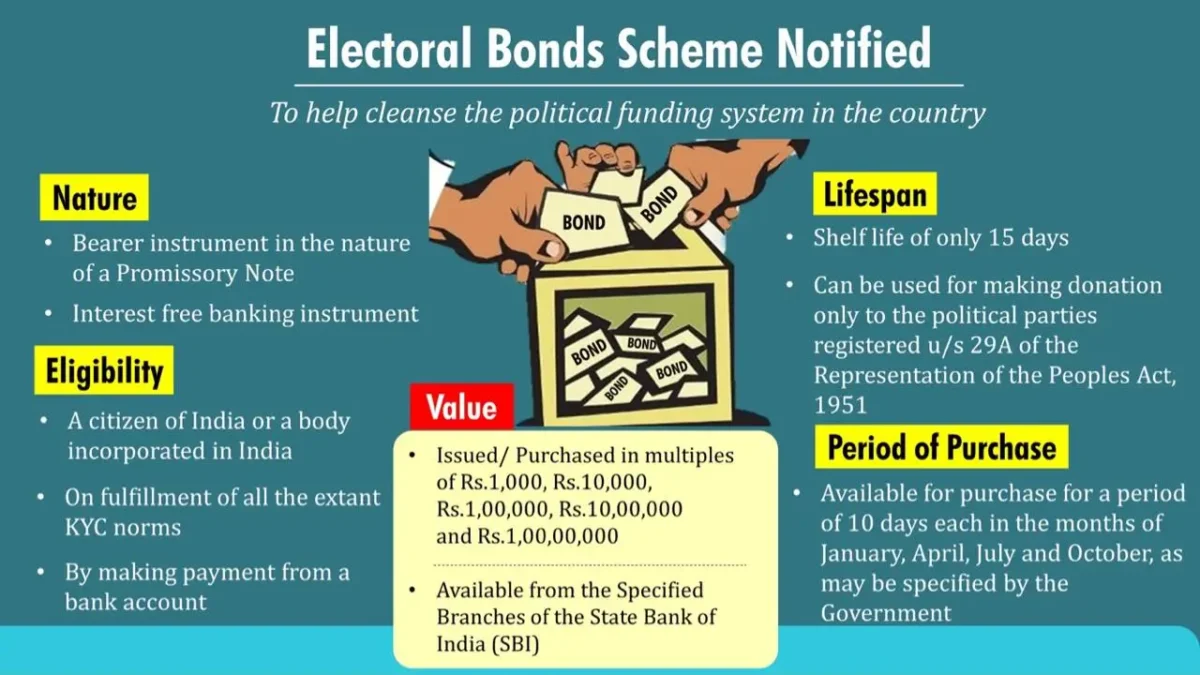
Electoral bonds are financial instruments akin to promissory notes that individuals and companies in India can purchase from the State Bank of India (SBI) and donate to political parties. The recipient party can then encash these bonds in their designated bank accounts.
Key Features of Electoral Bonds Scheme
Eligibility: Political parties registered under Section 29A of the Representation of the People Act, 1951, which secured at least 1% of votes in the last general election, can receive these under the Electoral Bonds Scheme.
Validity: Bonds under Electoral Bonds Scheme are valid for fifteen days from the date of issue.
Amendments: In 2022, an additional fifteen-day period was introduced for general elections to state legislatures and Union territories with a legislature.
Objectives of the Electoral Bonds Scheme
Launched in 2018, the Electoral Bonds Scheme is aimed to cleanse political funding by promoting transparency. However, the following criticisms have been raised:
Anonymity for the public and opposition: While donors remain anonymous to the public, the government can access donor details, potentially leading to extortion or victimization.
Lack of transparency: Amendments to the Finance Act, 2017, exempted political parties from disclosing donations received through electoral bonds, undermining voters’ right to know.
Crony capitalism: Unlimited corporate donations can lead to undue influence of money in politics.
Supreme Court’s Verdict on Electoral Bonds Scheme
Key Reasons for Striking Down the Electoral Bonds Scheme
Violation of the Right to Information: The court emphasized that anonymous political donations infringe upon the fundamental right to information under Article 19(1)(a) of the Constitution, crucial for participatory democracy.
Proportionality Test: Referencing the KS Puttaswamy case (2017), the court noted that the scheme did not adopt the least restrictive method to achieve its objective of curbing black money. Alternatives like the ₹20,000 cap on anonymous donations and Electoral Trusts were cited as less restrictive methods.
Donor Privacy vs. Public Interest: The court distinguished between donations as genuine political support and those made to influence policies, ruling that corporate donations should not be afforded the same privacy protections as individual contributions.
Unlimited Corporate Donations: The amendment to Section 182 of the Companies Act, 2013, allowing unlimited political contributions by companies, was deemed manifestly arbitrary and a threat to free and fair elections.
Amendment to Section 29C of RPA, 1951: The Finance Act, 2017, which exempted electoral bond donations from disclosure requirements, was struck down. The original requirement for parties to declare contributions over ₹20,000 was reinstated.
Supreme Court’s Directives on Electoral Bonds Scheme
Immediate Cessation: SBI must stop issuing Electoral Bonds Scheme immediately.
Disclosure: SBI must submit details of all bonds sold since April 12, 2019, to the Election Commission of India (ECI), which will publish this information by March 13, 2024.
Refund: Bonds within the validity period but not yet encashed must be returned, with refunds processed to the purchasers’ accounts.
Criticisms of the Electoral Bonds Scheme
Contradictory to Transparency: The scheme’s anonymity is counterproductive to its intended goal of transparency.
Possibility of Extortion: The government’s ability to access donor details can lead to extortion or coercion of companies.
Blow to Democracy: Voters remain unaware of the funding sources of political parties, undermining informed electoral choices.
Compromising Right to Know: The right to information is integral to the democratic process, allowing citizens to hold their representatives accountable.
Crony Capitalism: The removal of donation limits encourages undue corporate influence over politics.
Impact of the Supreme Court’s Ruling
The verdict reinforces the need for transparency in political funding and underscores the importance of protecting the right to information. By striking down the scheme, the court has set a precedent for future electoral reforms and highlighted the need for robust mechanisms to ensure accountability in political financing.
Suggestions for Electoral Funding Reforms
Regulation of Donations: Limitations on donations from certain individuals or entities, and caps on the amounts that can be donated, can prevent undue influence.
Expenditure Limits: Imposing limits on campaign expenditures can prevent financial arms races and ensure a level playing field.
Public Funding: Providing public funds based on criteria like past electoral performance can reduce dependency on private donations.
Disclosure Requirements: Balancing transparency and donor anonymity is crucial. Small donations could remain anonymous, while larger ones should be disclosed.
National Election Fund: Establishing a fund to distribute resources based on electoral performance can mitigate concerns about donor reprisals.
Recommendations on Funding of Political Parties
Indrajit Gupta Committee on State Funding of Elections, 1998
State Funding: Endorsed state funding of elections to establish a fair playing field for parties with less financial resources.
Limitations: State funds to be allocated only to national and state parties with allotted symbols, not independent candidates.
Initially, state funding should be provided in kind, offering certain facilities to recognised political parties and their candidates.
Acknowledged economic constraints, advocating partial rather than full state funding.
Election Commission’s Recommendations
The 2004 report emphasized the necessity for political parties to publish their accounts annually, allowing scrutiny by the general public and concerned entities.
Audited Accounts: Ensuring accuracy, accounts should be made public, with auditing performed by Comptroller and Auditor General-approved firms.
Law Commission, 1999
Total State Funding: Described total state funding of elections as “desirable” under the condition that political parties are prohibited from receiving funds from other sources.
Maintenance and Publication of Accounts: The Law Commission’s 1999 report proposed amending the RPA, 1951, introducing section 78A for maintenance, audit, and publication of political party accounts, with penalties for non-compliance.
Conclusion
February 15, 2024, marks a historic day in India’s democracy as the Supreme Court delivered a landmark verdict striking down the Electoral Bonds Scheme. Upholding democracy as the Constitution’s basic structure, the Court found the scheme unconstitutional in a unanimous decision, addressing every challenge raised. This decision requires the government to cease issuing electoral bonds immediately and disclose all relevant information to the Election Commission of India.
The Court’s ruling highlights the scheme’s violation of the right to information and rejects the government’s arguments, emphasizing that the Constitution cannot ignore potential misuse. As India moves forward, it is essential to implement reforms that balance transparency, donor privacy, and the integrity of the electoral process, ensuring that democracy remains robust and equitable for all.
Also read: Press release of Electoral Bond Scheme 2018