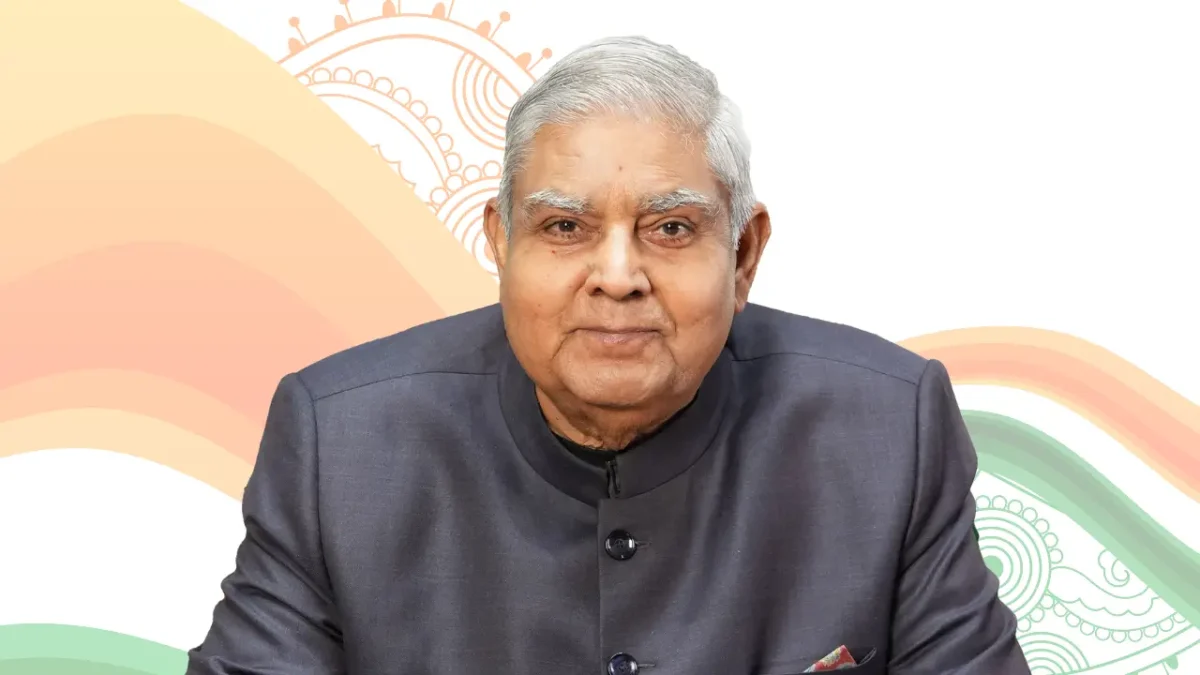
The Vice President of India holds the second-highest constitutional office in the country, ranking just after the President. Instituted under Article 63 of the Indian Constitution, the Vice President acts as a key link in India’s parliamentary democratic structure. Though largely considered a ceremonial office, the Vice President’s role becomes pivotal in specific constitutional and political scenarios, especially when functioning as the ex-officio Chairman of the Rajya Sabha or during presidential vacancies.
Constitutional Provisions
The office of the Vice President of India is established under Part V, Chapter I of the Indian Constitution. The key articles related to this office include:
- Article 63 – There shall be a Vice President of India.
- Article 64 – The Vice President shall be the ex-officio Chairman of the Council of States (Rajya Sabha).
- Article 65 – The Vice President shall act as President or discharge his functions during casual vacancies or in the absence of the President.
- Article 66 – Election of the Vice President.
- Article 67 – Term of office.
- Article 68 – Time of holding election to fill a vacancy.
- Article 69 – Oath or affirmation by the Vice President.
Election and Qualifications
The Vice President is elected indirectly by an electoral college consisting of members of both Houses of Parliament, using the system of proportional representation by means of a single transferable vote and secret ballot. State legislatures do not participate in this election.
Eligibility Criteria:
- Citizen of India
- Minimum 35 years of age
- Qualified for election as a member of the Rajya Sabha
- Must not hold any office of profit
Tenure and Removal
The Vice President of India serves a term of five years and is eligible for re-election. He/she continues in office until a successor is elected.
Removal Process:
- Removed by a resolution of the Rajya Sabha passed by an absolute majority and agreed to by the Lok Sabha.
- 14 days’ notice must be given.
- No formal impeachment process is required.
Powers and Functions
1. Ex-officio Chairman of the Rajya Sabha
- Presides over Rajya Sabha proceedings
- Maintains decorum and order
- Can cast a vote in case of a tie
- Refers bills to committees
2. Acting as President
In the absence or vacancy of the President, the Vice President acts as President and exercises all powers until a new President is elected. During this period, the Vice President does not preside over the Rajya Sabha.
Significance of the Office
While the Vice President of India does not have executive powers in normal circumstances, the significance lies in:
- Ensuring continuity in governance
- Upholding parliamentary decorum and legislative discipline
- Acting as a constitutional backup in presidential vacancies
Comparison with Other Democracies
In countries like the United States, the Vice President holds substantial power and automatically succeeds the President. In India, the Vice President only acts as President when necessary and does not automatically succeed unless elected separately.
Notable Vice Presidents of India
- Dr. S. Radhakrishnan – Later became the second President.
- Dr. Zakir Husain – First Muslim Vice President and later President.
- Hamid Ansari – Served two terms (2007–2017).
- M. Venkaiah Naidu – Known for oratory and legislative experience.
- Jagdeep Dhankhar – Current Vice President (as of 2025), legal expert and former Governor of West Bengal.
Challenges and Reforms
Some experts argue for reform and expansion of the Vice President’s role. Suggestions include:
- Enhancing active legislative participation
- Clearer powers during presidential emergencies
- Greater involvement in inter-house coordination
Conclusion
The Vice President of India plays a dual role — constitutional and parliamentary. While not as visible as the President or Prime Minister, the office is central to maintaining institutional balance and ensuring legislative discipline. For UPSC aspirants, understanding this office is essential for grasping the nuances of India’s constitutional framework and parliamentary democracy.
Also check – Vice President of India